Hazrat Babajan
Hazrat Babajan |
Hazrat Babajan (d. 1931) was a Sufi saint domiciled in her final years at the British cantonment in Poona (Pune). A Pathan Muslim by birth, and closely related to the Afghan nation, her early life is only very sparsely known. The marginalised role of women in Islam is a convergent issue.
CONTENTS KEY
4. At Poona
5. Victory Over the British Raj
Hazrat Babajan was born into a Pathan (Pashtun) warrior society, nevertheless escaping the confines generally befalling women. Her role as a faqir merits different criteria to the customary political assessments. Nevertheless, some historical background may be useful.
The British regarded the "independent Pathan tribes" of Afghanistan as the most formidable of all warrior breeds. In the sword dance known as khattak (primarily associated with the Khattak tribe), martial ardour could become overpowering; reputedly, even allied clans might fight each other before the main combat with the enemy. Such tendencies can be viewed in terms of the ghazi (warrior) vocation, as mediated via the Turko-Iranian sector of Islam.
Afridi warriors in 1878, Second Anglo-Afghan War, photographer John Burke. Courtesy British Library |
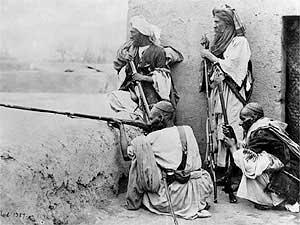
The Afridi tribe is probably the most well known Pathan grouping; these hill warriors guarded the strategic Khyber Pass, gaining a reputation as versatile fighters from the Mughal era onwards. The Pathan clans nurtured strong egalitarian tendencies, to some extent tempering the role of chieftains. In many instances, they pursued an agricultural livelihood. However, feuds could easily occur.
The Afghan empire was created by Ahmad Shah Durrani (rgd 1747-72), associated with a substantial Pathan tribal confederation known as Durrani. Ahmad Shah invaded the Punjab, sacked Mughal Delhi, and defeated the Marathas at the battle of Panipat. His soldiers then mutinied because of arrears in pay. The empire subsequently fragmented until the rise of Dost Muhammad Khan (rgd 1826-63), a Pathan of the Barakzai tribe. The Sikhs had since gained control of the Punjab, eventually to be defeated by the British, who annexed the sprawling Punjab territory.
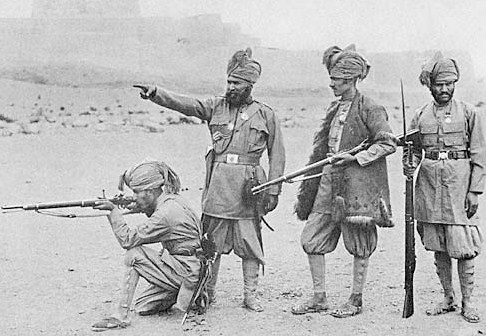
l to r: Afridi Pathan warriors; Afridi Pathan officer and sepoys, Khyber Rifles, 1895. |
In 1842, the First Afghan War produced a severe defeat for the British. The Pathans massacred a column of 16,000 who retreated from Kabul down the Gandamak Pass; some three-quarters of the dead were civilian camp followers. The military were mainly Indian troops. The musket known as jezail was a strong causative factor in the death toll. There was only one survivor. The resultant shockwave reversed a confident belief that the British Empire was invincible.
Much of the politics became concerned with the threat of Russian impingement. In 1879, the British gained control of the all-important Khyber Pass via an invasion which exacted a treaty. The Afghans retained internal control of their country, while foreign relations now passed to the British. The Indian regiments in this Second Afghan War (1878-80) included Baluchis, Gurkhas, and Sikhs. Colonel Robert Warburton launched the Khyber Rifles, recruiting Afridi Pathan auxiliaries who thus provided a counter approach to their Afridi tribal countrymen. This new local regiment manned the British posts in the Khyber Pass. The old musket (jezail) was initially employed, though soon superseded by superior British firearms.
The Afghan people faced another emerging problem. After 1880, the new amir (ruler) Abdur Rahman Khan (rgd 1880-1901) ruthlessly eliminated the system of tribal and regional autonomy. "When faced with numerous revolts by his own relatives and regional groups, he waged war against his own people until he and his government had no rivals of any type" (Thomas Barfield, Afghanistan: A Cultural and Political History, 2010, p. 5). The backlash ultimately led to a civil war in 1929. Meanwhile, the British interests were in high profile.
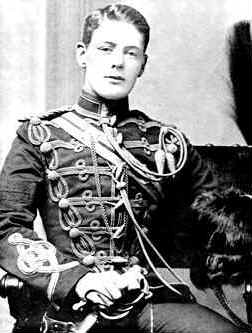
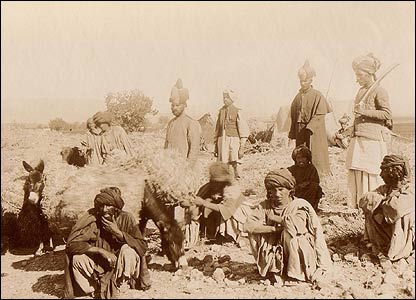
Winston Churchill as subaltern in the 4th Hussars, 1895; Pathans at Malakand, 1897. |
Sir Winston Churchill (1874-1965) participated in quelling the Pathan revolt of 1897. Serving as a young lieutenant on the North-West Frontier, he was also a journalist at that time for the London Daily Telegraph. The despatches and resulting book were decidedly in the British Raj spirit, to the detriment of the foe. Churchill wrote of the Pathans: "A continual state of feud and strife prevails throughout the land. Tribe wars with tribe. The people of one valley fight with those of the next.... To the ferocity of the Zulu are added the craft of the Redskin and the marksmanship of the Boer.... At a thousand yards the traveller falls wounded by the well-aimed bullet of a breech-loading rifle. His assailant, approaching, hacks him to death with the ferocity of a South Sea Islander" (Story of the Malakand Field Force: An Episode of Frontier War, 1898).
The colonial viewpoint of Churchill saw the Pathans as aboriginal savages incited to fanaticism by their religion. The presence of the British army in such locations was thereby conveniently justified. Churchill did have the unfortunate experience of seeing a helpless wounded officer (or "traveller") done to death by a Pathan swordsman during a fraught engagement. The mullas (religious teachers) did indeed incite tribes to jihad (holy war). However, there were also native grievances such as a tax on salt, the movement of British troops in Pathan territory, and the bisection of tribal lands. By August 1897, the Afridi and Orakzai tribes had assembled 15,000 men against the occupying British and Indian army force of 37,000. By November, the occupying force on the Frontier had become 70,000 strong, the largest ever mustered by the British in their Indian operations until that date. This was largely a sepoy army.
A bisection of Afghan tribal territory was imposed, meaning the Durand Line, created by an agreement of 1893 between the British and the Afghan amir Abdur Rahman Khan. That agreement officially separated India from Afghanistan via a disputed frontier. Pathan communities were divided by that problematic frontier. The Pathan resentment caused an attack upon the British garrison at Malakand, requiring a relief force in 1897 (involving Churchill). The siege was instigated by Saidullah, a militant Pathan faqir or holy man, very much of the orthodox type; he preached jihad (holy war), an emphasis frequently leading to complications. Claiming miraculous powers, Saidullah led a suggestible army of thousands. A retaliatory British campaign was afterwards undertaken in that Frontier sector. Mamund Pathan villages were destroyed by the military code of punishment. Forts were blown up with dynamite.
The Mamund tribesmen encountered, to their cost, the deadly repeating rifles of the British forces. With military relish, Churchill described the Lee-Metford rifle as "a beautiful machine," the expansive bullets "causing wounds which in the body must be generally mortal and in any limb necessitate amputation" (Story of the Malakand Field Force, repr. 2009, p. 199). There was no difficulty, for the riflemen, in judging the target range up to 500 yards. Moreover, the cavalry lancers were in accompaniment, and "eager for vengeance, pursued, cut up and speared them [the Pathans] in every direction, leaving their bodies thickly strewn over the fields" (ibid:179). Some tribes refused the offer of medical aid for their wounded, fearing a strategem in this British gesture. Even Churchill sympathised with the untreated pains of the victims. At the end of this punishment, the Mamund Pathans stated that the reason for their rebellion was a fear of annexation.
Churchill blamed the Pathans. In his reporting, the British retained an inviolable aura of civilised progress. The Pathans were indeed inclined to be warlike and ferocious; tribal khans incited warriors to torture captive soldiers. The British were more restrained and disciplined, though very punitive, and also rather more calculating in terms of their Empire assets.
The Afridis were the focus of the allied Tirah Expedition (1897-98). They had captured all the forts in the Khyber Pass, also attacking the forts on the Samana Range near the city of Peshawar. The British feared that if the Afridis and Orakzai united, they could muster up to 50,000 warriors.
Fortified Afridi villages were systematically destroyed by two divisions of the Punjab Army Corps, some 20,000 strong. The inhabitants resisted with a constant guerilla warfare. The British officers considered the punishment to be fair play for the tribal insubordination, which had defied the subsidy granted for sixteen years by the Raj to safeguard the Khyber Pass. Afterwards, the forts of the Khyber Pass were reoccupied by the invaders. The reluctant Afridis, threatened with a further action of punishment, eventually agreed to pay the imposed fines and surrender their rifles.
After other vicissitudes, having been disbanded by the British in 1919, the Khyber Rifles were revived in 1946, comprising Afridi veterans of World War Two. In this resuscitation, they outlasted the British Empire and continued into the new era of Pakistan, there fronting an operation to seal the Afghan border against Al Qaeda militants, and to end the opium trade.
Pathans formed a substantial ethnic group in Pakistan. By the twenty-first century, their numbers were an estimated 25 million, amounting to about 15 per cent of the population. This total exceeded the number of Pathans in Afghanistan, where they constituted nearly half of the population. The vast majority of Pathans (Pashtuns) are Sunni Muslims.
Hazrat Babajan had no known connection with any of the political movements or trends in Afghan/Pathan history. She was not linked to any fundamentalist cause, but to a renunciate code seldom understood. The earliest biography was brief, written soon after her death by the medic Dr. Abdul Ghani. The original milieu is described in these words:
Hazrat Babajan hails from Afghanistan and was the daughter of a well-to-do Afghan of noble lineage. Her maiden name was Gul-rukh ('rose-faced'), and her early training was that befitting the status of an Afghan aristocrat. (1)
The date of her birth is quite elusive. Subsequent assessments varied markedly; Gul-rukh (later known as Babajan) was reputedly a centenarian at her death. (2) The earliest accounts differ in describing her geographical origin; Afghanistan and Baluchistan are the two apparent contenders. Perhaps she was born near Quetta or Peshawar; the location is unknown. Territorial borders have changed much since that time, a matter which can cause confusion.
The new Baluchistan province was created by the British during the period 1876-91. A British military base was then established at Quetta, which became the capital of Baluchistan. Gul-rukh was born long before that, when Baluchistan was inhabited by Pathans, Baluchis, and other peoples. She herself was a Pathan, not a Baluch.
The Pashtu-speaking Afghan tribes, known as Pathans (or Pashtuns), had infiltrated the neighbouring provinces of the Punjab and Sind in the struggles between rival dynasties (those provinces are today in Pakistan). The linguistic designation of Pashtun is now common. However, the ethnic description of Pathan was in vogue during the nineteenth century and much later, being copiously found in the British Empire annals. I will therefore use the well known ethnic term rather than the linguistic.
The upbringing of Gul-rukh followed conventions of the Afghan aristocracy. She was educated from an early age, becoming fluent in both Arabic and Persian, in addition to her native Pashtu, the Afghan language spoken by Pathans. The religious element in such education was pronounced. Gul-rukh accordingly became a hafiz-i-Quran, meaning one who learns the Quran by heart.
From the sparse details available, it would seem probable that her family moved to, or had some connection with, a site nearer Kabul, the Afghan capital. It may have been in what later became known to the British as the North-West Frontier Province of India, the territory dividing the Punjab from Afghanistan, and which at the beginning of the nineteenth century was still part of the Afghan empire. This frontier area, and much of Afghanistan itself, was peopled by hardy Pathan tribesmen, Gul-rukh's own race. (3)
Gul-rukh was reared under the purdah system, in which women were secluded from the outside world. Female education could not go very far, being subservient to patriarchal clericalism and the system of arranged marriages. Gul-rukh opposed the unwelcome match planned for her, preferring solitary contemplation. According to the basic report, she ran away from home on her wedding day, at the age of eighteen.
Adjusting to the changed environment could not have been easy. Gul-rukh faced a very tough male-dominated environment featuring wars and turbulent clans. Bandits abounded; they could easily take slaves. She lost aristocratic identity, making her way to Peshawar, the frontier city at the foot of the Khyber Pass, affording a route from the Afghan mountain country to India. Subsequently, she moved to Rawalpindi, a city of the Punjab. In or near that city, she lived in an ascetic manner for some years. This could be viewed as a form of "Sufi" vocation (although women could not officially be recognised as Sufis).
Her version of ascetic faqiri was very different to the fundamentalist mentality, and jihad tendency, demonstrated by the influential Pathan preacher Saidullah and other religious figures. Throughout her life, Babajan remained outside the political dramas occurring in the Afghan territories (section one above).
An early biography affirms that Gul-rukh encountered a Hindu saint, who apparently exercised a strong impact upon her. His identity escaped reporting. Dr. Ghani says that afterwards:
She went into seclusion in a nearby mountain outside Rawalpindi and underwent very severe riyaz (austerities) for nearly seventeen months. Thereafter she came down to [the] Punjab and stayed a few months in Multan. It was in Multan, while Gul-rukh was 37 years of age, that she contacted a Muslim saint - a majzoob who put an end to her spiritual struggle by giving her God-realisation. (4)
Ghani does not identify the Muslim saint. A later version supplied the name of Maula Shah. According to Ghani's early account, Gul-rukh returned to Rawalpindi and again contacted the Hindu saint, who this time helped her in "the return to normal consciousness." These obscure matters were hagiologised in the later version of Bhau Kalchuri (d.2013), a Hindu writer representing the Meher Baba movement.
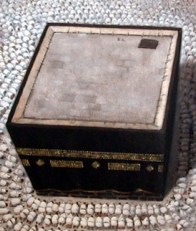
The Ka'bah at Mecca |
Thereafter Gul-rukh (Babajan) commenced extensive journeys throughout North India. She also visited Bombay. She reputedly travelled to Mecca disguised as a man, taking the difficult land route from Afghanistan to Turkey, and then travelling south via Syria and Lebanon. This report is regarded as legendary by some analysts; however, certain elements may have factual relevance. At the Ka'bah shrine in Mecca, she is said to have offered the customary Islamic prayers. While in Mecca "she would often gather food for the poor, and personally nursed pilgrims who had fallen ill." (5) She reputedly visited the tomb of the Prophet Muhammad at Medina. A second pilgrimage (hajj) is dated to 1903.
Meanwhile, in the Punjab, at an unknown date, she gained some fame as a saint. Babajan also suffered extreme opposition from orthodox Muslims, after uttering ecstatic words denoting an identity with the divine. The mystical reverie was considered blasphemous. Local ulama (religious teachers) were apparently at the root of this aversion. However, the active party were reputedly sepoys (soldiers), and more specifically, Baluchis. According to an early report, the soldiers considered her to be a heretic. One night they vengefully buried her alive.
Resort to premature burial in that zone has sometimes been interpreted in terms of a persisting tribal custom. More certainly, extremist censure was liable to result from nonconformist traits in Islamic society. Women had a low status in that society; they were not normally so visible as Babajan. According to an early report, the same violent soldiers later found their victim sitting under a tree at the British cantonment in Poona. According to Dr. Ghani:
The Baluchi sepoys looked upon this as a great miracle, and thus feeling convinced of her spiritual greatness, gave Gul-rukh an ovation by bowing to her reverentially. After this incident, her saintly fame spread far and wide, and she came to be universally known as Hazrat Babajan. (6)
This event has been dated to 1914, when these members of a Baluch (or Punjabi) Regiment were en route to the Near East for action in the First World War. Some of these men are said to have become devotees of the matriarch, thereafter zealously protecting her as bodyguards. The respectful term Hazrat was frequently used to designate Muslim saints.
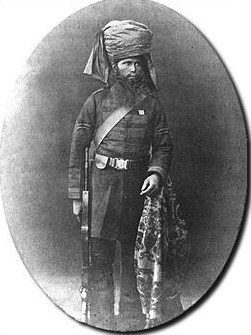
l to r: Baluchi soldier from the Rind tribe, 27th Regiment, circa 1865; soldiers of the Baluch 26th Regiment, 1897. |
The Baluchi soldiers are a complex subject of military history. Baluchi tribes originally lived a very independent existence in north-west India. When the British annexed the province of Sind, after defeating a confederacy of Baluchi chieftains in that zone, the Baluchi warriors were in demand as army soldiers. General Sir Charles Napier was impressed with their fighting spirit and reckless courage; he wished to assimilate them into British ranks. The renowned "Baluch Regiment" to some extent originated in 1844; that development ultimately resulted in several Regiments. The "Bellochee Battalion" of 1844 was mostly recruited from Baluchis, Sindis, and Pathans from Sind. These sepoys assimilated the new rifle power that made the sword comparatively obsolete. (7)
Hazrat Babajan settled in Poona by 1905. During the British Empire era and later, Pune was referred to as Poona, so I will here comply with the name found in the sources.
She had formerly appeared in Bombay (Mumbai), for the second time, about 1900, apparently staying at Chuna Bhatti for a few years. There she had occasionally visited two Sufi saints in the metropolis, namely Maulana Saheb of Bandra and Baba Abdul Rahman of Dongri. Babajan characteristically referred to them as "my children." They reputedly became her disciples. However, there was nothing even remotely formal about the unorthodox approach of Babajan, who remained aloof from all the conventional exercises and affiliations of the Sufi orders. She did not teach any doctrine. She is reported to have visited Ajmer in Rajputana, apparently in 1904, there offering her respects at the tomb of the Chishti saint Khwaja Muinu'd-Din Chishti (d.1236). In her case, however, there was no subscription to the Chishti order.
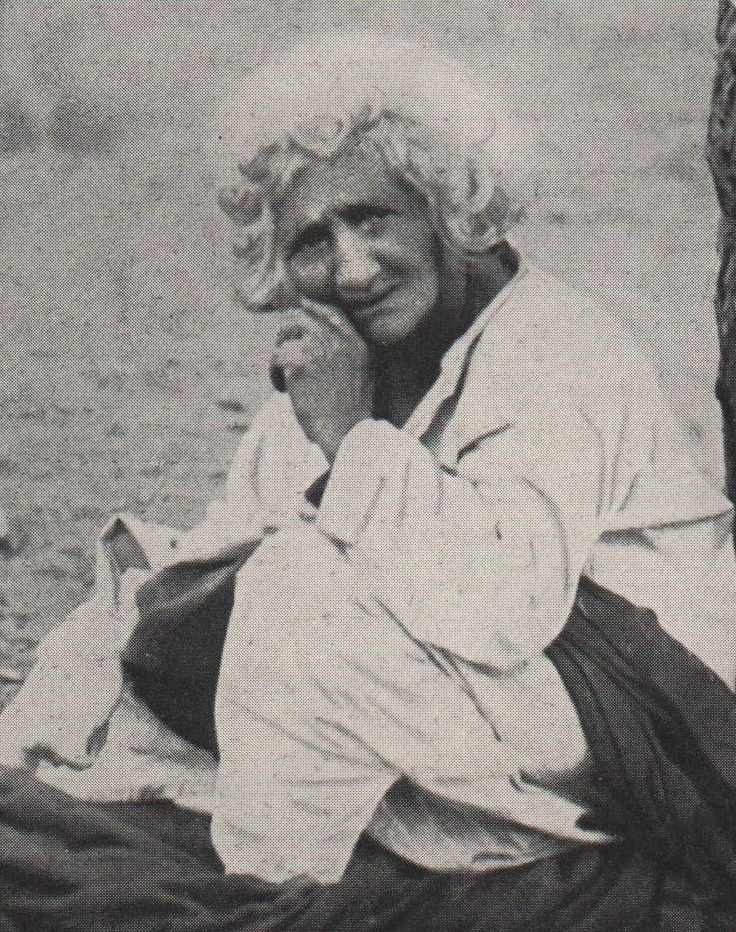
Hazrat Babajan at the tree in Char Bawdi, Poona |
In Poona, she at first moved between different parts of the city and cantonment, including the abject slum areas. Hers was the outdoor role of a street mendicant, not living in houses or hostels. She had evidently been living like this for much of her adult life, ever since she departed from aristocratic purdah. Her clothes were ragged. Babajan never wore a veil, and always described herself as a man. (8) She can be interpreted as insisting upon equality with those who dominated society.
Muslims sometimes called her Amma Saheb, this designation having both feminine and masculine connotations, being translated as "Mother Sir." However, the name Babajan was the victor. This term has been given different interpretations; the word Baba is often translated as "Father." (9)
A basic feature of Babajan's career was her explicit commitment to faqiri, a term of Arabic origin denoting the renunciate lifestyle. She had no home, no possessions, no assets. However, this was not the helpless poverty of the Indian masses, but a deliberate choice made in pursuit of a spiritual objective. When devotees gifted her with presents, she would give these away to the poor. Her only belongings were the clothes she wore. There are some similarities with her contemporary Sai Baba of Shirdi (d.1918), another liberal faqir, one who lived in a dilapidated rural mosque that was comfortable by comparison with her own situations. Even Shirdi Sai was not as hardy as Babajan, being afflicted by an asthmatic tendency; the matriarch was remarkably robust and of a more advanced age.
The "outdoor poverty" role of Hazrat Babajan serves to distinguish her totally from the commercial saints and gurus who gained such attention from circa 1970 onwards, including the notorious entity at Poona who (in America) so questionably acquired a large fleet of expensive Rolls Royce automobiles.
In Sufi history, there were instances of the female faqir role. These were for the most part very obscure and unfavoured in the conventional reports subsequent to the era of early Sufism, when female mystics were perhaps more common than in the later centuries typified by the dervish orders. "Some orders admitted women as affiliated members, though relatively few had dervishes, faqirat [female faqirs] or khawatat [female dervishes]." (10) Babajan has been described as a qalandar, (11) a term more recently discussed critically in relation to her role.
"Female mystics frequently became hermits or solitary dervishes, and frequently had to live without the comforts provided by the system of pirs (preceptors) and khanaqahs." (12) The Sufi khanaqah or hospice was very much a male-oriented institution, spreading from Iran into India during the medieval centuries.
Dr. Ghani left the following description of Babajan, whom he knew at firsthand during her last years:
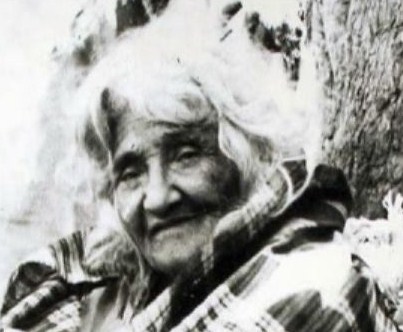
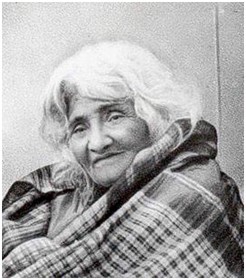
Short in stature, firm and agile in gait, back slightly bent with rounded shoulders, skin fair and sunburnt, face broad and heavily wrinkled, high cheek bones, liquid blue eyes possessing great depths, head covered with a silvery crown of thick white hair hanging loose to the shoulders, deep sonorous voice, all conspired to make her personality very unique and unworldly. Her attire was simple, consisting of a long apron extending below the knees, a pyjamas [paejamah, or trousers] narrowed round the legs and a linen scarf thrown carelessly round the shoulders. She always went about bare-headed; the luxuriant crop of white hair - never oiled or groomed - was for all practical purposes a headdress in itself. (13)
Some Tibetan Buddhist nuns had more elaborate coiffures of thick (black) hair that have been deemed startling in nineteenth century photographs. However, those Mahayana nuns were part of a cordoning and protective monastic system; they did not integrate with mundane and public circumstances like Babajan.
Babajan eventually settled under a neem tree near the mosque of Bukhari Shah in Rasta Peth suburb. Crowds began to gather around her; there was little space for free movement. Devotees requested her to choose another site for greater convenience, but she refused. She only departed when a large banyan tree nearby was chopped down to make the road wider. She evidently preferred trees to municipal developments, which were basically concerned with the new motor traffic, supposedly representing advanced civilisation.
Babajan moved to another neem tree, this time in the Char Bawdi (Bavadi) vicinity, on the fringe of the cantonment. Only after some months did she permit devotees to erect a simple protective covering (at the tree) made of sacks (the common gunny cloth). Here she stayed for the rest of her life, meaning about twenty years. The site was at first extremely unaccommodating, the dirt road being notorious for mosquitoes. The Char Bawdi area was at first subject to nocturnal gatherings of roughnecks and thieves, who were dislodged by events developing around Babajan. Within a decade, "the locality underwent a metamorphosis surpassing all expectations," and became "a place of pilgrimage for people from all over India." (14)
During the daytime, Char Bawdi was initially "desolate and deserted" (Kalchuri, Lord Meher Vol. 1, p. 14); nocturnal activities of drunkards and thieves were offset by the presence of Babajan's devotees, who included soldiers in off duty hours. The early (pre-1915) allegiance to the faqir of Pathan soldiers (sepoys), from the cantonment barracks, contributed to an upgrading of the environment. Some factors have been misrepresented. (15) The sepoy tendency, to form a bodyguard at the neem tree, apparently originated in an objection to the local underworld of thieves and loiterers. One thief stole a shawl from Babajan while she lay resting. Another roughly snatched two gold bangles from her wrists, drawing blood. However, Babajan expressed annoyance when her supporters wished to punish the culprit (Shepherd, A Sufi Matriarch, p. 54). The shawl and bangles were gifts from devotees, and meant little to her. She was customarily benign towards the socially depressed.
The devotee visitors comprised a Muslim majority. However, Hindus were also represented. A significant and substantial minority of Zoroastrians surface in available reports. Babajan did not distinguish between people on the basis of religion; she was indifferent to doctrinal rigidities. She called everyone "child" (bacha), no matter what their background. She did not discourse or give sermons. She generally talked only very briefly. She spoke in Pashtu, Persian, and Urdu (a dialect of the Indian Muslims). She preferred allusive speech to anything that might sound dogmatic.
One of those who approached her was a certain Zoroastrian, formerly a dervish, but now a grey-haired businessman inured to the ways of the world. He understood more than most the origins of the matriarch who graced the neem tree, since he had long been accustomed to sufi perspectives and had himself experienced a complex life in relation to those perspectives. (16)
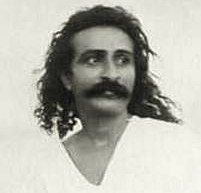
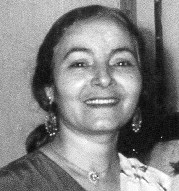
l to r: Sheriar Mundegar Irani, Meher Baba, Mehera J. Irani |
This unusual ex-dervish, if that is the right description, was Sheriar Mundegar Irani (1853-1932), an emigre from Central Iran and a resident of Poona in his final years. His contact with Babajan was completely eclipsed by the instance of his son, Merwan Sheriar Irani, now more well known as Meher Baba (1894-1969). The junior encountered Babajan in 1913 at the neem tree in Char Bawdi. That episode became celebrated in fairly numerous accounts thereafter.
This matriarch [Hazrat Babajan] lived in the same cantonment zone of Poona as Merwan's family. It was in May 1913 that Merwan began to frequent her makeshift abode under the neem tree in the Char Bavadi locality. He visited her every evening, but their meetings were almost completely silent.... In January 1914 Merwan's mother Shirin was horrified to discover early one morning that he could not speak and was lying on his bed with wide open but vacuously staring eyes. He lay like this for three days to her even greater alarm.... Medical treatment produced no change in Merwan's extraordinary condition. (17)
Ten years later, Zoroastrian followers of Babajan were still in evidence at the neem tree. There was a strong orthodox Parsi opposition to the Muslim saint, the Zoroastrian fire temple instead being viewed as the due focus of attention. A report from Mehera J. Irani (1907-1989), a Zoroastrian woman, describes some aspects of the situation in 1924.
Mehera, her mother Daulat(mai), and her sister Freni would visit Babajan in the evenings, when many devotees attended after their daily work. Mehera relates that the evening was more favourable to her own family; they would have stood out more in the daytime to disapproving Zoroastrian passers-by. However, Daulat Irani resisted the censure; she would also visit Babajan in the mornings, taking a gift of fruit and vegetables.
Mehera relates that Babajan, because of her advancing age, now sat on a seat (or bed), made for her at the request of Meher Baba some years before. In accordance with custom, the male devotees sat on one side and the women on the other. Babajan sat so that she was turned more in the direction of the men. She habitually redistributed the food that was brought to her, as she herself needed very little. She would also send someone to bring tea from one of the nearby stalls that had appeared; this commodity was shared likewise. Plaintive qawali songs were often sung in Urdu (by a special performer, not by the audience); qawali performances have a Sufi association, the songs exhibiting mystical themes popular in the Muslim sector.
Babajan hardly spoke, and when she did it was very softly. People [men] would talk to her, and she would sit and listen and nod her head, sometimes turning to see who was sitting amongst the women. (18)
5. Victory Over the British Raj
There was an underlying factor to Babajan's life in Poona. "Not far away, almost within earshot, the army of the Raj performed their drill and the officers' wives assembled for decorous tea parties." (19)
The gap between the British Raj and the Indian public was vast. The Poona cantonment, founded in 1818, was a satellite of the Viceroy's distant mansion. The early planning of the cantonment involved four square miles for European and native Indian troops, with various amenities for the officers. Growth of the adjacent urban precincts was encouraged as a source of supplies for the army. The surrounding native populace were tolerated. However, the British assumption of rulership was unassailable.
Hazrat Babajan at Char Bawdi |
In 1919, Babajan predicted that a destructive storm would hit Poona. The storm did in fact occur soon after. A tornado arose, accompanied by heavy rainfall; trees were uprooted and some houses collapsed. Despite pleas from devotees for her to take shelter in one of their homes, Babajan remained under the neem tree in accordance with her lifestyle of faqiri. She was soaked by the heavy rain, but survived. The local devotees (who numbered hundreds by this time in Poona) thereafter decided that a proper shelter must be provided for her, instead of the makeshift awning of gunny sacks.
Hazrat Babajan quite literally lived on the level of India's poor. She had no assets, no possessions, and lived outdoors like so many of the street indigents. The comparison with colonial tendencies is pronounced. The British Governor-Generals lived in grand style, annually retreating (along with other officials) to Simla, thereby escaping the summer heat. The British governing capital moved from Calcutta to Delhi in 1912. A Viceroy's House, or palace, commenced construction that year, and was not finished until 1929. The final cost of this ambitious project soared to over £877,000, more than twice the figure originally allocated, the total amounting to over £35 million in contemporary economic terms.
Permission from the aloof Cantonment Board was necessary for the comparatively trifling shelter which devotees desired for Babajan under the neem tree. The officials at first resisted, interpreting the gatherings of devotees as a serious blockage to traffic, including the new motor conveyances. A few of the more prudent officials eventually concluded that other problems could arise if public opinion was not catered for. The new political mood of the Non-Cooperation movement had dented the British complacency. Perhaps they worried about the Pathan (and Baluchi) bodyguards who were seen near Babajan at the neem tree in earlier years. These men were soldiers from the cantonment barracks, and strongly visible at the outset of the Great War; they disappeared by 1915, suffering casualties at Gallipoli (many Indian soldiers lost their lives in overseas service during the Great War).
The British army had advantageously assimilated extensive native ingredients, varying from the Nepalese Gurkhas to Baluchis, Pathans, Rajputs, and Sikhs. During the nineteenth century, that army was formed in such a way as to comprise a ratio of "nearly one [European] to two [native Indians] for the army as a whole (65,000 to 140,000)." (20) The British often relied on native troops in emergencies. This tactic backfired in the calamity which became lamented as "the massacre at Amritsar," occurring in April 1919. However, the tragedy was a fault of the British, not the natives.
The ultra-conservative Brigadier-General Reginald Dyer (1864-1927) gained disrepute at Amritsar. He ordered Gurkha and other native riflemen to shoot at the peaceful crowd in Jallianwalla Bagh. That action killed nearly four hundred people and injured over a thousand. These are the figures given in official reports. Other versions mention over a thousand dead. "I thought I would be doing a jolly lot of good," Dyer said afterwards in justification. (21) He was acclaimed as a hero by British conservatives. The more level-headed British colonialists regarded him as a serious liability. The critics of Dyer included army officers and the British government. Dyer became known as the "Butcher of Amritsar."
Even Sir Winston Churchill condemned the Amritsar massacre. The specially appointed Hunter Committee censured Dyer, who was forced to resign from the Indian Army. However, opinion was strongly divided between supporters of the Hunter Committee and the adamant supporters of Dyer, who believed this officer had prevented another Indian Mutiny.
Twenty-five Baluchi and Pathan riflemen also participated in the massacre. Some officers may have feared what could happen if native troops ever fired the other way, as they did in the Indian Mutiny over sixty years before. However, there was no military presence at Babajan's neem tree during the 1920s. The gatherings at Char Bawdi were peaceful inter-religious assemblies of devotees and well-wishers, with many women included.
The minority of Poona cantonment officials were successful in their politically liberal tactic. They evoked a new Board decision, meaning to build at military expense a permanent weatherproof dwelling for Babajan, under the neem tree. This occurred in 1924. The new Raj attitude now amounted to: "Hazrat Babajan had somehow become a celebrity, on their territory, and was their responsibility." (22)
Babajan's attitude to these developments was enigmatic. She allowed the workmen to build a structure of masonry and wood, with a roof of metal sheeting. This comprised a single room and a veranda. Prestigious members of the Board then decorously invited her to move in to her new home. She flatly refused to do so. Babajan had not actually agreed to modify her rigorous faqir lifestyle by living in a shelter.
The Board were now confronted with their error. They had constructed the new abode a few feet away from Babajan's chosen position at the base of the tree. The tree was obviously very important in her estimation (and far more so than the noisy and polluting motor vehicles now appearing, so often deemed a municipal priority). Babajan is known to have exercised a sense of humour, evident from various episodes related about her. Now the Board (all males, of course) had to devise a solution to their predicament.
An extension was made which connected the new dwelling with the trunk of the neem tree. The Board officials then gratefully retired from the scene, leaving Hazrat Babajan the virtual queen of Char Bavadi, legally installed in a British government building. As far as they were concerned, she had won. (23)
At her death in September 1931, "her funeral procession was a tremendous affair, never accorded to any dignitary or royalty in the annals of Poona." (24) Thousands of Muslims and Hindus are reported to have attended the funeral. The female faqir had triumphed over all odds. Her shrine (dargah) was created on the spot where she had lived under the neem tree, in accordance with her express wishes.
Kevin R. D. Shepherd
February 2011 (last modified December 2020)
Some controversy attaches to a Wikipedia article on Hazrat Babajan, which has caused confusions. A longstanding and influential assertion of that article was to identify the subject as a "Baloch Muslim saint" (accessed 25/01/2014). She was a Pathan, not a Baluch (Baloch), irrespective of exactly where she was born.
As a consequence of my webpage (above) on Babajan, a pseudonymous Wikipedia editor changed the erroneous description to "Pathan Muslim saint" on February 3rd, 2014 (the word Pathan was later changed to Pashtun). This revision occurred after several years of editorial resistance to basic factors involved. The Wikipedia article had influenced numerous web sources, thus extensively transmitting the error elsewhere. Uninformed and confused parties are now in the habit of referring to Babajan as a Baluch Muslim saint. Courtesy Wikipedia, which cannot always be trusted.
The Wikipedia article on Babajan also became disputed for an evident sense of favouritism. A strong commitment to the report of Bhau Kalchuri (d.2013) became obvious. This is easily explained by strong affinities of pseudonymous Wikipedia editors with the Meher Baba movement, of whom Kalchuri was a major spokesman. In contrast, a tactic of suppression befell my own book A Sufi Matriarch (1986), then the only annotated work on the subject, and somewhat longer than Kalchuri's 14-page chapter on Babajan in the book Lord Meher. (25)
Alert internet observers noticed that my book was removed from the bibliography of the Babajan article. (26) That book was afterwards supported by real name Wikipedia editor Stephen J. Castro, with the apparent acquiescence of resident pseudonymous editor Dazedbythebell (real name Christopher Ott, a Meher Baba supporter). In 2011, Castro cited A Sufi Matriarch several times with evident approval, at the Babajan article. Afterwards he retreated from that Wikipedia article, although his contribution partially remained, also via the talk page. Subsequently, the same book was again deleted from the article, afterwards reappearing.
The contribution of Castro, at the Babajan article, was "ruthlessly censored" (to use his own words) by the resident pseudonymous editor (an American devotee of Meher Baba). The latter afterwards reinstated some paragraphs, which included references to my output (accessed 25/01/2014). My new book Pathan Sufi of Poona (2014) was later added to the Further Reading list.
Meanwhile, at the Meher Baba article on Wikipedia, another book of mine was removed from the References section. This was Meher Baba, an Iranian Liberal (1988). Yet in contradiction, the same book was cited in a major work of the Meher Baba movement, published at Myrtle Beach (Meher Baba's Early Messages to the West, 2009). The context is that of my turning "a critical eye" on the accounts by two major detractors of Meher Baba (including Paul Brunton). Castro gave a reminder about this in the Babajan article, subsequently encountering censorship on such points from American Meher Baba devotee editors. Castro regarded those Wikipedia editors as irrational tyrants of dogmatic tendency. The Meher Baba movement is open to different interpretations.
The pseudonymous role of Wikipedia editors is a fraught issue with critics throughout the world. One accusation is that editors allied to religious movements are liable to interfere with the content of Wikipedia articles, preferring a partisan orientation of canonical auspices. I had the misfortune to be attacked on Wikipedia by an apologist for the Sathya Sai Baba sect, an American blogger whose industry and scale of cyberstalker operation became notorious. This attack was even carried over into a deletionist page on Wikipedia, where hostile blogs from Gerald Joe Moreno were presented by a Meher Baba supporter (Dazedbythebell) as a compelling reason for opposing my output (I have never been a Wikipedia contributor; the output was published material). An offensive Wikipedia User page of Moreno (SSS108) was later deleted by Jimmy Wales in 2012; that User page was an attack on my output, effectively censored by sectarian interests on the pretext of self-published material. See further Wikipedia Anomalies. Lawyers passed a verdict that the overall activity of Gerald Joe Moreno (Equalizer) in my direction amounted to defamation of a serious nature.
Ironically, the former Wikipedia theme of "Baloch Muslim saint" cannot be found in Kalchuri. Instead he refers to Babajan as a Pathan princess (Lord Meher Vol. 1, 1986, p. 7). Whether she was actually a princess (rather than a lesser aristocrat) is not certain; however, Kalchuri did get the ethnic factor correct. The editorial endnotes give no indication of his sources (which were both oral and published, some of which can be traced). The unqualified reference of Kalchuri to "a royal Muslim family of Baluchistan" (ibid) is not beyond question. This reference evidently inspired the "Baloch" theory. An alternative exegesis relates to the Amir of Kabul.
The Wikipedia entry on Babajan has stated that Gul-rukh "embarked on several long journeys through the Middle Eastern countries" (accessed 25/01/2014). This is a direct quote from Kalchuri (Lord Meher Vol. 1, p. 10). The legend, not found in other reports, is seemingly impossible to confirm. The contention source may have elaborated details of a possible early pilgrimage Babajan made to Mecca (meaning prior to the hajj occurring in 1903). See also Lord Meher Critique.
With regard to another matter, the same Wikipedia entry asserted that Sheriar Mundegar Irani "held Babajan in high regard" (accessed 25/01/2014). The same sentence provided no due source for this disclosure, instead providing a link to the Wikipedia article on Sheriar, where editorial complications had excised reference to the only book attesting the link between Sheriar and Babajan. Meher Baba devotionalism on Wikipedia here plagiarised some suppressed source material. The same article scrupulously cited the Kalchuri version of Sheriar Irani (Lord Meher Vol 1, pp. 118ff), to the total exclusion of a more detailed account in my From Oppression to Freedom (1988). Kalchuri does not mention the link between Sheriar Irani and Babajan.
As a consequence of my complaint in this Appendix, the pseudonymous Wikipedia editor inserted a new note (accessed 03/02/2014) disclosing the relevant source as being From Oppression to Freedom (1988). The link between Babajan and Sheriar Irani is detailed on pages 71-3 of that work. Furthermore, the same suppressed book was now reinstated (beneath Kalchuri) in the Further Reading section of the Sheriar Mundegar Irani article. That article (along with some others) was subsequently deleted from Wikipedia, in what has been described as an internal Wikipedia reaction to Meher Baba devotee editors.
Kevin R. D. Shepherd
January 2014 (last modified December 2020)
(1) Ghani, "Hazrat Babajan of Poona" (1939), p. 31, cited in Shepherd, Hazrat Babajan: A Pathan Sufi of Poona (2014), p. 1. See also Shepherd, A Sufi Matriarch (1986), p. 27, reporting that some basic statements here utilised about the subject "were made while Babajan was still alive, and it is unlikely that they were fabricated." (ibid:72 note 17). The derivative report of Jean Adriel is faithful to Ghani in such statements as: "Babajan was born in Afghanistan of well-to-do, aristocratic Mohammedan parentage" (Adriel, Avatar, Santa Barbara, California: J. F. Rowny Press, 1947), p. 36. More recently, Professor J. J. Roy Burman reported some people affirming that the original name of the subject was Razia Sultana. "She is said to be the daughter of one Bahadur Shah Zaffar and had come from Afghanistan." Quotation from Burman, Hindu-Muslim Syncretic Shrines and Communities (2002), p. 237. Bahadur Shah is a name evocative of the last Mughal emperor, whose pen name was Zafar. For a comment, see Siege of Delhi (last paragraph).
(2) "In view of the repeated assertions as to Babajan's great age, I think it possible that she may have been born c. 1820 or even earlier" (Shepherd, A Sufi Matriarch, p. 72 note 16; see also pp. 77-8 note 54). The date of birth is impossible to confirm. Cf. Charles B. Purdom, The Perfect Master (1937), p. 19, who states: "Her actual date of birth is not known, but it is supposed to have been about 1790, in that land of mountains, deserts, and stony plains, Baluchistan." Purdom was here repeating what he had been told by Indian devotees of Meher Baba, who was the main subject of his book. The same book reports a discourse by Meher Baba in 1927, informing: "Babajan was the daughter of one of the chief ministers of the Amir of Afghanistan" (ibid:115). Ghani does not mention Baluchistan as the birthplace; a degree of doubt may therefore attend that attribution. While Purdom's early notice of Babajan is relevant, the conjectural date of 1790 stretches credulity. I met Purdom in 1965, finding him to be an unusually analytical follower of Meher Baba. He did not always trust devotional reports, and indeed he was sceptical of various enthusiasms.
(3) A Sufi Matriarch (1986), p. 29. On the ethnic data, see further Olaf Caroe, The Pathans 550 B.C. - A.D. 1957 (Oxford University Press, 1958); Jules Stewart, The Khyber Rifles: From the British Raj to Al Qaeda (Stroud, Glos.: History Press, 2005). The academic system of reference now generally describes the Pathans of Afghanistan as Pashtuns. There are diverse ethnic groups in that country, including Aimaqs, Hazara, Kirghiz, Tajiks, Turkmen, and Uzbeks. The Pashtuns are located in the east and south, including the regions of Kabul and Kandahar. See further Thomas Barfield, Afghanistan: A Cultural and Political History (Princeton University Press, 2010), including a review of recent troubled events. In 1996, the Afghan Taliban gained power in Kabul; they "were largely Pashtuns who saw all other ethnic groups as enemies" (ibid:7). That Islamist regime fell several years later in 2001. "Every region of the country (including the Pashtun south) turned against them" (ibid). The Islamic Republic of Afghanistan was founded in 2001; conflict with the Taliban continued.
(4) Ghani, "Hazrat Babajan of Poona" (1939), p. 32. A contradiction in the sources is evident, receiving comment in Shepherd, A Pathan Sufi of Poona (2014), pp. 13-14. Further, Kalchuri refers to Maula Shah without providing any source (ibid:128 note 16). That writer refers to Maula Shah as a qutub (Kalchuri, Lord Meher Vol. 1, p. 9). Ghani asserted: "Hazrat Babajan's spiritual status in the [Sufi] hierarchy of saints is that of Qutub" (article cited, p. 38). Babajan herself did not claim this high status; the theme originated with Meher Baba in the 1920s.
(5) Bhau Kalchuri et al, Lord Meher (Meher Prabhu) Vol. One, p. 10. These details are not found in the version of Dr. Ghani, who nevertheless does state that Babajan voyaged to Mecca and Medina in 1903. This detail appears in an anecdote originating from Professor Hyder Ibrahim Sayani, who taught at the Deccan College. Sayani travelled on the steamer S. S. Hyderi. He recounted a "miracle" story of how Babajan saved the boat from a cyclonic wind; via the intermediary Nur Muhammad Pankhawala, she asked all the passengers to offer a prayer. Such anecdotes were presented by Ghani in The Meher Baba Jnl, and reprinted in Kantak, ed., Hazrat Babajan: The Emperor (1981), pp. 47ff. Confirmation of the voyage to Arabia is found in Purdom 1937:19, whose early report relays the same date of 1903. See further Shepherd 1986:44. Cf. Kalchuri, op. cit., pp. 11-12, who describes this event in terms of Babajan's second pilgrimage to Mecca. See also Shepherd 2014:18-19.
(6) Ghani 1939:33, specifying "the sepoys of the Baluchi Regiment, which had only recently arrived from the North." The numerical identity of the regiment is not supplied (there is another description of that military unit in terms of the Punjabi Regiment). Cf. Burman, Hindu-Muslim Syncretic Shrines and Communities (2002), p. 237, who says that the Baluchi soldiers "had learnt about her in Peshawar and heard the miraculous story of her getting buried alive." There seems to be a confusion in this later version. In the extension to Ghani's early account, he refers to the North West Frontier Province, informing: "Some of them [the Baluchi soldiers arriving at Poona] were the actual perpetrators of the tragedy" (Ghani, "Miracles of Babajan," in Kantak 1981, p. 57), meaning the burial. Another, and even earlier, source was also explicit on the point. See Purdom, The Perfect Master (1937), p. 115, reporting a 1927 commentary by Meher Baba that is missing from Vol. 3 (1988) of Kalchuri's Lord Meher, p. 924. Purdom's version identifies the Punjab as the locale of the burial, with no reference to any town or city. This account refers to "certain Baluchis of a local regiment" as the aggressors. "When she came out of the living grave she went towards Bombay" (Purdom 1937:115). See further Shepherd 1986:49-50, dating the Poona event to 1914 on the basis of an early notice. See also Shepherd 2014:132 note 26.
(7) See Major General Raffiudin Ahmed, History of the Baloch Regiment 1820-1939 (Abbotabad, Pakistan: Baluch Regimental Centre, 1998). The Baluchi soldiers became celebrated for a high standard of performance. In terms of uniform, they were colourful with their distinctive red trousers, green jackets, and white gaiters. During the early years of their formation, several battalions were created. By 1901, all of these became Baluch Regiments in what was known as the Bombay Native Infantry. All five Regiments were in active service during the Great War of 1914-18, the locations varying from Eastern countries to the Western Front. The 1st Belooch Regiment was also known as the 27th Regiment of Bombay Native Infantry; they participated in the Expedition to Abyssinia, the Second Afghan War, and the Third Burmese War. Due to the new format devised by Lord Kitchener in 1903, all the Bombay military units had 100 added to their numeral identification. Thus, the 27th became the 127th Baluch Light Infantry. They served in East Africa, Iran, and Palestine during the First World War. Meanwhile, the 26th Regiment had been reconstituted in Baluchistan, and during the 1890s recruited Baluchis, Brahuis, Pathans, and Punjabi Muslims. Their uniforms were of drab colour, but with the red trousers worn by all five Baluch Regiments. In 1903, the 26th became the 126th Baluchistan Infantry, serving in Aden during the Great War. The 2nd Belooch Regiment was raised in 1846, later serving in China and becoming the first foreign troops to be stationed in Japan. In 1883, the Duke of Connaught was appointed their Colonel-in-Chief. In 1903 they became the 129th Baluchis. During the First World War, they served in France and Belgium, and were the first Indian regiment to engage the German army. The heroic Khudadad Khan was one of their number; in France during 1914, he became the first Indian soldier to be awarded the Victoria Cross. Sadly, this regiment suffered heavy casualties during that war. The five Baluch Regiments were amalgamated as the 10th Baluch Regiment in 1922, later becoming part of the Pakistan army in 1947.
(8) Ghani 1939:35, reporting that Babajan would respond negatively to the name of Mai, meaning "mother." She would retort, "I am a man and not a woman." Women had a lesser status in more than one religion, including Hinduism. The low status of women in fundamentalist Islam is a strongly contested matter. With regard to the current controversy over the Islamic veil, in 2010 the Syrian government banned face-covering veils from universities. The niqab (face veil) is distinct from the burqa, a total body covering that is even more controversial. Some scholars have urged that niqab is not obligatory in Islam, amounting to a custom deriving from Arab tribal societies. The recent Taliban movement are associated with the worst impositions. The British Muslim journalist Yasmin Alibhai-Brown founded in 2008 the BMSD (meaning British Muslims for Secular Democracy), resisting fundamentalist constraint. On September 10th 2001, she "condemned the brutal Taliban rulers in Afghanistan, where girls and women shrouded in full burkas, were beaten and denied health and education." The following day, Al Qaeda operatives destroyed the Twin Towers in a well known American location. In the post-9/11 era, Yasmin Alibhai-Brown refers to "immigrant Muslims who came to Britain to get away from Stalinist ayatollahs, mullas and women-hating fanatic regimes in their home countries." She has stressed: "For this sensitive issue, we need enlightened political leaders who can work with the progressive Muslims and stop the relentless rise of the burka [burqa]." Quotations from "The Islamic Veil," FAIR News, February 2011, pp. 1,3. Of some related interest is Tahera Aftab, Inscribing South Asian Muslim Women: An Annotated Bibliography and Research Guide (Leiden, 2008). Dr. Aftab became editor of the Pakistan Journal of Women's Studies (Karachi).
(9) Shepherd, Hazrat Babajan: A Pathan Sufi of Poona (2014), pp. 26-7.
(10) J. Spencer Trimingham, The Sufi Orders in Islam (Oxford University Press, 1971), p. 176.
(11) Ghani 1939:38, refers to Babajan as "possessing all the characteristics of a Qalandar," a suggestion offered in the unusual context of salik-majzub, meaning that Babajan had the majzub and salik polarities equally balanced. This equation denotes an indrawn absorption or "divinity" balanced by a "gnosis." That suggestion would appear to be too advanced for the current academic interpretations in which the majzub is merely a mentally unbalanced person. Babajan is often described as a majzub. In respect of the word qalandar, Ghani's venturesome interpretations did not address the problems in Sufi history relevant to the qalandar phenomenon. One approach to those problems can be found in Shepherd 2014:96-103.
(12) Shepherd 1986:22, also referring to the figure of Jahanara, daughter of the Mughal emperor Shah Jahan. "Though formally initiated into the Qadiri order of dervishes, there was no question of her [Jahanara's] formal recognition as a member of any dervish hierarchy" (ibid). Of related interest is the figure of Zebunnisa (1638-1702), daughter of the Mughal emperor Aurangzeb (Shepherd 2014:110-12). See further Aftab 2008:57ff.
(13) Ghani 1939:35. Two well known photographs of Babajan to some extent bear out this description. The image associated with Meelan Photo Studio underwent a degree of retouching, erasing the facial wrinkles. Cf. Burman 2002:237, relaying a report that Babajan "used to wear dress like men and kept short hair and that is why she was called Baba Jan - a man's name." This explanation is not convincing in view of other details, and certainly not for the Poona phase. However, there may well be an element of truth here in relation to her earlier years and the legendary first pilgrimage to Mecca, occurring prior to the Poona phase. Another commentary says: "For a while, she [Babajan] wandered around in male attire and finally settled down in Poona" (Aftab 2008:103).
(14) Ghani 1939:34. The date of Babajan's taking up residence at Char Bavadi escaped reporting. This event "was possibly by 1910" (Shepherd 1986:47). A basic emphasis applying to Babajan is: "She was persecuted by orthodox religionists but gained an inter-religious following" (Aftab 2008:112, commenting on A Sufi Matriarch).
(15) Green 2009:128ff, referring to the "quotidian pleasures of tea-drinking and ganja-smoking" amongst the soldiers who gathered around Babajan (ibid:139). That is a misleading statement incorporating a conjecture. Babajan herself favoured tea, which she drank frequently. The barracks milieu in India was to some extent prone to drug use; the Poona situation under discussion is another matter. Ganja refers to cannabis-smoking. There is no proof that the soldiers devoted to Babajan indulged in this habit. Green gives a brief and unsympathetic portrayal of Babajan; he cites Charles Purdom and Dr. Ghani, observing that "those accounts, which generally overlap closely, are expanded in K. R. D. Shepherd, A Sufi Matriarch" (ibid:186 note 148). See further Shepherd 2014:120ff, 135-6 note 42, 140 note 56.
(16) Shepherd 1986:48, without reference to the identity of this Zoroastrian. The omitted identity was due to his more extensive inclusion in another manuscript I had written, subsequently published as From Oppression to Freedom (1988), a book containing some cues in Part One from Sheriar M. Irani's son Adi S. Irani, domiciled in London and whom I personally encountered. Some references to Adi S. Irani appeared in the annotations to my Investigating the Sai Baba Movement (2005), more specifically, relevant to Part Three of that work, which reported on Meher Baba. Adi S. Irani was the informative brother of Meher Baba. See Investigating, index page 309. See also Shepherd 2014:49-50, on Sheriar M. Irani.
(17) Shepherd, Meher Baba, an Iranian Liberal (1988), p. 17. This book was ignored by the Meher Baba movement for many years, though cited favourably in Ward Parks, ed., Meher Baba's Early Messages to the West: The 1932-1935 Western Tours (North Myrtle Beach, SC: Sheriar Foundation, 2009), pp. 223-4.
(18) Mehera, ed., J. Judson (1989), p. 45. Mehera subsequently resided at the Meherabad ashram of Meher Baba. Daulatmai later stayed with Freni at Nasik, maintaining silence for over twenty years at the unusual instruction of Meher Baba. "In silence my mother managed all her work; she even went to the bazaar where she would carry a slate and pencil and write in Marathi, Hindi, or Gujarati what she needed" (ibid:102). Daulatmai Irani died still silent in 1952. Other details about Mehera and Babajan are recorded in David Fenster, Mehera-Meher (2003).
(19) Shepherd 1986:47. Further comments on the British Raj can be found in my Pathan Sufi of Poona (2014), pp. 23-5.
(20) Percival Spear, A History of India Vol. 2 (Harmondsworth: Penguin, 1970), p. 146.
(21) Louis Fischer, The Life of Mahatma Gandhi (London: Cape, 1951), p. 234. Fischer mentions 25 Gurkhas and 25 Baluchis as the riflemen. Elsewhere, the latter are identified in terms of 25 Pathans and Baluch of 54th Sikhs and 59th Sindh Rifles. Some of the riflemen at first shot high into the air, but were reprimanded by the relentless Dyer for this act of consideration.
(22) Shepherd 1986:57. Ghani says of the initial British reaction: "Had it been possible they [the Poona Cantonment Board] would unhesitatingly have had Babajan shifted to some out of the way spot" (Ghani, "Hazrat Babajan of Poona," p. 34).
(23) Shepherd 1986:58. See also Shepherd 2014:67-70, on the politics attending the shelter, which was apparently constructed in 1924.
(24) Ghani 1939:38. On the last years, see Shepherd 2014:88-95. The Hazrat Babajan shrine (or dargah) subsequently became more ornate and famous, while the adjoining road grew ever more busy. The prevalent Indian language in the cantonment area is Hindi. Professor Anne Feldhaus, a Marathi-speaking expert on Pune, has reported: "Many more Indians in Pune are Muslims, and many of them are more comfortable using Hindi or Urdu than Marathi." See further A. Feldhaus, ed., Images of Women in Maharashtrian Society (State University of New York Press, 1998). Babajan's own linguistic recourse in Poona seems to have been Urdu more than any other language.
(25) One of the Wikipedia Meher Baba supporters did refer sympathetically, in 2008, to the annotated book on Babajan that was subsequently deleted in 2009 from the bibliography. The editor Nemonoman stated on the Hazrat Babajan discussion page: "Shepherd's biography is a scholarly work." Nevertheless, the same Wikipedia editor also stated: "Among english [sic] speakers, however, she [Babajan] is virtually undocumented outside the Meher Baba community, who have studied her background extensively, although few regard [her] as much more than a curious influence" (accessed 04/02/2014). There is no proof that Meher Baba devotees have extensively researched Babajan; they are to date avid promoters of the version supplied by Kalchuri et al.
(26) Dazedbythebell (Christopher Ott) deleted A Sufi Matriarch (1986) from the Hazrat Babajan article, this action being associated with a sectarian bias. The deletion, dating to December 2009, was reported by the academic philosopher Simon Kidd on the DGG talk page (16 February 2010), with the additional remark: "This is the only full biography of the subject." Kidd also informed that the deletion had occurred without any discussion. See Wikipedia Harassment. The deleted book was afterwards restored to the Wikipedia Hazrat Babajan article in 2011, and subsequently again deleted in 2012 (yet again being restored). See also Wikipedia Anomalies: Sequel and Wikipedia Misinformation. On my output so far, see further the relevant bibliography.
Bibliography relating to Hazrat Babajan
Aftab, Tahera, Inscribing South Asian Muslim Women: An Annotated Bibliography and Research Guide (Leiden: Brill, 2008).
Brunton, Paul, A Search in Secret India (London: Rider, 1934).
Burman, J. J. Roy, Hindu-Muslim Syncretic Shrines and Communities (New Delhi: Mittal Publications, 2002).
Fenster, David, Mehera-Meher Vol. 1 (Ahmednagar: Meher Nazar, 2003; second edn, 2013).
Ghani (Munsiff), Abdul, "Hazrat Babajan of Poona," The Meher Baba Journal (Ahmednagar-Bangalore, Feb. 1939) 1 (4): 29-39.
Green, Nile, Islam and the Army in Colonial India: Sepoy Religion and the Service of Empire (Cambridge University Press, 2009).
Judson, Janet, ed., Mehera (New Jersey: Naosherwan Anzar, 1989).
Kalchuri, Bhau, et al, Lord Meher (Meher Prabhu) Vol. 1 (Reiter edn, North Myrtle Beach, SC: Manifestation Inc., 1986).
Kantak, M. R., ed., Hazrat Babajan: The Emperor of Spiritual Realm of her Time (Pune: K. K. Ramakrishnan, 1981). This miscellany includes reprints of two early Ghani articles.
Purdom, Charles B., The Perfect Master: Life of Shri Meher Baba (London: Williams and Norgate, 1937).
-------The God-Man: The Life, Journeys and Work of Meher Baba (London: George Allen and Unwin, 1964).
Shepherd, Kevin R. D., A Sufi Matriarch: Hazrat Babajan (Cambridge: Anthropographia, 1986).
-------Meher Baba, an Iranian Liberal (Cambridge: Anthropographia, 1988).
-------From Oppression to Freedom: A Study of the Kaivani Gnostics (Cambridge: Anthropographia, 1988).
-------Investigating the Sai Baba Movement (Dorchester: Citizen Initiative, 2005).
-------Hazrat Babajan: A Pathan Sufi of Poona (New Delhi: Sterling Publishers Private Ltd, 2014).
Copyright © 2020 Kevin R. D. Shepherd. All Rights Reserved. Page uploaded February 2011, last modified December 2020.
.jpg)
_Regiment,_Bombay_Infantry_1897.jpg)
.jpg)