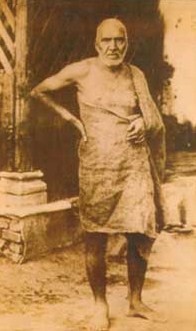
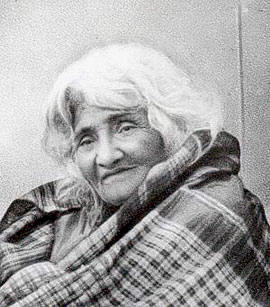
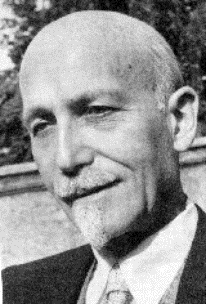
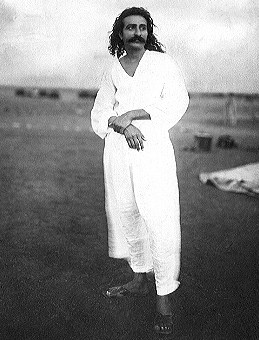
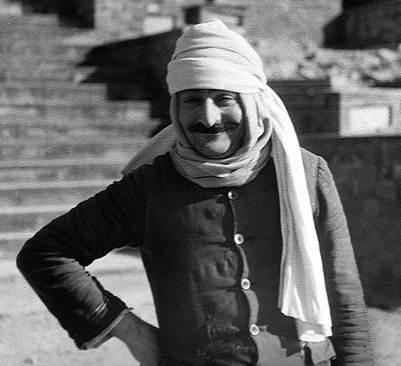
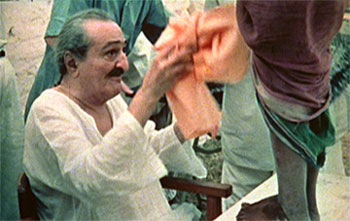
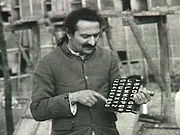
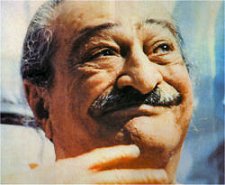
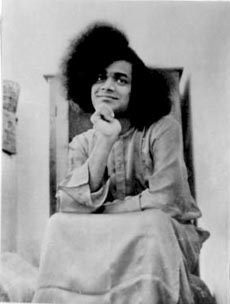
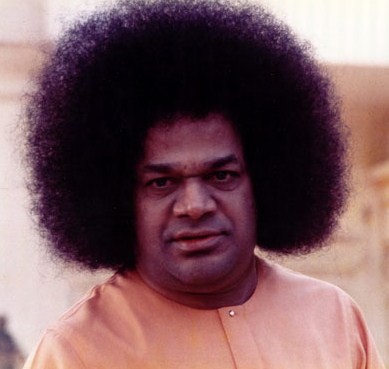
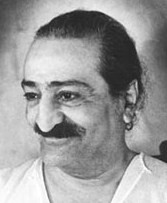
l to r: Shirdi Sai Baba, Upasani Maharaj |
l to r: Shirdi Sai Baba, Upasani Maharaj |
The conflatory phrase "Sai Baba movement" refers to a complex phenomenon which has been given different interpretations. That strongly disputed phrase encompasses the entities known as Shirdi Sai Baba, Upasani (Upasni) Maharaj and Godavari Mataji, Meher Baba, and Sathya Sai Baba. The treatment below analyses components of the presumed convergence, with the primary accent on Shirdi Sai Baba.
CONTENTS KEY
1. Introduction
7. Religious Syncretism in Maharashtra
10. Meher Baba
11. The Sai Baba Movement at Issue
12. Sectarian Globalisation and Devotional Memory
Update: Tulasi Srinivas and the Politics of Religion
The phrase "Sai Baba movement" was innovated by followers of Sathya Sai Baba (d.2011), being employed in some academic texts. The State University of New York Press stated on the cover of a well known book: "A vast and diversified religious movement originating from Sai Baba of Shirdi, is often referred to as 'the Sai Baba movement.' Through the chronological presentation of Sai Baba's life, light is shed on the various ways in which the important guru figures in this movement came to be linked to the saint of Shirdi."
This influential SUNY promotion related to the contents of Antonio Rigopoulos, The Life and Teachings of Sai Baba of Shirdi (SUNY Press, 1993), a work including some deference to Sathya Sai Baba. The same book also referred to Upasani Maharaj and Meher Baba.
The designation of "Sai Baba movement" represents an academic theory. In practice, three of the devotional movements involved do not favour this usage, not regarding Sathya Sai Baba as a priority. Moreover, the Sathya Sai movement frequently abbreviates the theory to a proposed connection between Shirdi Sai Baba (d.1918) and Sathya Sai Baba (d.2011). The extensions in relation to Upasani Maharaj (d.1941) and Meher Baba (d.1969) are too frequently omitted. An exception to this convenience was my own non-sectarian book Investigating the Sai Baba Movement (2005).
I have found that general readers are often confused by the academic theory. In 2012, some American followers of Meher Baba even tended to imagine that I had invented the phraseology involved. In the face of widespread non-comprehension, it is relevant to take account of the various presentations, and to analyse accordingly. Some of the issues are controversial.
Devotees of Shirdi Sai Baba have been known to use the counter phrase Shirdi Sai Baba Movement, evidently to distinguish themselves from associations with Sathya Sai Baba. Whereas devotees of Sathya Sai Baba have employed the phrase Sathya Sai Baba Movement.
The career of Shirdi Sai Baba is distinctive. Complexities relating to his religious background enliven the portrayal. I am not myself a devotee or sectarian, approaching him from another angle, commencing with a book published over thirty years ago. (1)
Sai Baba of Shirdi is frequently known as Shirdi Sai Baba, the purpose here being to distinguish him from his controversial namesake, Sathya Sai Baba of Puttaparthi. In 1943, the latter claimed to be the reincarnation of the Shirdi saint. That sensational claim facilitated the rise to fame of the young Sathyanarayana Raju, alias Sathya Sai Baba (officially born in 1926). Born in or near the village of Puttaparthi, in Andhra Pradesh, the putative successor appropriated the name of the Shirdi saint, an event which has not been viewed with favour by devotees of Shirdi Sai. The Andhra celebrity subsequently claimed and elaborated the prerogative of avatarhood, meaning the role of a divine incarnation.
Most followers of Shirdi Sai have not accepted the reincarnation claim. Yet some books, by devotees of Sathya Sai Baba, interpose lore about the Shirdi saint deriving from the Puttaparthi celebrity. This trend has caused confusions.
Islamic Tombs at Khuldabad |
Two different geographical areas are represented by the two bearers of the name Sai Baba. The original entity lived in Maharashtra, a Marathi-speaking state. Whereas the proclaimed reincarnation emerged in Telegu-speaking Andhra, located further south.
The favoured language of Shirdi Sai was Urdu, an Islamic tongue widely used by Indian Muslims. In this respect, one requires to emphasise the Muslim occupation of the area formerly known as the Deccan. That term broadly signifies the Deccan Plateau, a vast territory covering Maharashtra, Andhra, and Karnataka. The Muslims invaded the Deccan in the thirteenth century (after centuries of complex Sufi developments in Iran and Central Asia). Various cities of the Deccan are strongly associated with the Islamic occupation, e.g., Hyderabad in Andhra, and Aurangabad in Maharashtra.
A little to the north of Aurangabad is the medieval town of Khuldabad, strongly linked with the Chishti Sufis. This place became a major Sufi pilgrimage centre in the Deccan. Scholarly discussion of Deccani history has found in the Khuldabad tradition a foil to the idea of militant religious activism, equated with Sufism via the ghazi religious warriors of the Anatolian frontier and the early Safavid state in Iran. (2) The “Warrior Sufi” interpretation arose in relation to Bijapur, a city in the southern Deccan, where a strong Sufi presence is also attested. The “Warrior Sufi” attribution has since been viewed as an exaggeration. (3)
Khuldabad Tombs, including that of Zar Zari Zar Bakhsh |
In the fourteenth century, the Sultan of Delhi transferred his religious and administrative elite south to Daulatabad, located in Maharashtra. For a time, this city functioned as the new Islamic capital in India. The enforced move south, in 1329, included many Sufis of the emerging Chishti Order. A substantial number of these men elected to remain at Daulatabad when Delhi again became the favoured administrative centre of the Sultan. Relations with the monarch had become strained. (4)
Near Daulatabad and Aurangabad, the town known as Khuldabad (Rawza) became a major Sufi pilgrimage site in subsequent centuries, being noted for many domed tombs (dargahs) of Sufis. Khuldabad is rather less than a hundred miles from Shirdi, gaining in some quarters an association with the faqir Sai Baba, who is said to have stayed in a Chishti-related cave during his obscure early years. This association does not prove any Chishti identity of the Shirdi saint. (5)
3. A Liberal Muslim Sufi
Hyderabad, a major Islamic centre, was a home for the Urdu language evolving in response to the Hindu environment. Urdu is described as a form of Hindustani incorporating many Persian and Arabic words. Urdu became the official literary language of Pakistan. Many years prior to that development, Shirdi Sai Baba was a speaker of Deccani Urdu. He adapted to Marathi, a language he also spoke. A controversial matter is that his basic linguistic and cultural affiliations reveal him as a Muslim, and more specifically, as a Sufi of the liberal and unorthodox variety. (6)
Sai Baba of Shirdi emerges in early accounts as a Muslim faqir or ascetic. He wore the typical garb of that category. The date of his birth is unknown (though attributions have been made). His early life is obscure and legendary. Nevertheless, there are certain indicators afforded. An important early report is dated 1911, surfacing only recently. This testimony came from the British policing department based at Calcutta. The report describes Sai Baba as a faqir, adding the words “said to be a Mahomedan” (Satpathy 2019:30).
The early British report refers to Sai Baba as “an old man of about 70 who came to Shirdi some 30 or 35 years ago and put up in the village mosque where he has resided since” (ibid). The assessment of his age is not definitive. Dr. C. B. Satpathy favours the date of 1872 for the arrival of Sai Baba in Shirdi (ibid:34). This dateline converges with former estimates of Narasimhaswami and other sources.
Shirdi, a village in the Ahmednagar district of Maharashtra, was inhabited largely by Hindus. Only about one tenth of the population are estimated to have been Muslims. The Hindu villagers at first regarded Sai Baba as an alien, as a Muslim faqir unsuited for entry into Hindu temples. Sai Baba made his abode in a dilapidated mosque of rural dimensions. One of his early Muslim disciples kept a notebook in Urdu, permitting a strong insight into the Sufi orientation of the Shirdi saint.
The Muslim disciple Abdul Baba was a close servitor of the Shirdi saint for almost thirty years until the latter’s death. Thus, we know that the "Sufism" exposited by Shirdi Sai was apparently in evidence from 1889 until his last years. Abdul would read the Quran in the presence of the saint, at the latter’s request. During these sessions, Sai Baba would make diverse utterances, some of these being recorded in the Notebook. Abdul's Urdu manuscript was not published in any form until 1999. (7) The basic and underlying significances had passed into oblivion.
Dr. Marianne Warren observed:
The manuscript largely pertains to Muslim and Sufi material in Deccani Urdu; there are a number of quotations in Arabic included from the Quran and hadith [traditions of the Prophet].... the fact that the manuscript’s Islamic nature does not fit in with the accepted Hindu interpretation and presentation of Sai Baba may explain why it has remained unpublished. (8)
Moreover, the translated Urdu Notebook “establishes beyond doubt that Sai Baba was totally familiar with both the Islamic and Sufi traditions, and that as a Sufi master he taught this tradition to Abdul." (9) However, Sai Baba did not generally project himself as a Sufi master, remaining allusively neutral to different religious traditions. He was not interested in conversion to a belief system. Instead, he favoured parables that were often difficult to understand.
Shirdi Sai Baba |
The major devotional biography, written in Marathi, likewise confirms the Muslim background. Unfortunately for popular assimilation, this book by Govind R. Dabholkar (alias Hemadpant) gained a very misleading English adaptation that seems to have been more widely read than the original.
The Marathi biography, entitled Shri Sai Satcharita, was composed by an early brahman devotee who repeatedly acknowledged and indicated the Muslim faqir identity of the saint. However, the English adaptation by N. V. Gunaji neglected to include the Muslim context, instead improvising a Vedantic complexion to the subject. (10) For instance, Gunaji ignored the frequent use of Urdu by Shirdi Sai. He omitted sections of the Dabholkar work referring to Muslims, Muslim practices, and Sufi teachings. Gunaji deleted reference to the Islamic ritual of goat slaughter (takkya). In contrast, Dabholkar duly reported that the saint would occasionally permit this ritual so abhorrent to Hindus (without himself participating in the slaughter).
The name (or rather title) of this saint is evocative of Muslim origins (though not definitive as to religious identity). The word Sai appears to be derived from the Arabic sa’ih, a term used to designate itinerant ascetics in the Islamic world. (11) The word Baba is sometimes given a Hindu context, which is only partially correct. Baba is a common Marathi expression meaning “father.” The word was also employed in the medieval Indian Sufi tradition. The Turkish word baba referred to diverse preachers and shaikhs, having an origin in the itinerant babas from Central Asia. (12)
The first festival performed in Sai Baba’s honour was significantly that of the urs, in 1897. The urs is a Muslim festival, and usually commemorates the anniversary of a saint’s death, though in this instance it celebrated a living saint who was being honoured by a Hindu, Gopalrao Gund of Kopergaon, who attributed to Sai the birth of his son. The Muslim background of the saint was so obvious that Gund had to honour him in Islamic terms. (13) [The word urs comes from the Arabic language]
Sai Baba was frequently believed by Hindus to confer the blessing of childbirth. Many instances of this are reported in the hagiology. Social and religious taboos had conspired to make a childless couple seem very undesirable in Hinduism; a strong stigma could result. Women were particularly subject to the accusation of disgracing the family. A male child was highly prized. There were thus compulsive reasons for this preoccupation with progeny, frequently projected onto holy men, who were believed to be an alleviating factor.
The Hindu followers eventually came to substantially outnumber the Muslim devotees. From about 1910, an urban influx of Hindu admirers was in strong evidence at Shirdi. Sai Baba was welcoming and inclusive, not being a doctrinaire exponent of Sufism. He did not preach, instead advocating a religious tolerance extending to Christianity and Zoroastrianism. Sai Baba referred amenably to Hindu gods and avatars, and permitted arati worship at his mosque. Frequently resorting to allusive speech, he tended to be very enigmatic.
4. The Hinduization Process
In the Shri Sai Satcharita, Dabholkar records: "A Hindu or a Muslim, to him [Sai Baba] both were equal" (Indira Kher trans., p. 165). This feature of universalism can easily be overlooked, or modified, by religious preferences.
The theme of "Hinduization" was emphasised by Dr. Marianne Warren, who urged that an overlay occurred in much reporting about Sai Baba, tending to obscure the Sufi dimensions of his profile. One is obliged to probe this factor (without necessarily endorsing all the contentions and suggestions of Warren about Sufism).
The Shirdi saint was believed to possess an intimate knowledge of Sanskrit, the language of Hindu scriptures. This attribution was based upon his explanation of a verse in the Bhagavad Gita, a classic text associated with Vedanta. This explanation was imparted to a Hindu devotee. Subsequent analysis has strongly contested the "Sanskrit" theory, favoured by B. V. Narasimhaswami, who relayed an earlier report. “That interpretation was followed by other writers, and served to strengthen the tendency to portray the saint in a Hinduized manner.” (14)
Sai Baba's explanation of the Gita verse is described by Warren as “totally different” to the version of Shankara and other canonical Hindu commentators. In this view, the relevant dialogue does not in fact prove that Sai Baba knew the Gita or even Sanskrit, his emphasis being Sufistic. The version of Dr. Warren stresses that the saint gave a unique interpretation. He did not need to know the text at all, as the verse was read out to him along with a statement of grammatical meanings. This was done at his own request. “Sai Baba had all the raw material of the verse given to him, so there is no basis to the supposition that he in fact ‘knew’ Sanskrit or even the Bhagavad Gita." (15) There are various complexities attaching to the dialogue.
Sai Baba the faqir |
During his lifetime, the saint was generally regarded as a Muslim faqir, with Sufi associations not in general well understood. His white robe (kafni) and headgear were clearly Muslim. He used the Islamic name for God, and repeated Islamic sacred phrases, not Hindu mantras. He even had a habit of referring to God as the Faqir. However, his liberalism was so pronounced that no distinct religious message could be attributed to him. He was a believer in reincarnation, a subject that is not generally associated with Sufism.
The influx of urban devotees from Bombay, in the last years of Sai Baba, made the Hindus a clear majority in his following. Tendencies to "Hinduization" appeared in the later reports, obtained from devotees who were interviewed by Narasimhaswami in 1936. Eighty persons were then interviewed, although only 51 have a clear religious identity. No less than 43 of those were Hindu, with 26 of that contingent being members of the elite brahman caste. Only four were Muslims. There were also two Parsi Zoroastrians and two Christians. (16)
A revealing factor emerges. Narasimhaswami asked all the devotees he interviewed a rather pointed question. Did they think that Sai Baba taught Vedanta? “In all cases they said he did not.” (17) It can therefore seem anomalous that Narasimhaswami promoted a theme of the Sanskrit expert based on a Vedantic text. In the 1940s, Gunaji was giving an erroneous impression, via his Vedantic interpretations of the Shirdi saint, which cannot be found in the original work by Dabholkar that Gunaji was rendering. According to Professor Narke, a prominent Hindu devotee, the affinity of Sai Baba was not with Vedanta or Yoga, but with Bhakti.
Narasimhaswami had never met Sai Baba. This sannyasin arrived at Shirdi nearly twenty years after the saint’s demise. He was not familiar with either Marathi or Urdu. (18) His books on the subject became very influential amongst Hindus. He did refer to Sai Baba as a Muslim, and one whose teachings were indistinguishable from Sufism. He nevertheless admitted to knowing little about Sufism, himself clearly preferring the bhakti (devotion) approach of Hinduism.
Narasimhaswami could reason that Sai Baba was apparently a Muslim because he lived in a mosque. However, the commentator was very partial to a report (of Mhalsapati) which claimed that the saint was a brahman by birth. The version of Narasimhaswami can convey the impression of regarding the subject as a Hindu, not as a Muslim. Sai Baba himself showed no concern with religious identity.
The influential testimonies provided by Narasimhaswami are varied in complexion. That enthusiastic promoter of the “Shirdi revival” produced a work entitled Devotees’ Experiences of Sri Sai Baba (1940). This has a substantial documentary value, but also includes hagiology, which has been differently assessed. An academic commentator described the same book in terms of:
a detailed presentation of alleged miraculous phenomena.... the intent of the work is clearly hagiographic, aiming at the expansion of Sai Baba’s popularity among the public at large. (19)
Narasimhaswami later produced in English a four volume biography of the saint, which likewise has a documentary value. However, that work exhibits a strongly Hinduizing gloss. Two of those volumes draw from reports of devotees the author had interviewed. Narasimhaswami says: "Externally the mass of Hindus regarded him as a Muslim but worshipped him as a Hindu god." The same commentator also stated, with honesty, that the ideas and teachings with which the saint was saturated "up to the last were in no way distinguishable from Sufism." (20)
In his last years, Sai Baba freely allowed his Hindu devotees to perform puja (worship) before him at the mosque. This concession annoyed Muslims, creating initial problems. (21) Despite the liberal attitude of the saint to Hindu religious tendencies, he continued to make constant reference to Allah and maintained the simple kafni (robe) of the Muslim faqir.
Shirdi Sai was ruggedly ascetic to the end, daily begging his food from local houses. He redistributed money (or dakshina) that he requested. He did not keep or hoard funds.
Sai Baba on his daily begging round in Shirdi |
Discrepancies in reporting apply to such episodes as the alleged wrestling match of the saint, in Shirdi, with Mohiuddin Tambuli, a Muslim. The event is undated. According to Dabholkar (and Gunaji), Sai Baba lost this contest, thereafter changing his apparel to the kafni of faqirs. In contrast, the Hindu informant Ramgiri Bua emphasised that Sai Baba did not wrestle, instead having a disagreement with the son-in-law of Tambuli, as a consequence of which the faqir retreated to the nearby wilderness. This obscure episode has been tentatively dated to the 1880s. (22)
The popular theme of Sai Baba as a miracleworker is misleading. He did not perform “miracle” stunts like some Hindu holy men. This faqir was merely in the habit of giving sacred ash (udi) from his dhuni fire, as a token of blessing. The ash became credited with healing properties. Devotees like Dabholkar did strongly credit him with miracles, generally of the minor variety, a frequent preoccupation being the birth of a child. Sai Baba himself is reported to have expressed annoyance at the mundane desires entertained by visitors.
In temperament, Shirdi Sai Baba was complex. Sometimes irascible with lax devotees, he could also be very patient, and liked to joke. His strong tendency to allusive speech, in his later years, was perhaps prompted by the gulf existing between different religions. There was another contrast between the renunciate lifestyle and the householder career. Most of the devotees were householders, meaning those in the married state. Their domestic preoccupations were far removed from the ascetic milieu which Sai Baba represented.
A revealing situation emerged in relation to devotees who proved aberrant: "A few of them even played various tricks, including sentimentalizing trivial issues to extract money from Sai Baba on some pretext or other. Some became boisterous in their demands and quarrelled in front of Sai Baba. The compassionate Sai Baba tolerated this nuisance for long but, at times, reproved them for not being ethical in their conduct. In spite of many admonitions, there was no qualitative improvement in the situation. Sai Baba expressed his exasperation in Marathi language" (Satpathy 2019:115).
In 1915, this situation contributed to the Dakshina Bhiksha Sansthan being created at his request. For long obscured, this development has recently gained due focus. The attempt to control perverse inclinations of petitioners aroused resistance. The problems included "manipulation and extraction of money and food items from Sai Baba on various pretexts" (ibid:120). See further Sai Baba Versus Impertinence.
At his death, there was a disagreement amongst the followers of Sai Baba about burial procedures. The Muslim minority are reported to have included the category of theologians known as maulvis and maulanas. An air of dignity would thus have attended the argument. The Muslims wanted Sai Baba to be buried in a Sufi tomb or dargah of the type well known in the Deccan. In contrast, the Hindu majority wanted the saint to be buried in the courtyard of a large house (wada), recently constructed by the wealthy Hindu devotee Gopalrao Buti.
The Hindus were victorious, the Muslim proposal being offset by the heavy expense involved. However, the Hindus deferred to Muslim sensitivities, initially permitting the new tomb interior to resemble a dargah, and making Abdul Baba the custodian of the shrine. These details indicate that the Muslim identity of the saint was still clearly recognised by the Hindu majority.
After a few years, however, Abdul was denied his role as tomb custodian in 1922. A prominent Hindu devotee, Hari Sitaram Dixit, overruled the authority of Abdul by setting up a Public Trust through the Ahmednagar District court, with the intention of administering the tomb. Abdul was persuaded by sympathisers to challenge the court ruling. He filed a counter-suit declaring that he was the legal heir to Sai Baba, and that the Public Trust was illegal. Abdul lost his case, being obliged to leave the room reserved for him at the shrine. The severe restrictions were relaxed at a later date. However, the Muslim claim to dominance was permanently eliminated.
The new official Sansthan (Trust) was exclusively composed of Hindu members. The tomb at Butiwada became known as the samadhi mandir. During the 1950s, a marble statue of Sai Baba was installed on a silver throne; above the statue was placed a sign identifying Sai Baba with the Hindu avatar Rama. Acccording to Warren, this innovation caused offence to Muslims; faqirs are reported to have stopped visiting the tomb. (23) In contrast, the substantial Hindu support increased over the years. Shirdi became a famous and expanding pilgrimage site. The samadhi mandir is reported to gain a large number of annual visitors from Mumbai and other cities.
Writers who followed in the wake of Gunaji and Narasimhaswami, were strongly influenced by the "Hinduization" tendency. A Parsi writer composed a chapter entitled “What the Master Taught.” There is not a single reference to Sufism, but instead many to Hindu bhakti, and also one or two that can be interpreted in terms of a simplified Vedanta. Furthermore, another chapter includes the statement:
The saint of Shirdi baffled his admirers! No one knew whether he was a Hindu or a Muslim. He dressed like a Muslim and bore the caste marks of a Hindu! (24)
The equivocal theme of “Hindu or Muslim” had replaced the earlier awareness that Sai Baba was a Muslim faqir. The reference to caste marks is superficial, arising from hagiological tendencies.
5. Some Aspects of Teaching
The teaching of Sai Baba did not occur in the generalising terms associated with gurus and pirs. He was not a preacher, and did not give lectures. The original Hindu devotees, like Dabholkar, testify that he was constantly uttering Islamic sacred phrases such as “Allah Malik” (God is the Owner/Ruler). Vedanta is not here evident, but rather a version of the Sufi theme tauhid (unity, oneness of God). However, no doctrine was transmitted. There were instead many parables, enigmatic statements, and ethical reflections. In various ways, the Shirdi faqir emphasised a religious liberalism.
During his last years, Sai Baba permitted his brahman devotee Bapusaheb Jog to read aloud and expound Hindu scriptures at the Sathewada (a building in Shirdi). Jog would relay the Jnaneshvari and the Eknathi Bhagavat, texts associated with the Maharashtrian bhakti tradition. The faqir would tell visiting Hindu devotees to attend the daily sessions held by Jog, who was proficient in Sanskrit. Such events convey the liberal attitude of Sai Baba.
The Urdu Notebook of Abdul relays that Sai Baba strongly criticised false Sufis, and also corrupt orthodox (Muslim) divines who accepted bribes. The Notebook "includes conciliatory verbal gestures to Hindu themes, testifying to the fact that Sai Baba was not insular." (25)
Biases against Muslims are unfortunately prevalent today in both America and India. This factor has to some extent hindered due assimilation of relevant facts and textual references in the case of Sai Baba. Researchers are not obliged to believe that this saint was a Hindu because of political preferences. As a very rare category of non-dogmatic faqir, he remains largely unknown a century after his death. See Shirdi Sai Baba Issues.
6. The Pathri Legend
The British writer Arthur Osborne became well known for his interpretation of Ramana Maharshi. He also wrote The Incredible Sai Baba (1957). This book formed an introduction to the subject for most Westerners prior to the 1980s. Osborne made a sympathetic attempt to decipher the Shirdi saint, grasping that he was not typical of the Hindu guru category. However, his commentary does not refer to a Sufi context. Osborne reports that Sai Baba was regarded as a Muslim faqir, but does not supply any due contextual description. The Western writer was strongly influenced by works of Narasimhaswami. Osborne states of Sai Baba:
It is fairly certain that he was born of a middle class Brahmin family in a small town in Hyderabad State. Possibly his parents died when he was young, because at a very early age he left home to follow a Muslim fakir. (26)
Some analysts are sceptical of this version. Narasimhaswami favoured a report gleaned from Mhalsapati, a Hindu priest who became one of the earliest devotees. According to this source, Sai Baba revealed in his later years that his parents were brahmans of Pathri. If there is any truth in that now popular legend, then Hindu parentage was quickly superseded by a Muslim ascetic lifestyle. The Pathri legend has become influential. However, less well known details can afford a different complexion.
Pathri is a small town in Maharashtra, in the Aurangabad region. Warren reported that sixty per cent of the Pathri population is Muslim, a fact reflecting the strong Islamic concentration in this zone. Pathri was a known centre of the Qadiri Sufis, and features Sufi tombs dating back to the medieval era. The most salient tomb (dargah) is that of Sayyad Sadat (Aminuddin Shah), whose urs festival (death anniversary) has been popular amongst both Hindus and Muslims. (27)
Sai Baba is noted for giving contradictory replies to questions concerning his parentage and origins.
7. Religious Syncretism in Maharashtra
Strong tendencies to Hinduize the subject influenced writers like Arthur Osborne into making the Shirdi saint a subject of equivocal affiliation. According to Osborne, Sai Baba “did not fully conform to either” religion, meaning Islam and Hinduism. To some extent this is true enough. Nevertheless, details have to be carefully fathomed. Osborne states that Sai Baba was a vegetarian. (28) The vegetarian theory has since been exposed as a myth, one inadvertently siding with the Gunaji excision of Dabholkar's reference to the Islamic ritual involving goat slaughter. Sai Baba did eat meat in the company of Muslims. In contrast, on his daily begging round (at Hindu houses) he was restricted to vegetarian food. The faqir was thus a vegetarian to Hindus, but not to Muslims.
The most convincing explanation, for the Shirdi phenomenon, is that Sai Baba's assimilating approach to Hinduism represented a continuation of syncretistic trends operative between Muslim Sufis and Hindus. Indeed, Sai Baba's enlightened (if at times eccentric) form of syncretism can appeal equally to the sociological and religious modes of analysis. The Shirdi saint represented a Muslim minority amongst a Maharashtrian Hindu majority. Avoidance of Sufi significances has the effect of reducing the scale of his achievement.
Sai Baba with Hindu devotees |
In his interactions with Hindus, Sai Baba made diverse references to Hindu gods. That gesture can be interpreted in terms of a liberal Sufi tendency. His speech was frequently so allusive that even the word brahman has been tagged as symbolic. (29) The story of a Hindu guru, favoured in some sources for the early life of the saint, has been discredited by critical scholarship. (30) The Hindu scholar V. B. Kher (associated with the Shirdi Sansthan) arrived at a memorable conclusion. “The fact that Sai Baba's guru was a Sufi is not a matter of surprise." (31)
The first major account of Sai Baba achieved an elite reputation amongst Hindu devotees. Hemadpant was the name bestowed by the saint upon his brahman devotee Govind Raghunath Dabholkar. The contact of Dabholkar with Sai Baba commenced in 1910, subsequently resulting in the devotional biography known as Sri Sai Satcharita. Written in Marathi verse, this work was published in 1929. Dabholkar was here following a long Hindu tradition of writing saintly biographies in verse format.
Dabholkar was at times concerned to describe miracles of the saint. Nevertheless, the factual dimension is strong. Legendary details and actual events have been discerned to overlap, requiring careful analysis. Another realistic assessment concerning the work of Dabholkar is: “When he did not understand the enigmatic mystic, he would rationalize sayings and events in conformity with his own religious background.” (32)
Dabholkar’s poetic biography assimilated a devotional tendency to identify Sai Baba with the god Dattatreya, often depicted as an ascetic or yogi. Various Hindu gurus gained repute in the nineteenth century as incarnations of the ascetic deity Dattatreya. A well known instance of Dattatreya association is Swami Samarth of Akalkot (d.1878). A subsequent “Dattatreya guru” was Narayan Maharaj of Kedgaon (1885-1945); this ascetic favoured an opulent lifestyle in his later years, while acting as a patron of Dattatreya worship at his ashram. (33)
At the beginning of each chapter, Dabholkar extols Sai Baba as Shri Sainath, in the context of an obeisance to tutelary deities like Ganesha and Saraswati. The Shirdi faqir is here totally compatible with Hinduism. "O Self-illumined Sainath, to us you are truly, Ganadheesh and Brahma, Vishnu and Mahesh." (34)
In the opening chapter, Dabholkar extols Hindu gods, also referring to the bhakti saints of Maharashtra such as Eknath and Tukaram. The Eknathi Bhagavat has been discerned as a strong influence in his direction. Yet Dabholkar "fails to mention any Muslim saints or famous Sufis, although there were many whose names were quite famous in Maharashtra.” (35) According to Dr. Warren, the overall impression conveyed by the work under discussion is that Dabholkar “personally regarded Sai Baba as a Muslim, although he was limited in fully understanding Sai Baba's Muslim-Sufi identity due to his own ignorance of Islam and Sufism in Maharashtra." (36)
Dabholkar includes the emphasis, closely associated with Sai Baba, that “Ram and Rahim are one and the same.” Ram here means the Hindu avatar Rama, while Rahim is an Islamic sacred name. The same writer reports that Sai Baba associated with all castes and outcastes, ignoring the conventional caste distinctions. Such achievement needed stressing to the caste bigotries prevailing in Maharashtra and elsewhere in India. To numerous (but not all) high caste Hindus, the Muslim faqir was an outcaste, considered unfit to enter temples.
Dabholkar (12:151ff) provides an instance of the formidable bias encountered. A Ram bhakta (devotee of Rama) had strong reservations about visiting Shirdi. This man was a brahman, and said: "I cannot bring myself to make obeisance at the feet of a Muslim." His friend, a mamlatdar (revenue official), urged that nobody would request him to perform any obeisance to Sai Baba. Thus reassured, the Rama devotee agreed to visit Shirdi. When he arrived at the mosque, he made a prostration to the saint of his own accord. His accompanying friend was amazed, asking the reason for this concession. "How did you prostrate before a Muslim?" The brahman related that he had seen Rama in the person of Sai Baba; he had not been aware of any Muslim presence. Now the visitor reasoned: "How can he [Sai Baba] be a Muslim? No, indeed! He is a yogi, an Incarnation of God!"
Dabholkar comments that the caste background of saints was not important. "The great saint Chokhamela was a mahar [untouchable] by caste; Rohidas was a cobbler; Sajan was a butcher, who killed animals for a livelihood. But who ever thinks of the caste of these saints?" (37)
Dabholkar faithfully reported another significant episode. A Hindu devotee (Dr. Pandit) was allowed by the saint, on one occasion, to apply sandal paste to his (Sai Baba’s) forehead, thus reproducing the tripundra emblem of the Shaiva tradition (i.e., of Shiva). When questioned afterwards as to why he permitted this form of worship, Sai Baba explained that, although he (Sai) was of the Muslim caste (mi jatica Musulman), Dr. Pandit thought of him as a guru and was here performing ritual worship to the guru (guru-puja). The saint then revealingly added: "He (Dr. Pandit) did not even entertain the thought that he was a pure brahman and that I was an unclean yavana (Muslim)." (38)
The overall liberalism of Sai Baba, in a divided religious milieu, is remarkable to an extent as yet only partially comprehended.
8. Insularism and Unorthodoxy
The reported statement of Sai Baba that “I am of the Muslim caste” is significant. In passing from Dabholkar to the adaptation of Gunaji, we encounter omission in this respect. Gunaji evidently resisted any prospect of the saint having been a Muslim.
In a well known passage preserved from Dabholkar, Gunaji poses the question: If Sai Baba was a Muslim, how could he keep a dhuni fire burning in his mosque, and how could he keep a sacred tulsi plant in the yard outside, and how could he permit Hindu music, and how could he have pierced ears, and how could he have donated money to repair Hindu temples?
The tolerance of Sai Baba in relation to Hindu ceremonial adjuncts was notable. This feature of tolerance does not invalidate his own (excised) statement that he was a Muslim. (39) The insular thinking can be contradicted; Sai Baba was not an orthodox Muslim, but a very distinctive and unorthodox Sufi faqir.
The sacred fire or dhuni, associated with Hindu holy men, was also favoured by Muslim faqirs. (40) The issue of pierced ears is not definitive. Many Hindus gained pierced ears at birth. Hindu biographers have urged that the Shirdi saint had pierced ears. Against this must be set an assertion of the prominent Hindu devotee Das Ganu, in a well known poem, that Sai Baba can be called a Muslim because of such characteristics as his ears not being pierced. Das Ganu added his own conclusion that the saint was a Hindu, adducing the dhuni fire as support. Dabholkar is also contradictory, favouring pierced ears while affirming that Sai Baba was circumcised. (41)
As to the repair of Hindu temples, in his last years Sai Baba gave away large amounts of money, daily gifted to him as dakshina or alms. His mosque was repaired by Hindu devotees; a reciprocal gesture was surely appropriate. He did not actually want any renovation of the ramshackle mosque. An affluent devotee pointedly dumped cartloads of stone outside the building. The saint responded by telling him to give the stone to temples. Sai Baba eventually agreed to the renovation but continually interfered with the project, to the extent that workmen could only be on the site during nocturnal hours. Sai Baba insisted upon the standard minarets and nimbar recess in the west wall facing Mecca. The dhuni fireplace was an innovation; he apparently regarded this as the ennobling of a faqir observance.
Sai Baba sometimes advocated to Hindus the reading of various sacred texts such as the Eknathi Bhagavat. However, he would not give the formal initiations that some supplicants anticipated. He occasionally recited the first chapter of the Quran. Consisting of seven verses, that chapter is known as Al-Fatihah (“The Opening”).
Dabholkar's book in Marathi gained a foreword by Hari Sitaram Dixit (d.1926). This was the same prominent devotee who ousted Abdul Baba from the role of tomb custodian. Dixit subscribed to an interpretation of the saint that is currently considered idiosyncratic by Sai devotees. He referred to Sai Baba as having been born ayoniya, which literally means without a womb, i.e., without a human mother.
The ayoniya concept avoided the issue of whether the saint was born a Muslim or a Hindu. The innovation was closely linked to an interpretation of divine incarnations in the Hindu tradition, entities who were all considered to be the consequence of a virgin birth. (42)
A realistic alternative, for the biography of Shirdi Sai Baba, is to accommodate both religious orientations (i..e., Muslim and Hindu) in due perspective, duly checking the available sources and contextual details.
9. Upasani Maharaj
Despite the preferential manipulations of context, many Hindus continued to regard Sai Baba as a Muslim. Indeed, Narasimhaswami reacted to the widely emphasised Muslim identity during the early 1930s, not at first wishing to visit Shirdi. Narasimha Iyer, later known as Narasimhaswami (1874-1956), was a brahman of South India who became a lawyer. He subsequently renounced his professional career and opted for a renunciate life. He joined the ashram of Ramana Maharshi, but afterwards moved elsewhere. One interpretation says that he reacted to the Advaita Vedanta of Ramana, which Narasimha found too intellectual for his own disposition. (43)
In 1936, the pilgrim arrived at Shirdi, subsequently to become celebrated as the "apostle of Sai Baba," via his new role as the founder and president of the All India Sai Samaj, based at Madras. By the early 1940s, Narasimhaswami had become the influential populariser of Sai Baba in South India. His “Shirdi revival” quickly spread the fame of the shrine maintained at Shirdi by the Shri Sai Baba Sansthan. His industrious spate of publications assisted the growth of a nationwide Sai Baba movement. However, there is scope for disagreement about a number of his interpretations.
Narasimhaswami notably discountenanced the view, in some Hindu quarters, that Upasani Maharaj (1870-1941) was the successor of Sai Baba. Upasani (Upasni) was also a brahman, having established an ashram at Sakori (Sakuri), a few miles from Shirdi. The intricacies of this situation are complex.
Ironically enough, Narasimhaswami had formerly composed a partisan biography of Upasani. (44) He subsequently fell victim to some strongly circulated rumours about the Sakori guru. The scandal was contrived by influential brahman opponents of Upasani, who were incensed at the importance he gave to a select group of his women disciples. Upasani broke orthodox stigmas by making those women participants in priestly rites and recitation. Upasani dispensed with the primacy of male priests, instead emphasising a return to the Vedic tradition of kanyadin, a word connoting female celibacy and discipline. Upasani even said that women could make more rapid progress in spiritual development than men (he did not mean in all cases, however).
The very conservative libellers accused Upasni of immorality. In reality, the Sakori ashram was a scene of austere discipline. The selected women lived as nuns called kanyas. In later years they emerged victorious from the libels; their leader Godavari Mataji (1914-1990) became famous as a saint in her own right. She and others were able to describe what really happened. Their institution became known as the Kanya Kumari Sthan. By the time of Godavari Mataji's death, there were almost fifty nuns in this community.
Godavari Mataji, Upasani Maharaj |
Upasani Maharaj was similar in some ways to Sai Baba. A vigorous ascetic, he exhibited the same attitude of indifference to physical hardships. Like Sai Baba, he was also eccentric at times, and frequently enigmatic. There was a difference in that Upasani was a brahman, completely unrelated to Islam or Sufism. In his earlier life, he became an ascetic while still in his teens. He subsequently changed to the role of a householder, conducting a professional career in Ayurvedic medicine. When he first heard of Sai Baba, he did not wish to visit the Shirdi saint because of the Muslim identity that was so well known in Maharashtra.
Kashinath Govind Upasani Shastri was born in 1870 at Satana, near Nasik. He was the second son in a family of Maharashtra village priests. His grandfather Gopalrao Shastri was noted for accomplishments as a pundit. Upasani early favoured austerities extolled in the scriptures; he is reported to have adopted Yoga asanas (postures) and pranayama (breath control) in his youth. Upasani appears to have resumed those practices at a later date, after he relinquished his medical career and resorted to pilgrimage with his wife. His reliance upon ascetic exercises then included pranayama, according to one version (Shepherd, Investigating the Sai Baba Movement, pp. 64-5, 189 note 189).
Those exercises, or other dramatic experiences, now resulted in a severe problem: his breathing lost all normal rhythm. Upasni was only able to breathe, though with difficulty, when he massaged his stomach. This precarious condition continually lost the artificially induced rhythm, such as when he tried to sleep or eat. His stomach is reported to have become swollen.
In desperation, the pilgrim Yogi left his seclusion and travelled to Nagpur and Dhulia, searching in vain for a remedy. No doctor knew how to cure him. Upasani became convinced that only another Yogi could help him, one with more knowledge than he himself possessed. He commenced this new quest in April 1911. At Rahuri, he visited a Yogi known as Kulkarni Maharaj. Upasani was disconcerted to find that this practitioner urged him to see Sai Baba of Shirdi, who was here identified as an aulia or Muslim saint. Kulkarni Maharaj reassured his visitor by emphasising that Sai Baba was above caste distinctions. However, Upasani possessed a strong caste pride and persisted in searching for a Hindu mentor.
Upasani subsequently found a degree of relief by drinking only hot water. However, he was in constant fear of a relapse into deficient breathing. He later returned to Kulkarni Maharaj in June. The Yogi again urged him to visit Sai Baba, emphasising that the latter was above creed and caste. This time Upasni acted upon the advice, although still feeling reluctance. He arrived at Shirdi in late June, 1911. His breathing ailment thereafter disappears from the record.
The visitor found that Sai Baba frequently spoke in cryptic language. The enigmatic device muted the religious divide between the Muslim faqir and Hindus. Upasani remained disconcerted by the mosque environment at Shirdi. The visitor intended to leave and return to his wife. However, via a combination of circumstances, he ended up staying at Shirdi (his wife died soon after). His doubts were resolved; he came to view the faqir Sai Baba as the most exceptional entity he had ever met.
Upasani initially stayed with other devotees at Shirdi. Then Sai Baba started to make statements like: "Have nothing to do with them. Your future is excellent; none of the others have such a future." At this juncture, Upasani moved to the far more inhospitable Khandoba temple, inhabited by scorpions. That disused temple was situated on the outskirts of Shirdi, affording a relative degree of seclusion. Khandoba, sometimes described as a form of Shiva, was a popular deity in Maharashtra.
This bizarre phase lasted for a few years; the accompanying interaction with Sai Baba was complex. The liberal Sufi made glowing references to his exceptional Hindu disciple. He enjoined that Upasani was to stay in the derelict temple for a few years, living quietly and "doing nothing." There were no prescriptions for meditation or sadhana (spiritual discipline). The faqir did not sanction exercises like pranayama, an adventure which Upasani did not repeat, knowing too much about hazards that were not generally envisaged by Yoga enthusiasts.
At first the disciple found the changes difficult to accept. He retained his caste complex in matters of food preparation. One day he found that a beggar, a shudra by birth, was hovering nearby while the food was being cooked at the temple. Upasani drove the beggar away with some stern words, a gesture reflecting his brahmanical fear of pollution from lower castes.
When he subsequently took the prepared food to Sai Baba, the old faqir refused to accept the offering and instead drove him away. The disciple believed that Sai Baba was deliberately reflecting his own harsh treatment of the beggar. This event appears to have been the origin of Upasani's subsequent sense of identity with shudras and untouchables (Dalits), an affinity moving at an acute tangent to caste prejudices. "Wherever you may look, I am there." This was one of the allusive statements made to him by the faqir.
Resident devotees became jealous of the temple dweller, who was celebrated by Sai Baba. The situation is generally abbreviated in most reports, indeed to the point of fractional content. Allusive references of the faqir are on record in different languages. "You should not now talk to me, and nor will I talk to you. After four years, you will have the full grace of Khandoba." Upon request, Upasani stopped visiting Sai Baba at the mosque. However, their contact did not cease. There were a number of occasions when Upasani adroitly approached the faqir during the Lendi excursion. Cryptic reassurances were expressed by Sai Baba.
For Upasani, the householder caste life was over. He gained visions and experiences which he later described in fragments. He became averse to food, which he would throw away to dogs. He had no money left, his clothes were now rags. At the mosque, the faqir commented: "Everything I have has been passed to him (Upasani)." Such remarks were puzzling to devotees, some of whom refused to accept the implications. Upasani had nothing. How could he have so much?
Upasani stopped eating, reportedly for a whole year and more. Losing much weight, he became very thin. During that same phase however, he was intent upon performing hard manual labour; his activities extended to making roads and ploughing fields. He would now associate with untouchables and common labourers. He had lost all caste pride. This development was an extension of "doing nothing," a feat which entailed no obvious religious significance.
To some observers, he seemed crazy, no longer the decorous brahman. He lived with snakes and scorpions in the derelict temple, and once embraced a dead horse. Upasani was mocked by local youths and a cantankerous holy man, the latter being a devotee of Sai Baba. Some devotees remained incurably jealous. The situation of animosity increased when, in the summer of 1913, Sai Baba instructed devotees to worship Upasani at the Khandoba temple in the same manner that he (Sai Baba) was worshipped at the Shirdi mosque.
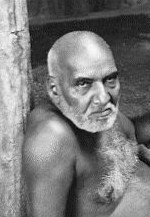 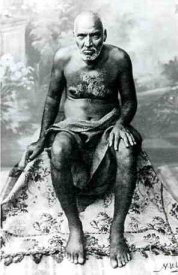 Upasani Maharaj |
Two medical doctors subsequently persuaded Upasani to leave the temple; he was in need of medical assistance after his severe abstinence. These men also wished to stop the harassment in evidence. During 1914, and in the company of a medic, Upasani left Shirdi, subsequently resuming a normal intake of food. He returned to the Khandoba temple over a year later, still meeting opposition from his detractors. Meanwhile, he gained many new devotees at Kharagpur and elsewhere, also living in a bhangi (or Dalit) colony. Upasani undertook further sojourns at the Khandoba temple, largely forgotten in Shirdi devotee annals. Nevertheless, a surprising amount of detail is on record for these years.
Upasani finally settled on the outskirts of Sakori village in 1918. His simple formative ashram was at first an uninviting prospect. However, he gained many followers. These converts included the learned Bapusaheb Jog (d.1926), a former prominent devotee of the deceased Sai Baba. Many brahmans were impressed by the ascetic saintliness and scriptural knowledge of Upasani Maharaj (alias Upasani Baba). He had become very thin during his first sojourn at Khandoba’s temple. He subsequently regained full flesh, appearing in photographs as an ascetic of robust physique.
A distinguishing hallmark was his attire. Upasani did not wear the conventional ochre robe of Hindu sannyasins; he did not take initiation as a swami. Instead he wore a strip of sackcloth (known as gunny cloth) draped over his body. His spartan lifestyle extended to confinement in a “cage” of bamboo bars at Sakori ashram. His austere traditional outlook disliked European cameras; he customarily scowled at the photographers who captured his image.
Upasani made efforts to accommodate orthodox attitudes of the brahman caste, as reflected in his extant discourses. However, there was an underlying element of nonconformism. He early exhibited a strong sympathy with the untouchables or Dalits, also forming a habit of bathing lepers. Such traits were not typical of Hindu gurus.
He was very unpredictable in temperament. Like Sai Baba, he could express irascible moods when confronted by inappropriate tendencies. Gaining a reputation for leonine strength, he was known to place a pretentious person over his knee, slapping the miscreant like a naughty child. Upasani was six feet tall (or more), with a solid torso.
Upasani Maharaj |
A notable episode occurred at Varanasi (Benares) in 1920, during the sojourn of Upasani in this sacred city. The occasion was a maha-yajna, a fire ritual, climaxing in a feast instigated by Upasani. Thousands of brahmans arrived for the feast. Upasani insisted upon displaying a large painting of Sai Baba, who had died in 1918.
The priests reacted to the painting. Some of them complained that Sai Baba was a Muslim, which meant they could not participate in a feast bearing such outcaste auspices. Upasani did not deny the Muslim identity, and at first tried to reason with the objectors. He was patient for some two hours, maintaining that Sai Baba was above religious distinctions, existing as much for brahmans as for Muslims. He even offered to increase the payment for ritual services of the officiating priests.
His opponents insisted that the painting of the alien saint must be removed. They refused to eat the food provided for them until this removal occurred. Upasani then lost patience, instructing his disciples to give the unwanted food to the poor, who were summoned by banging drums. The objectors then anxiously apologised, realising that they were losing their food and the increase in payment (dakshina) for the officiants amongst them. Too late, Upasani was now refusing to comply. He derided the objectors, asserting that Sai Baba was the real pundit (religious expert), not the formal pundits of Varanasi. Upasani dramatically terminated the assembly. (45)
When in such a mood, Upasani Maharaj could be very forthright. He appears to have demonstrated this tendency when the increasingly famous politician Mahatma Gandhi (1869-1948) visited him at Sakori during the 1920s. Gandhi apparently wished to gain the blessing of the sackcloth saint. There are different versions of the event; some caution is required. Upasani is reported to have said; "You may be a great man, but what is that to me?" (46)
The most obvious conclusion is that Upasani did not want any political involvement such as Gandhi represented. On his own part, Gandhi later complained to the Irani mystic Meher Baba that he could not understand Upasani. The silent Meher Baba was rather more amiable in temperament, treating Gandhi in a disarming manner. However, the Irani asserted that Upasani was a genuine sadguru (spiritual master).
Some analysts have concluded that Upasani Maharaj is the most under-rated Hindu guru of the twentieth century. The full details about him, largely obscured, testify to an entity more interesting (and potentially more significant) than many of those who gained fame in the ashram publicity strategies extending to Western countries. Upasani was not a commercial guru, nor a copyist.
10. Meher Baba
Meher Baba (1894-1969) was one of the two major disciples of Upasani Maharaj (though not recognised by Sakori ashram, who have demonstrated a Hindu caste cordon against Zoroastrians appearing in the biography of Upasani). Meher Baba was neither Muslim nor Hindu, but an Irani Zoroastrian. Born Merwan Sheriar Irani, his biography is far more detailed than that of Sai Baba, or even Upasani Maharaj. His parents came from the severely repressed Zoroastrian minority in Iran. His father was Sheriar Mundegar Irani. Reared at Poona (Pune), Merwan attended the Deccan College, having a talent for English literature. A spiritual experience then dramatically altered his horizons.
Afterwards Merwan personally encountered Sai Baba in 1915 on a visit to Shirdi. He subsequently became a disciple of Upasani Maharaj, visiting Sakori ashram from the inception, even being present at the abovementioned maha-yajna at Varanasi. Merwan Irani was also closely involved with the distinctive figure of Hazrat Babajan (d.1931), the female Muslim faqir who became renowned at Poona.
Hazrat Babajan, Meher Baba |
The copious literature on Meher Baba includes important significators to both Upasani Maharaj and Sai Baba. Meher Baba and some of his disciples knew a great deal about Upasani. Gustad Hansotia, a Parsi Zoroastrian, was originally a devotee of Sai Baba before transferring to Upasani (and later Meher Baba) when the Shirdi faqir died.
Some brahman devotees of Upasani stigmatised Meher Baba as an outcaste intruder at the Sakori ashram. He was unwelcome, both as a Zoroastrian and as a favoured disciple of the brahman guru. The jealousy arising in his direction is reminiscent of the rather similar situation afflicting Upasani at Shirdi several years earlier. Meher Baba moved on to other locales, arriving in 1923 at a site a few miles south of Ahmednagar. That desolate and very inhospitable environment was a disused military camp of the British, adjoining the village of Arangaon. Two years later, this site became Meherabad ashram, the eventual setting for the tomb of Meher Baba many years afterwards. Meherabad was in the same zone of Maharashtra as Shirdi and Sakori, though further south of those two villages.
At Meherabad, the disciple of Babajan and Upasani created a hospital and a school for boys and girls, also commencing an activity of personally ministering to the poor. He gave close attention in varied ways to the local untouchables (Dalits) of Arangaon. However, perhaps the most singular event occurred on July 10, 1925, when the Irani ascetic commenced strict silence, which he maintained until the end of his life. He became dexterous at using an English alphabet board for communication.
Meher Baba's sympathy for the Indian untouchables (Dalits) emerged strongly at Meherabad. In 1932, he gained a significant (and completely unpublicised) interview with the Dalit leader Dr. Bhimrao R. Ambedkar. Unlike many gurus, Meher Baba would not compromise with caste stigmas or the elevation of ritualism. Caste was eliminated at his ashram.
A commercial writer who proved insensitive to various aspects of Meher Baba's background was the British occultist Paul Brunton (1898-1981), who visited Meherabad in 1930. He included misleading information in a popular book entitled A Search in Secret India (1934). Brunton here snubs Meher Baba as a “Parsee messiah,” instead preferring the Hindu sage Ramana Maharshi (1879-1950). The narrative is deceptive, and not merely because the British writer gives a chronically inaccurate description of the Irani’s physiognomy.
Brunton failed to disclose that he was initially a follower of Meher Baba, and moreover, one who claimed telepathic experiences in this direction. Indeed, Brunton exercised such a strong interest in Meher Baba that he was acclaimed by the Saidapet ashram at Madras, where he gave a talk in December 1930. This ashram was affiliated to Meher Baba, being run by well-educated Hindu devotees, who explicitly acknowledged Brunton as "the founder of the Meher League in England" (the League had been created by the Saidapet ashram, not by Meher Baba). The documentation attests that Brunton was intending to further the League when he returned to Britain.
The conclusion is pressing that Brunton subsequently felt thwarted because his expectations were not fulfilled. His report of a subsequent sojourn, at Meher Baba’s Nasik ashram in February 1931, is substantially misleading. The subsequent British biographer of Meher Baba, namely Charles B. Purdom, states that when Brunton, “then known as Raphael Hirsch, came to see me in London some time after his visit (to Meher Baba), he said he had no doubt Baba was false, as he, Raphael Hirsch, had asked him to perform a miracle but Baba could not." (47)
l to r: Meher Baba, Paul Brunton |
Meher Baba was notably averse to the desire of devotees and “seekers” for miracles. He evidently regarded that disposition as a psychological failing; he would sometimes shock this tendency, and at other times ignore it.
The loss of context in Brunton's Secret India is very pronounced. Various ingredients are very suspect; some reported statements do not tally with other accounts of Meher Baba idioms. The clear intention of Brunton was to make the Irani mystic look a fool for making extravagant claims. Meher Baba did occasionally make private statements about his "spiritual work" that can sound fantastic. However, the generally misleading context contrived by Brunton is underhand, involving the omission of crucial details.
Brunton shows only a very superficial acquaintance with his subject. He even derides the robe of Meher Baba in terms of "looks ludicrously like an old-fashioned English nightshirt." (48) That long white robe was certainly a different auspice to the ochre robe of Hindu holy men, who were a far more common sight. Meher Baba never wore ochre, instead favouring a white garment known as sadra (sudrah), related to the sacred vest or shirt of Zoroastrian apparel. This garment did not in fact match English nightshirts, being rather more reminiscent of the white kafni worn by Muslim ascetics like Shirdi Sai. The relatively unfamiliar Zoroastrian context needs emphasising.
The distortions and pique of Paul Brunton were strangely influential. Many readers of his commercial book appear to have believed every word he wrote. He followed up with a string of bestselling “esoteric” books, eventually adding to his public profile the description of himself as Dr. Paul Brunton. He is on record as explicitly claiming the Ph.D. credential from Roosevelt University in Chicago.
A disillusioned academic partisan discovered that the doctoral credential was fraudulent, amounting to a deception in university terms (in reality, the elevated Dr. Brunton gained a misleading commercial "degree" via a predatory correspondence school that was obliged to close down). Dr. Jeffrey Masson also referred to the nebulous Astral University, one of the fantasies in which Brunton indulged. (49) Some parties continued to advertise the bogus doctoral credential, including the publisher Rider & Company. Brunton's followers regard him as a spiritual teacher and extol The Notebooks of Paul Brunton, a multi-volume work.
There is a pronounced irony in the situation concerning Ramana Maharshi. While Brunton chose to proclaim the merits of the Arunachala sage, no less a writer than B. V. Narasimhaswami (1874-1956) was moving in the direction of Meher Baba. Narasimhaswami composed the first biography of Ramana, having lived at Ramanashram as a disciple. This book was Self-Realization (1931), widely read in later editions. Meher Baba is known to have expressed respect for Ramana as a saintly person; however, these two never met.
Advaita Vedanta proved problematic for Narasimhaswami. Ramana reportedly told him: "I am not your guru." After three years, in 1929, Narasimhaswami left Ramanashram. In 1933, he sojourned at the Kedgaon ashram of Narayan Maharaj (d.1945), where he learned of Meher Baba. He now desired to become the disciple of Meher Baba, and to write the latter's biography. Narasimhaswami visited Meherabad at the end of 1933, where Meher Baba was living in seclusion. The visitor apparently stayed for several weeks (details require confirmation; about seventy followers were staying with Meher Baba at Meherabad in December 1933, see LM:1844). However, events did not occur as Narasimhaswami anticipated. The Irani mystic was not enthusiastic about accepting the new candidate as a disciple. The host reportedly told the visitor: "I am not your guru."
Narasimhaswami is said to have been very upset when Meher Baba told him not to write a biography. The visitor is known to have made a close study of the Irani mystic's life and teaching. He evidently did not want to leave Meherabad, only doing so because Meher Baba suggested that he go to Sakori and write the biography of Upasani Maharaj. (50)
In March 1934, Narasimhaswami accordingly moved on to Sakori ashram, where he became a devotee of Upasani Maharaj, a fellow brahman. He composed a biography of Upasani that was published in 1936. However, that same year he defected, influenced by hostile brahmans who had created adverse rumours. These critics wanted to enforce strict caste attitudes, having reacted to the equality for women favoured by the Sakori guru. Narasimhaswami moved to Shirdi, where he became a follower of the deceased Sai Baba; he was subsequently very influential in the "Shirdi revival," himself now being regarded as a saint.
Meher Baba, Meherabad 1928; incognito, Delhi 1939 |
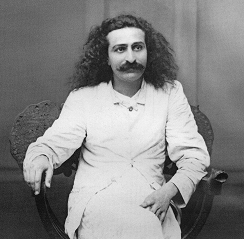
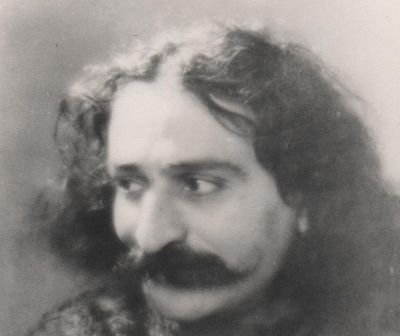
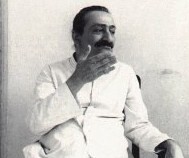
Some physical details are now of interest. Meher Baba had auburn hair, indicative of his Irani ethnicity. He wore his hair long in the early years of his career, like a dervish or Yogi; during the 1930s he resorted to a braid, which he subsequently favoured on a permanent basis. Of average height, his cranium was large in proportion to his physique. He did not possess the receding forehead so dubiously described by Paul Brunton. His physique was lean, filling out in his later years. He would probably have lost in a wrestling match with the formidable Upasani Maharaj, but his stamina was pronounced. It is said that only the strongest men in his entourage could maintain the pace he demanded on so many of his laborious journeys in India, which could easily become marathon tests of endurance. Meher Baba was a fast walker and an agile hill climber.
Charles Purdom has left the following firsthand description of the Irani saint, dating to the 1930s:
Baba is a small man, five feet six inches in height, slight in build, with a rather large head or a head that appears to be large, an aquiline nose, and an olive complexion. He is extremely animated, has a mobile face, constantly smiles, and has expressive hands and gestures. He creates the opposite of a sense of remoteness or strangeness, making an immediately friendly appeal to those who meet him. He is indeed disarming in his obvious simplicity, and the atmosphere that surrounds him might be described as that of innocence. He is childlike and mischievous as well as innocent. I discovered, and others have told me, that he is a superb actor with quickly changing moods. (51)
The reference to being mischievous relates to a sense of humour, which was pronounced. This attribute is confirmed by a number of the sources. Although an ascetic entity, Meher Baba was anything but the stereotyped image of the mournful penitent. His fasts and seclusions are perhaps more interesting in view of such factors. He did not encourage asceticism or renunciation in his followers, instead strongly advocating a "be in the world but not of the world" outlook.
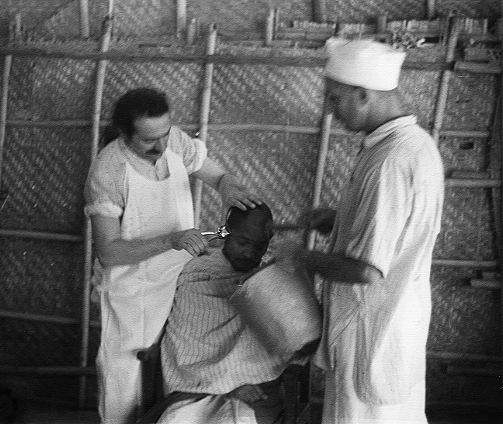
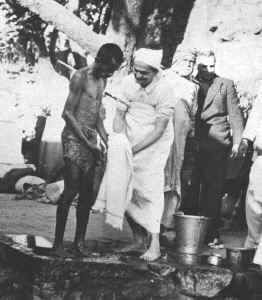
The first thirty years of Meher Baba’s ashram career were marked by many incognito journeys, including some to Western countries during the 1930s. In India, he customarily travelled by third class rail, which could frequently prove a difficult experience. (52) He notably demonstrated humanitarian and philanthropic tendencies, personally ministering to lepers and diverse indigents. He had a rather uncommon habit of washing the feet of poor people, also presenting them with a gift of food and clothing (or cloth), and sometimes money. He maintained these traits until the end of his life.
Meher Baba tending the poor, circa 1960 |
In 1936, Meher Baba created at Rahuri (about 30 miles north of Ahmednagar) a settlement for mad people, whom he personally tended. This became known as the Mad Ashram. Every day he would scour the ashram latrine, a task relegated to untouchables or low caste people in many Hindu ashrams. There was no publicity for this distinctive project, which had no economic motive.
The Mad Ashram moved to Meherabad the following year, being the precursor of more specialised activities involving the obscure category defined as mast (God-intoxicated), comprising many Hindu and Muslim specimens on a nationwide basis. The only publicity for this unusual pursuit was a book published in 1948, written by the English medical doctor William Donkin, who personally observed a number of the events described. (53)
l to r: Meher Baba as barber, Rahuri 1936; bathing a leper, Pandharpur 1954 |
The charity for the poor maintained by Meher Baba was frequently anonymous. The selected needy persons were generally given numbered tickets supplying the address and date of the venue. The name of the benefactor was not given; Meher Baba was effectively incognito when he dispensed money or other gifts with his own hands. (54) Unlike certain well known gurus, he did not delegate philanthropic work to devotees, instead performing the task himself.
There was no caste management at his ashrams. Meher Baba supervised everything himself, maintaining a simple routine. He gained a degree of donor funding that enabled him to support various devotees and their families. The ashram devotees were known as mandali, predominantly men but also some women; they wore ordinary clothes, not distinctive regalia. There was no ritualism or initiation.
During the late 1930s, a significant gesture was made by Upasani Maharaj. Via messengers, Upasani repeatedly requested Meher Baba to take over management of Sakori ashram. This tactic effectively dramatised the insular attitude of the existing caste Hindu management towards the Irani disciple. The management had been insisting for many years that Meher Baba was only an ordinary disciple of Upasani, just like them. This relegation was attended by their fear of his (Meher Baba's) resistance to caste ritualism and his known sympathies with the cause of untouchable (Dalits).
The Irani disciple (now quite independent) would not agree to the request of Upasani, complaining at the Hindu ritualism prominent at Sakori, which to him signified caste exclusivism. Meher Baba stated that all the Hindu rituals would have to stop at Sakori if he agreed to the request.
After several years of this unusual and obscure series of communications (ongoing since 1936), Upasani became compliant with the counter request. In 1940, Meher Baba at last agreed to purchase Sakori ashram, on the basis of the exceptional arrangement about eliminating ritualism. However, nothing came of the proposal, which was evidently resisted by prominent Hindu devotees at Sakori.
The last meeting between Meher Baba and Upasani Maharaj occurred in October 1941, at the insistent request of the latter. The venue was a solitary hut at Dahigaon, near Sakori. These two entities had not met for nearly twenty years. The event was unpublicised; only a few persons were present. Upasani died two months later at Sakori.
Meher Baba and Upasani Maharaj, Dahigaon 1941 |
Not until the 1950s did a new attitude emerge at Sakori. This change was brought about by Godavari Mataji, the female disciple of Upasani who had become the recognised spiritual leader of Sakori ashram. Her role was elevated by the management, who were now very disconcerted to discover that she revered Meher Baba.
Godavari prevailed upon the management to allow Meher Baba to visit Sakori, first in 1952 and later in March 1954. Meher Baba proved to be tactful, despite the stigmas aimed at him in the past. He was very appreciative of Godavari Mataji, who also visited Meherabad with some of the other Sakori nuns. Meher Baba subsequently made further visits to Sakori ashram at the intervention of Godavari. (55) A detailed account exists of the visit to Sakori in September 1954.
Meher Baba was markedly universalist in outlook. His early following comprised Hindus, Muslims, and Zoroastrians. He was noted for his disciplined way of life. Despite his lifelong silence commencing in 1925, he communicated fluently via an alphabet board and gesture language. His major book exhibits an unusual format, including many terms drawn from Sufism and Vedanta. He spoke Persian, Urdu, Gujarati, Marathi, and English. He would not identify himself with any one religious or mystical tradition. For such reasons, he has proved difficult to classify. He abundantly demonstrated the religio-mystical syncretism occurring in Maharashtra over the centuries. He made this very explicit in his major work, published in 1955, which incorporated Arabo-Persian and Sanskrit (plus Marathi and Hindi) vocabularies, thus strongly attesting Sufi and Vedantic associations (also bhakti or sant associations via Kabir poetry).
He may be viewed as a successor to some aspects of the legacy associated with the Nizam Shahi kingdom of Ahmednagar, founded in 1494 and surviving into the seventeenth century. That regional dynasty was established by a brahman convert to Islam, namely Ahmed Nizam Shah, who possessed a strong ancestral link with Pathri. The Nizam Shahi dynasty, with their capital at Ahmednagar, exhibited more religious tolerance than many other Muslim rulerships. They were keen to patronise learning, with Persian constituting their official language. The Deccani Urdu dialect was strongly nurtured in this territory, resulting from a combination of Persian, Arabic, and Marathi. (56)
Certain associations with Hinduism are misleading. Meher Baba certainly did integrate some features of Hindu philosophy and terminology. However, he was basically at variance with the caste system, brahmanical ritualism, and diverse trappings believed to represent spirituality. He was known to criticise Vedantic punditry, which so fluently recited scriptures and assumed that numerous renunciates were "knowers of Brahman." Meher Baba himself ministered to sadhus (holy men) in his charitable projects. However, he is reported to have said that such categories are not spiritually advanced (save perhaps in exceptional cases).
The teaching of Meher Baba strongly features reincarnation; the expanded format is difficult to find elsewhere. He applied an intensive emphasis to the Sanskrit word sanskara ("impression"), here meaning an impression in the mind or a binding operative in consciousness. Ritualists and Yogis had used this term differently; Meher Baba is much closer to the latter, though nevertheless distinctive. He discountenanced Yogic exercises, which he viewed as bindings, amounting to a category of impressions (sanskaras) that trap the mind.
He sometimes referred to the situation of Yogis who claim the "stopped state of mind" in meditation. That condition, in which the mind is temporarily suspended, is deceptive. Meher Baba observed that when the meditation ceases, the Yogi is again subject to the complex flow of impressions in the mind. The Yogi has not escaped the sanskaras, which may even intensify.
Meher Baba did not view meditation as an end in itself, maintaining that this common resort cannot achieve what he called "God-realisation." This attainment he depicted as being extremely rare, indeed so rare that a frequent response is incredulity. A reason given is that the impressions in the mind must be completely eliminated for this realisation to occur. The elimination is virtually impossible to achieve, because of the nature of impressions acting on the mind. This perspective is very different to ideas of "self-realisation" generally found in Hinduism and Western "new age" derivatives.
From this angle, the scope for delusion is prodigious amongst enthusiasts of "nondualism" and other mystical concepts. How does anyone break through the dense and subjective net of impressions which determine thoughts and actions? According to Meher Baba, only some of the 56 God-realized entities (living at any one time) are capable of eliminating the binding sanskaras in the mind of a suitably prepared individual. This version may seem exotic or elitist. However, the exacting criteria separate his version quite substantially from both conventional and popular presentations of enlightenment, including the format of Aurobindo Ghose.
The "spiritual hierarchy" theme of Meher Baba has some affinities with the "hierarchy of saints (awliya)" found in Sufism, although the format is different. The five leaders are here described in terms of qutub, an Arabic word meaning "axis" or "pivot." In Sufism, the five are sometimes split into the qutub and four awtad ("pillars"). The Irani exegete included (as an equivalent for qutub) the Hindu term sadguru, which he translated as "perfect master," a nuance intended to distinguish between a proficient grade and lesser roles of guru, yogi, and advaitin (the term "perfect master" is now widespread, and can easily arouse strong criticism, becoming a commercial label designed to impress the gullible).
The teaching of Meher Baba is that of an independent mystic who had no link with organisational groupings associated with Islamic Sufism or Hinduism. His correlation of terminology between the Sufi and Vedantic traditions appears to have been unique. Furthermore, his version of transmigration through the species is explicable from a Darwinian perspective, with the strong qualification that his spiritualised format eschews both Darwinist materialism and the superstitions about retrograde incarnation found in Asiatic religions.
Meher Baba |
During the latter part of his life, from the 1940s, Meher Baba was active at another ashram called Meherazad, to the north of Ahmednagar. That new ashram (near the village of Pimpalgaon) remained secluded, being very different to some of the more prominent institutions of Hindu gurus existing elsewhere. There were no "miracles." Meanwhile, he continued his incognito journeys. He also undertook public darshans on a very intermittent basis. During the 1950s, he made a public claim to be the avatar, a Hindu term meaning a divine incarnation. This proved to be the most controversial aspect of his career.
A motoring accident in 1956 curtailed his movements, leaving him with a damaged hip. In the late 1960s, he became noted for contesting the supposed spiritual validity of drug experiences, a belief which had become fashionable in the West. He was especially concerned to oppose the popular theories about LSD that gained favour amongst the hippy generation.
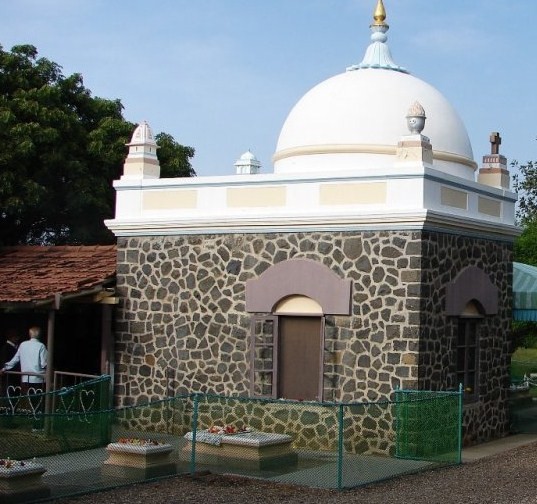
His tomb (built to his own specification in 1938) exists at Meherabad. This building resembles the Sufi dargahs of the Deccan, though relatively plain and unadorned. (57)
Tomb of Meher Baba, Meherabad Hill |
After his death, the Western followers of Meher Baba (including Pete Townshend) promoted a sentimental devotionalism. Many of them tended to favour simplistic catchphrases like “Don’t worry be happy.” That represented an aside of their figurehead, not his teaching, which remained relatively obscure, like many of the biographical details. See further Sectarian Issue and Oceanic.
11. The Sai Baba Movement at Issue
The close juxtaposition of the abovementioned three saints (or whatever they are diversely called) in Maharashtra has been considered distinctive, and even unique. These three entities (Sai Baba, Upasani Baba, Meher Baba) were significantly interlinked in terms of personal affiliations. Their geographical proximity is relevant. They covered a whole century and three Eastern religions between them, with Christian and other followers being added. The linguistic range encompassed Persian, Urdu, Marathi, Gujarati, Sanskrit, and English.
This convergence has been dubbed the “Sai Baba movement.” A problem is nevertheless evident in such description. That is because the phrase “Sai Baba movement” was innovated by supporters of Sathya Sai Baba, whose career occurred in a different part of India. The contention of those supporters has amounted to endorsing the claim of Sathya Sai to be the reincarnation of Shirdi Sai. The assumption is that Sathya Sai represents the culmination of the “movement” signified. This view has been contested. The basic claim has proved particularly unpopular with the Sai Baba Sansthan of Shirdi, who are the most influential of the three Maharashtrian religious movements mentioned above.
Supporters of Sathya Sai tend very much to relegate Upasani Maharaj and Meher Baba in the sectarian preference for a theme of Shirdi Sai being reincarnated as Sathya Sai. The intervening figures are quite rarely mentioned, and in a purely secondary context. From Shirdi to Puttaparthi is the basic emphasis of this interpretation.
The Puttaparthi ashram of Sathya Sai Baba (d.2011) is situated in Andhra Pradesh. From the initially humble beginnings in 1948, that ashram (known as Prashanthi Nilayam) grew into a very wealthy complex of buildings. Devotees extolled the humanitarian activities of Sathya Sai; his ashram was promoted as a paradise of love and spirituality. His proclaimed miracles were believed to confirm his authority as a God-man, while his major work Sathya Sai Speaks received partisan acclaim as divine messages. That work is an extensive multi-volume presentation, the sub-title being Discourses of Bhagavan Sri Sathya Sai Baba.
In another camp, disaffected Western ex-devotees insisted that the much publicised humanitarian activities at Puttaparthi were easy to accomplish via wealthy devotees, who actually performed the work involved. Some emphasise that Sathya Sai maintained a formidable security force to protect himself at the ashram. Testimonies of sexual (homosexual) abuse by the guru were denied by devotee spokesmen. Sathya Sai was described as a paedophile by critics. Many Western devotees left the movement in disillusionment from the year 2000 onwards. Certain of these people have contributed strong criticism of Sathya Sai Speaks, also the hagiological works supporting this lengthy collection of discourses.
Accusations were lodged about economic manipulation at Puttaparthi. There was certainly an extensive funding involved, making possible the elaborate building programme at Puttaparthi. The ashram mandir (temple) was ornate. Sathya Sai Baba was described as creating "palaces." By the time of his death, his assets were considerable, even by standards of the super-rich. The precise total of those assets has varied in different reports. The scale runs from 9 billion to over 30 billion US dollars. Many devotees and critics were astonished when, in June 2011, the sealed private residence of the deceased guru was opened by officials. The inspectors found a hoard of gold and silver ornaments, plus the equivalent of 2.6 million dollars in cash. The total value of this personal hoard was assessed at being equivalent to 8 million US dollars.
Critics say that Sathya Sai Baba did not live up to the standards of a renunciate; the hoarding of wealth is discrepant with such a value system. A comparison with the Maharashtra trio in the putative "Sai Baba movement" is surely relevant.
Shirdi Sai Baba never created an ashram, merely living in a rural mosque while daily begging his food. He died a poor man, without assets. Upasani Maharaj did permit his brahman devotees to build temples at Sakori ashram, a development which changed the character of that simple rural site. However, the scale of innovation was not comparable to the far more lavish Puttaparthi project. Upasani also maintained a frugal lifestyle.
Meher Baba established two permanent ashrams in the Ahmednagar zone, both of these being simple in appearance and function. The Irani mystic did not permit temples; the utility structures in favour at his ashrams were basic, not elaborate. Indeed, the early colony at Meherabad was dismantled after only two years duration (1925-6), the population subsequently decreasing and eventually becoming sparse. This was not a public venue after the 1920s. Meherazad also remained simple to the end, housing only a small number of devotees, and likewise not being a public venue. There was nothing here even remotely resembling the daily darshan (audience, meeting) at Puttaparthi, where Western guests were encouraged in large numbers from the 1970s onwards.
The disputed claim of Sathya Sai to be a reincarnation of Shirdi Sai, arose in circumstances influenced by the popular “Shirdi revival” associated with B. V. Narasimhaswami, whose books were read in South India from 1938, being published at Madras. The official date for the declaration of reincarnation is 1940. However, this has been revised to 1943 by ex-devotee Brian Steel. Either date would accommodate the influence of Narasimhaswami’s version of “Sai Baba bhakti” and the attendant hagiology of miracles. The revised date allows a much stronger anchorage in this respect.
Sathya Sai Baba of Puttaparthi |
Another controversial feature of Sathya Sai’s teenage years was his strong inclination to practise sleight of hand magic tricks. Critics like Basava Premanand lodged the accusation that Sathya Sai later developed these tricks into an ambitious programme of deception, extending to the "materialisation" of jewellery and holy ash. A further drawback is that the extensive literature on Sathya Sai is markedly hagiographical.
The version of Shirdi Sai by Sathya Sai was enthusiastically extolled at Puttaparthi, but received with caution elsewhere. The relevant discourses have been observed to minimise the Muslim Sufi element and to reflect some themes of Narasimhaswami, including the alleged birth of Shirdi Sai at Pathri. (58)
The phrase “Sai Baba Movement” arose in the 1970s, being proposed by a Western academic in 1972. The innovator was principally referring to Shirdi Sai, Upasani Maharaj, Godavari Mataji, and Sathya Sai. Charles White was evidently influenced by the Sathya Sai movement, having met Sathya Sai at the latter’s Whitefield ashram (near Bangalore) in 1969. (59) Another academic writer, identified with the pro-Sathya category, added a brief version of Meher Baba at a later date. (60)
Ex-devotee Brian Steel has commented on the misleading nature of the White version, which stated: "The competence of Sathya Sai Baba to serve as the successor of Shirdi Sai Baba is increasingly recognised in the Sai Baba cult.” (61) Steel duly emphasises: “It is no secret outside Andhra Pradesh that most followers of Shirdi Sai have never accepted Sathya’s incarnation claims.” See further the critique by Brian Steel, On the Terms “Sai Baba” and “the Sai Baba Movement” (December 2008).
A number of scholars were observed to accept the description of “Sai Baba Movement” in a rather facile manner. This seems to have been initially the case with the late Dr. Marianne Warren (d.2004). However, she eventually repudiated the basic associations in train. A devotee of Sathya Sai, her research on Shirdi Sai arrived at the overwhelming conclusion of a full-bodied Sufi identity that contradicted the Hinduized accounts. Observers noted the acute discrepancy between her findings and the version of Shirdi Sai by Sathya Sai. Dr. Warren’s lengthy book Unravelling the Enigma (1999) was a clarification of many anomalies, although some issues were still awaiting resolution.
Soon after publication of the first edition of her book, Dr. Warren seceded from the Sathya Sai movement, instead siding with the growing ex-devotee mood of reaction. She subsequently contributed a revised edition (2004) of her book shortly before her death, amending the preface with some accusing statements aimed at her former guru. She now said that Sathya Sai had introduced “typical puranic stories” about the birth and life of the Shirdi saint, and by this she meant fictions of a Hinduizing nature. Dr. Warren also wrote the introduction to an intended future volume that would expose Sathya Sai. She now totally disagreed with his reincarnation claim, which she viewed as a symptom of opportunism. See Shirdi Sai Baba and Dr. Marianne Warren's Rejection of Sathya Sai.
Another ex-devotee has complained that enthusiasts of the reincarnation claim are actually celebrating the "Sathya Sai Baba Movement" of Andhra, not the earlier associated events in Maharashtra. See Brian Steel, web article linked above, citing an academic work by Professor Smriti Srinivas. (62) See further the review by Steel of that work. Brian Steel here accuses Srinivas of failure to give due attention to the first two volumes of Sathya Sai Speaks, which comprise discourses and claims recorded between 1953 and the early 1960s, “a period which most academics have also ignored, preferring to be guided by the Sathya Sai Organisation’s simplistic selection of four ‘landmark’ Discourses to indicate the progression of Sathya Sai Baba’s claims.”
Steel also urges that Srinivas demonstrated “a tendency to read and use material favourable to Sathya Sai Baba and the official story of his Mission, while ignoring other points which have recently come to light.” Brian Steel stresses that certain critical works are missing from the lengthy bibliography of In the Presence of Sai Baba (2008), including those by Dr. Dale Beyerstein which query the alleged paranormal powers of the Puttaparthi guru.
Although she (Srinivas) shows signs of being aware of critical Internet activity about Sathya Sai Baba in the past six years, she has chosen, deliberately (see pp. 333-334), not to examine it, thereby laying herself open to the criticism of staying too close to the 'official line' on Sathya Sai Baba, however unconsciously this may have occurred. (Steel, internet review of Srinivas, section 5)
The Steel analysis continues by emphasising a discrepancy, evident in the Srinivas book, of not adequately distinguishing between “two Sai Baba Movements.” He urges that the Shirdi Sai (Baba) Movement should be regarded as distinct from the Sathya Sai (Baba) Movement. The point being that "Srinivas makes frequent specific references to the 'Sathya Sai Baba Movement' as a synonym for her (debatable) concept of the 'Sai Baba Movement'."
Brian Steel pointedly alights upon the idea (favoured by Srinivas) of the two Sai figures being "identified" within the Sathya Sai Baba Movement. He observes that this claim "is clearly Sathya-centric and Shirdi-exclusive." Nearly forty pages further on, Professor Srinivas acknowledges that the Sai Baba Sansthan at Shirdi "does not recognise any successor to [Shirdi] Sai Baba."
Steel concludes that the Srinivas presentation “makes the elementary mistake” of regarding sexual abuse accusations as being the most central component of the controversies about Sathya Sai. Some academics have conveniently treated the presumed category of "allegation" as being cause to ignore the controversy.
Coincidentally, but more deliberately, the Sathya Sai Organisation often adopts a similar attitude in order to be able to issue lofty dismissals of all critical comment and discussion. (Steel review of Srinivas)
According to Steel, a more fundamental issue than the sexual allegations (actually solid testimonies) are the obvious discrepancies between the translated content of Sathya Sai Speaks and the original Telegu discourses. Yet these matters are likewise ignored by the disputed commentary of Srinivas.
Two avatars: Meher Baba, Sathya Sai Baba |
The problems and anomalies attaching to “Sai Baba movement” conceptualism are not restricted to the reincarnation controversy and the dispute about miracles. There is also the relatively neglected matter of two avatars being discernible in the supposed “movement” theorised by Charles White and others. The word avatar belongs to the Hindu lexicon and generally has the meaning of divine incarnation.
The two major devotional biographies of Meher Baba supply relevant details. In February 1954, Meher Baba publicly confirmed his avatar role by dictating on his alphabet board the words “Avatar Meher Baba ki jai,” representing a devotional salute that he had never before acknowledged. The biographers make much of this, relaying that he was formerly indifferent to what people called him. (63)
For many years, the title of Meher Baba was often merely Shri, a common term of respect amongst Hindus. He was also sometimes called Sadguru, which is a more celebratory word. Yet as from February 10, 1954, Meher Baba referred to himself as avatar both in public and in private. He subsequently supplied complex explanations of the avatar role. He is known to have made earlier sporadic private references to his avatar identity; these date back to the 1920s.
The venue for the public confirmation was Mahewa, in the Hamirpur district of Uttar Pradesh. This event occurred during a darshan tour, which gained a sequel that same month in Andhra. In response to invitations, Meher Baba visited a number of towns in Andhra, such as Eluru and Rajahmundry, many thousands of people being involved. These darshan tours represented a major extension of his contact with Hindus in a devotional milieu. At Eluru, he also visited a temple dedicated to Shirdi Sai. There he is reported to have said of the Shirdi faqir: “He is my Grandfather.” (64) The meaning related to a spiritual ancestry devolving via Upasani Maharaj.
These Andhra events occurred during the very early years of the Puttaparthi ashram, before the discourses of Sathya Sai began to be published in 1955 (as Sathya Sai Speaks). The avataric claims of both Meher Baba and Sathya Sai Baba sound fantastic to most critical assessors. However, the Irani did not claim to be a reincarnation of Shirdi Sai, whom he had actually encountered. Meher Baba instead referred to a long term cyclical manifestation of avataric entities, meaning the founders of religions. This theme might be interpreted as an attempt to embrace or unite different religions, five of which were mentioned in the exegesis under discussion. The Irani avatar of Maharashtra remained impervious to miracle consumerism, which he frequently criticised. This is one of his most impressive traits. He was also very resistant to the caste system and attendant forms of ritualism.
In contrast, Sathya Sai formulated a theme of “triple avatar,” as this has been called. The pivotal reference often cited dates to July 6, 1963, and can be found in Vol. 3 of Sathya Sai Speaks. In the relevant discourse Shiva-Shakthi, Sathya Sai briefly referred to himself as an incarnation of Shiva and Shakti (Shiva is the “destroyer” deity, and Shakti is the feminine consort). Shirdi Sai is here described as an incarnation of Shiva, while the third in the series is named as Prema Sai Baba, here identified with Shakti. In a later statement, Sathya Sai said that he would live to the age of 96 (i.e., 2022), and that Prema Sai would be born eight years after.
The ex-devotee analyst Brian Steel has contributed an important online bibliography relating to Sathya Sai. He describes the influential four volume biography by Narayan Kasturi as “rank hagiography.” This refers to Sathyam Sivaram Sundaram (1961-80). Kasturi is reported to have acknowledged a heavy debt to a booklet of 30 pages dating to 1944, originally written in Telegu by V. C. Kondappa. Sixty years later, the translation was entitled Sai's Story. This work claims to be the first book ever written about Sathya Sai. The contents include several pages of alleged early Shirdi Sai biography in relation to the reincarnation claim, which had then so recently been made, in 1943 and not in 1940 as Kasturi believed. (65)
Brian Steel has offered many pressing reflections upon the discourses of Sathya Sai, including the Convocation discourse of 22/11/2008. In that discourse, the guru gave the misleading message of “No bombs for India,” a statement which completely ignored the ongoing terrorist attacks in that country. The embarrassing statement was quickly removed, from the (visible internet) discourse in question, by the Sathya Sai Organisation and devotee websites.
Ex-devotees made much of this matter. In the excised paragraph, Sathya Sai stated: "In India, there is no fear of bombs; India will never have any such attacks." This assertion was made immediately prior to the grim terrorist attack at Mumbai in late November 2008. The guru mistakenly claimed that America and Germany were in a far more critical condition of fear about terrorism. India had suffered terrorist attacks for two years or so, a fact that was well known. Sathya Sai was clearly out of contact with current events.
According to Steel, “the constant disappearance of embarrassing or incorrect utterances by Sathya Sai Baba is a well documented phenomenon.” Critics maintain that extensive editing was applied, before publication, to the Telegu discourses of the Puttaparthi guru.
In 2002, a flourishing multilingual website maintained by some devotees of Sathya Sai (a group called Premsai) "totally disappeared from the Internet." This Premsai website inadvertently afforded clear proof about the extent of official editing in relation to the guru's Telegu discourses, before their publication and translation in several languages. Steel relates: "The new insights into the Discourses also raised important questions outside devotee circles about the official image of Sathya Sai Baba as projected for so many years by the Sathya Sai Organisation."
According to the same researcher, a comparison of literal translations and the final edited form of discourses, reveals that Sathya Sai Baba's “impromptu public preaching in Telegu is rambling, not very well structured, and sometimes contains unclear or muddled statements, discrepancies, and errors.” Ex-devotees have accordingly objected to the guru's claim of omniscience, so strongly promoted by the Sathya Sai Organisation. See Brian Steel, Sathya Sai Baba Discourse Evidence Disappears from Public View (2008). Steel made a personal visit to the ashram of Sathya Sai in 2008. (66)
12. Sectarian Globalisation and Devotional Memory
A book by Professor Smriti Srinivas is entitled In the Presence of Sai Baba (2008). This work acknowledges that the bulk of material employed was furnished by the Sathya Sai Baba Movement. The coverage by Srinivas emphasises the globalisation of that movement, while evidencing a disinterest in critical sources from ex-devotees and others. In the eyes of critics, this form of presentation, though innovative in a sociological sense, is nevertheless one-sided and misleading.
The Srinivas presentation benefits from fieldwork in different countries, and formulates a sociological theory in relation to global centres of the Sathya Sai Baba Movement, i.e., Bangalore, Nairobi, Atlanta. This theory differs from official doctrines of the movement, which are nevertheless compatible. Some basic themes are declared in the sub-title, i.e., body, city, and memory in a global religious movement. Some analysts think that devotional memory is the most significant of these components. There are acute disadvantages signified by the excision factor, meaning that critical sources are eschewed, these being an embarassment to sectarian doctrine. Devotional (and sectarian) memory frequently screens out matters not appearing in doctrine.
The limitations of “devotional memory” can be pronounced. The Muslim faqir Shirdi Sai was de-Islamized to fit Hindu devotee preferences. The Irani Zoroastrian Meher Baba was censored by brahmanical caste prejudices in the devotional following of Upasani Maharaj at Sakori. The Shirdi variant of devotional memory discounted the eulogistic statements of Sai Baba about Upasani and instead opted to view the latter as a peripheral factor. The Hindu champion of female celibates was subsequently libelled by ultra-conservative Hindu insularists who influenced Narasimhaswami.
A very accented sectarian tactic was conducted by American blogger Gerald Joe Moreno during the years 2004-2010. The loaded pro-Sathya apologist campaign of Moreno exhibited an unyielding attitude amounting to: “Remove or caricature all sources that compromise sectarian priorities and beliefs.”
The aggressive internet activity of Moreno was strongly associated with the Sathya Sai Organisation (SSO), sometimes described as International Sai Organisation, which is misleading in that there are two Sai entities to account for. The SSO had become inseparable from the presiding official Michael Goldstein of California, who was alleged to be funding Moreno (alias Equalizer). The total absence of sectarian accountability resulted in a defamatory agenda aimed at critics of anomalies. That is what can happen in devotional memory and globalisation drives.
When a sector of American anthropology (associated with the University of California) opted for the excision factor, the standard of elucidation remained at the heavily compromised stage of effective support for sectarian sources at the expense of ex-devotee and related non-sectarian critiques. Criteria such as “devotional memory” require to be complemented and enlarged. Globalisation of the Sathya Sai Baba Movement was surely no excuse for libellous blogs and the extremist website saisathyasai.com. The academic relegation of critical reports can unfortunately have the effect of assisting apologist actions, which may be libellous.
Two of the key phrases associated with In the Presence of Sai Baba (2008) are “understandings of citizenship” and “new forms of urban modernity.” What does this actually mean in real life rather than academic theory? To take a known recent example: an eighty year old relative of mine (my mother) was targeted by the Moreno sectarian campaign flourishing in the urban modernity of Las Cruces in New Mexico. Five copyrighted photographs of her were insolently and vindictively paraded on the primary Moreno website saisathyasai.com. There was an accompanying mockery caption, plus an offensive paragraph containing a known libel promulgated by the controversial Findhorn Foundation [associated with problems involved in the David Lorimer issue].
The victim had done absolutely nothing to merit such a calculating attack from the internet terrorism attending the Sathya Sai Baba Movement. She was not a computer user, and had not mentioned Moreno. The truth is that Jean Shepherd (Kate Thomas) was attacked because she is my mother. The issue of relatives (of victims) being targeted by manic cult psychology is now on the agenda for realistic analysis in "understandings of citizenship." The cyberstalker tendency to attack all connections of victims is a further warning.
The Moreno attack shifted from vilification of ex-devotees to denunciation of a complete outsider (myself) – although some journalists and the BBC had also been castigated for criticism of Sathya Sai. While close analysts conceded that many of the Sathya Sai devotees (especially in India and Africa) do not evidence aggression, a growing fear developed that the provocative example set by Moreno (allegedly backed by Goldstein) could prove contagious elsewhere in the Sathya Sai Baba Movement, more especially in America.
The preferred blog anonymity of Gerald Joe Moreno (alias Equalizer and other pseudonyms) presented a difficulty for uninformed parties, who were unable to discern the web ploys conducted in the cause of Sathya Sai Baba. See analysis of a cultist defamation. Moreno is reported to have died in 2010; however, numerous attack blogs of his remained visible on the internet.
“New forms of urban modernity” are perhaps particularly dangerous in a country like America, where there is virtually no limit to misrepresentation by the blog detritus and cultweb encouraged by blogspot.com and wordpress.com. New forms of international legal expertise may be required to deal with the excesses, which are inimical to the misunderstood and abused citizenship trashed by "devotional memory" and sectarian globalisation at defective blogger level.
I contributed an annotated book entitled Investigating the Sai Baba Movement (2005). This was suppressed on Wikipedia, in 2006, by Gerald Joe Moreno (SSS108), under the guise of Wikipedia Neutral Point of View. The context of his attack was total opposition to ex-devotee objections (and testimonies) in relation to the Puttaparthi guru. I had reported those objections in appendices. The text of the proscribed book awarded a sympathetic treatment to three other gurus/saints (Shirdi Sai, Upasani Maharaj, Meher Baba). This was not therefore an "anti-guru" book of the type despised by Moreno. The observer verdict, over quite a wide spectrum, was one of alarm at belligerent sectarian tactics. See further Wikipedia Issues and Sathya Sai Baba and Wikipedia, Gerald Joe Moreno, Google. See also Hate Campaign Blogs.
In more general terms, the problem of deficient gurus has been spotlighted by the Indian Rationalist cause. One of the spokesmen here is Professor Narendra Nayak, who has urged the elimination of godmen and superstitions from India. This is a controversial issue. Events in Kerala were much discussed. In May 2008, Swami Amrithachaithanya “was arrested in Kochi for alleged rape and possession of narcotics and pornographic films.” Furthermore, to quote from an online report: “After the incident, complaints against godmen started pouring in from various parts of the state [Kerala], prompting the government to initiate a statewide crackdown.”
Kevin R. D. Shepherd
July 2009 (last modified December 2020)
UPDATE: Tulasi Srinivas and the Politics of Religion
Tulasi Srinivas |
In 2010, a significant book was published by Columbia University Press. Professor Tulasi Srinivas, an anthropologist at Emerson College, emerged with a version of the Sathya Sai Baba sect that broke new ground in academic literature. Professor Srinivas included some coverage of dissident online reports. This dimension is considered relevant by the more thorough investigators, though frequently ignored to date by political strategies and one-sided academic commentaries.
A variety of sources were employed by Professor Srinivas in Winged Faith: Rethinking Globalization and Religious Pluralism through the Sathya Sai Movement (2010). In contrast to the amiable academic reviews was a very hostile coverage by the Pro-Sai activist Gerald Joe Moreno (of New Mexico), appearing on his website saisathyasai.com and his blog at wordpress.com. That disapproving review is dated June 30th, 2010, being composed in the third person, like many other Moreno pseudonymous blogs appearing under names like Equalizer. Moreno asserts that Winged Faith is "poorly researched, highly biased." This opinion urges that the book by Professor Srinivas "heavily relies" upon the critical internet material supplied by disillusioned devotees of Sathya Sai Baba.
Moreno applied the stigma of "tattered research" to the Srinivas book. This is strongly reminiscent of other verdicts from the same blogger concerning materials and publications that are not invested with academic status. The fact that professorial research is also denigrated as an aberration may be significant. Professor Srinivas spent nine years in her research, and therefore may have been getting to grips with the controversial subject.
Emerson College supplied a description of Winged Faith in terms of telling "the promising and problematic story of a rapidly globalizing Indic sect." However, Gerald Joe Moreno did not recognise any problematic elements, which he instead considered to lie solely with the critics. Moreno had created a network of sites/blogs displaying Pro-Sai activism; he was allegedly funded by an American official of the Sathya Sai Organisation. Moreno evidently believed that his tactics were abundantly justified by his support for the guru of Puttaparthi.
A contradictory theme of Moreno aroused disbelief. He maintained that he was not a devotee of Sathya Sai Baba. He accused Professor Srinivas of neglecting his contention. He states correctly that he did provide this information on his FAQ page in 2005 (which I have elsewhere acknowledged, while commenting: "Though Moreno says that he is not a devotee, it is obvious that he considers himself to be a Pro-Sai Activist"). In view of the very strident defence of Sathya Sai Baba, expressed by Moreno via innumerable blogs, observers have frequently interpreted his contribution in the context of a devotee supporter. Furthermore, his vehement attacks on critics and objectors were so severe, in a number of cases, that a contrasting identity requires special pleading. If not a devotee, then surely a very militant supporter with a strong devotee background in his earlier years.
The extensive agitation of Moreno, against persons he derisively called "Anti-Sai" commentators, has been considered a prime instance of sectarian standpoint (he also opposed critics of other gurus). His general presentation of Sathya Sai Baba was that of the immaculate guru transcending all testimonies of abuse made by ex-devotees. Many of the latter regarded Moreno as a blog bully and internet hit man. His website at saisathyasai.com gained disrepute as an excessive exercise in justifying the guru against all criticisms, which Moreno ridiculed in terms of "smear campaign."
Moreno's own explicit campaign extended to defamatory blogs claiming to "expose" a number of persons (including myself) who had argued against him. Rational dialogue cannot occur in such a situation. Strong suspicions of an underlying cult tactic were aroused.
The Moreno review of Winged Faith states: "Although Moreno [third person] runs the largest internet websites exposing the many smear campaigns waged against Sathya Sai Baba by critics and ex-devotees, Tulasi Srinivas never attempted to contact Moreno even once although she cited links to his websites." The accusation of not contacting Moreno was also made by him in my direction during 2007. This tactic was transparent as a rhetorical device, especially in view of his then very recent hostile gestures.
In his capacity as Wikipedia editor SSS108 (a role subsequently terminated by a Wikipedia arbitration committee), Moreno had less than a year earlier attacked my books on a Wikipedia User page; he strongly insinuated that my publishing output was effectively off the map and totally inconsequential. See Wikipedia and Moreno. He followed up this "official" denunciation with a related aspersion on a sectarian blog at wordpress.com. My subsequent online objections were evaded and dismissed in various ways, including the accusation of not having contacted him. I had seen online what happened to persons who did contact him, their emails being paraded as proof of error and worse.
Moreno found fault with some of the notes in Winged Faith. He even implied that Professor Tulasi Srinivas would be laughed out of Emerson College in the light of his disclosures. This anticipation proved erroneous. I will here confine attention to the accusations with which I am more intimately acquainted.
In reference to pages 353-4 of Winged Faith, Moreno chastises the author for having referred to myself as a "biographer of Shirdi Sai Baba." A bizarre justification for this indictment is supplied in terms of "a vanity self-publisher who admitted he is not an academic and who admitted he dropped out of school at the age of fifteen." I repeatedly objected to such stigmas, countering the misinformation of sectarian hate campaign. See Hate Campaign Blogs. Moreno ignored my protests, just as he ignored the protests of many other victims.
I did not have to admit anything, as I never claimed anything in respect of academic status. This is known from my published output since 1983, long before Moreno appeared on the web. My route through life and study has intentionally bypassed the salaried career of credential (as some academics do appreciate). See Autobiographical Reflections. The Moreno commentary was more than superficial, being vindictively deceptive. He himself had no academic credentials, and also no history of private library research or authorship of annotated books. He is currently classifiable as an aggressive inhabitant of the American blogosphere during the period 2004-2010.
The Moreno review of Srinivas also describes me as "a malicious critic of Sathya Sai Baba." What I actually did was to report the submerged views of dissidents and critics like the late Basava Premanand, an Indian Rationalist who referred to many disturbing murders and other molestations closely associated with the Puttaparthi guru. I contributed a web article entitled Sathya Sai Baba: Problems. This was not malicious, but effectively defensive, in the face of censorious antipathy devolving from Wikipedia via Pro-Sai activism. If Premanand was even partly right, the underlying situation at Puttaparthi was horrific for many years, nurturing a strong element of terrorism. Premanand convincingly proved that the sleight of hand ruses used by Sathya Sai Baba (and other gurus) were not "miracles."
I was described by Moreno's third person rhetoric as having "fanatically accused Moreno" of being an internet terrorist. That description was indeed evoked from me in 2009, but not in any fanatical cause. The web article Internet Terrorist was a defence and statement against the dismissive libel to which I had been subjected, a libel inviting legal analysis (partially reproduced online).
The Moreno web campaign against myself subsequently infiltrated Wikipedia at a renewed angle in 2009, to such an extent that superficial editors and administrators (having no obvious research ability) were deceived by the blog tactics (see Wikipedia and Kevin Shepherd). Professor Tulasi Srinivas proved more resistant to the politics of sectarian religion, and can be congratulated upon a standard of reporting and research that is far more objective than the customary academic relegation of such matters to oblivion.
Professor Srinivas was correct to cite me as a biographer of Shirdi Sai Baba. However, I do not claim any great achievement in that respect. I have to date provided four published and annotated biographical overviews, and also the present webpage. Non-sectarian analysts concluded that I contributed the first annotated version of Shirdi Sai in his Muslim Sufi context (Gurus Rediscovered, 1986), and the first annotated biographical commentary disputing some emphases found in two academic works of note (Investigating the Sai Baba Movement, 2005, Part One).
Moreno ends his hostile aspersion against myself with the remark: "This is the type of person that Tulasi Srinivas deemed credible enough to cite as a reference in her book." Once again, the contrivance of total stigma, unfit to be cited, further justifying Moreno's Wikipedia editorial role in 2006, when he reacted to a Wikipedia citation of my book Investigating the Sai Baba Movement. The disdained citation appeared in the Wikipedia article on the ex-devotee and retired academic Robert C. Priddy. The "Anti-Sai" opposition was favouring me, so I had to be censored by Pro-Sai activism on Wikipedia. Moreno was afterwards banned from Wikipedia for activism.
In April 2010, I deleted the sole known image of Moreno from my websites. He was aggravating about this matter, and so I complied. He desired image anonymity. It is obviously convenient for some parties to avoid the protocol of due pictorial web identity, a common trait of the blogosphere and Wikipedia. Moreno did not return the conciliatory gesture, instead preserving three images of myself that he had appropriated from my Citizen Initiative website, while also retaining the five abused images of my mother (who had never mentioned him).
The invisible Moreno berated Professor Srinivas for citing Conny Larsson, an eccentric ex-devotee whose activities in new age "workshops" and "counselling" were well known. Moreno became notorious for his attacks on Larsson, a major testifier to abuse (meaning sexual abuse by Sathya Sai Baba). Moreno now interposed the very deceptive statement: "Robert Priddy and Kevin R. D. Shepherd attempted to defend Conny Larsson and were subsequently silenced by two scathing responses by Moreno."
A few words can be said about this misrepresentation. Neither myself nor Priddy were silenced by Moreno invective. Gerald Joe Moreno frequently referred to me in combination with the ex-devotee Robert Priddy (his major and ultimate opponent). The truth is that I was, and am, a complete outsider to the Sathya Sai Baba sect, furthermore holding independent views from those of ex-devotees.
Priddy expressed valid complaints, demonstrating an extensive output. The persistent attempt of Moreno to "expose" him was strongly denied, e.g., Robert Priddy Not Exposed. More graphic is Priddy's own statement at Gerald Moreno. Priddy complains of an excessive and distorting campaign moving well beyond the conventions of legitimate criticism. These matters of sectarian attack psychology generally sound almost incredible to persons unfamiliar with Moreno events.
In more philosophical areas however, I do not agree with Priddy's overall worldview; his disillusionment with Sathya Sai Baba created in him a strong tendency to materialist scepticism which I do not share. This shift of outlook frequently happens to people in his category, being quite understandable. The ultimate truth remains elusive. Priddy closes down metaphysical issues, whereas I leave those open, though not in any sectarian or cultist context. Remote from such intellectual complexities, Moreno devised the ludicrous story that I endorsed Priddy as an LSD consumer. The poverty of sectarian contrivance is acute.
I did not defend Larsson's eccentric "workshop" career, which I regarded as an indulgence and distraction, also a cause of further confusions. A number of ex-devotees have sought psychological reassurance in "alternative" avenues after their acute dissatisfaction with the guru. Larsson contested the accusations made against him by Moreno.
I cited the relevant statements of Larsson about sexual abuse testimonies and related matters. Moreover, I was not silenced by the extremely misleading judgments and accusations of Gerald Joe Moreno. The following year I provided a commentary on the Moreno-Larsson role problems, the purport of which was ignored by Moreno, who never accepted criticism of his extremist arguments and tactics. The title of the relevant entry was New Age Confusions and Sectarian Misinformation, meaning Larsson and Moreno respectively.
Moreno died in 2010, the circumstances remaining obscure. His attack blogs had targeted about a hundred victims, some of these receiving intensive derision. Moreno was the subject of solicitor correspondence in different countries. He had become notorious as a cyberstalker and libeller.
Kevin R. D. Shepherd
February 2011 (last modified December 2020)
ANNOTATIONS
(1) Shepherd, Gurus Rediscovered: Biographies of Sai Baba of Shirdi and Upasni Maharaj of Sakori (Cambridge: Anthropographia, 1986). Gurus Rediscovered was recognised in some circles as a relevant innovation, presenting two figures in combination who had become separated into contrasting sectarian figureheads. See also Shepherd 2005:2-58, on Sai Baba. For a more extensive version of the Shirdi saint, see Shepherd, Sai Baba of Shirdi: A Biographical Investigation (New Delhi: Sterling, 2015). A supplementary work is Shepherd, Sai Baba: Faqir of Shirdi (New Delhi: Sterling, 2017).
(2) “Contemporary sources show that the mystical philosophy and social role of the Chishtis of Daulatabad differed markedly from that of the Turkish babas and the Safavis in Iran, which both combined radical elements of Shi’ism with tribal military affiliations.” The quote comes from Carl W. Ernst, Eternal Garden: Mysticism, History, and Politics at a South Asian Sufi Center (Albany: State University of New York Press, 1992), pp. 100-101.
(3) Cf. Richard M. Eaton, Sufis of Bijapur 1300-1700: Social Roles of Sufis in Medieval India (Princeton University Press, 1978). In support of the non-warrior counter theory, Professor Ernst states: “The early Chishtis were generally either urban Sufis with close connections to the court or else reclusive teachers who maintained their lodges in remote areas” (Ernst 1992:101).
(4) See further Saiyid Athar Abbas Rizvi, A History of Sufism in India Vol. One (New Delhi: Manoharlal, 1978), pp. 175ff, 189, describing frictions with Sultan Muhammad bin Tughluq, the ambitious monarch who established Daulatabad in an effort to maintain subjugation of the Deccan. This Sultan wished to transfer many Sufis to that new centre, for the purpose of undermining their influence in Delhi. However, the philosophers (falasifa) are reported to have benefited from political developments.
(5) The cave at Khuldabad has strong associations with the legend of an early Chishti Sufi who migrated to the Deccan. Very little is known about Zar Zari Zar Bakhsh (d.1309). His legendary fame has exceeded that of other saints buried at Khuldabad. Cf. Warren 1999:91ff, citing the statement of Meher Baba. Warren stipulates (without proof) the cave on Hoda Hill, closely associated with Zar Zari Zar Bakhsh, alias Muntajebuddin Zarzari. The reference of Meher Baba was first exhumed in Shepherd 1986:11-12. See also Shepherd 2015:39-40. Dr. Warren attributes one of the reports involved to Naosherwan Anzar. In fact, that industrious Parsi merely edited the narration of Eruch B. Jessawala, which is entitled The Ancient One: A Disciple's Memoirs of Meher Baba (New Jersey 1985). That narration is cited in Gurus Rediscovered. On the legendary Muntajebuddin, see Ernst 1992:235ff.
(6) Shepherd 2015:22-37. My interpretation differs, in certain respects, from that of Warren. See Shepherd, Faqir of Shirdi (2017), pp. 87-99. A specific Sufi link was proposed for Sai Baba in B. K. Narayan, Saint Shah Waris Ali and Sai Baba (New Delhi: Vikas, 1995). The mentor here suggested is Haji Shah Waris Ali (1819-1905), a Sufi who became noted for tolerance towards Hindus. Haji Waris Ali has some similarities to the Shirdi saint.
(7) See Warren 1999:261-333, including a translation of the neglected Urdu Notebook. Some pages of that document were written in the Marathi script known as Modi; the Notebook mostly comprises Deccani Urdu. Though idiosyncratic in some ways, the Notebook (or Saibaba MS) attests familiarity of the saint with Islamic history, including early Shi'ism, Ismaili teachings, and the Sufi orders in India. The comments of the saint occurred when Abdul Baba read verses from the Quran, a large copy of which was kept for this purpose at the Shirdi mosque. Dr. Warren believed that only “a very small percentage” of the commentary was ever written down by Abdul (ibid:313).
(8) Warren 1999:267. Abdul mentioned the Notebook in his later conversations with Narasimhaswami during the 1930s. However, the Hindu commentator evidently could not assimilate the significances. The sannyasin was at a linguistic disadvantage, not being able to read Urdu.
(9) Ibid:277. Dr. Warren had the Notebook of Abdul Baba examined and translated into English by three Urdu specialists, who all agreed that the manuscript comprises random jottings relating to Islamic and Sufi topics (ibid: 272). The Notebook is not therefore a treatise demonstrating continuity of thought. The contents are nevertheless evocative.
(10) Ibid:3-8. See also Nagesh V. Gunaji, Shri Sai Satcharita or the Wonderful Life and Teachings of Shri Sai Baba (1944). This book has gained many reprints published by the Shri Sai Baba Sansthan of Shirdi. More reliable is Indira Kher, trans., Shri Sai Satcharita: The Life and Teachings of Shirdi Sai Baba (New Delhi: Sterling, 1999).
(11) Shepherd 1986:26; Warren 1999:35-6; Rigopoulos 1993:3. See also Trimingham 1971:49, 310, translating the Arabic word sa’ih as itinerant, an equivalent of the Persian darvish (anglicised to dervish).
(12) Trimingham 1971:301; Ernst 1992:375. Many Hindu sadhus or holy men are commonly addressed as Baba, frequently with the respectful suffix ji. Alternative titles are Sant (saint) and Maharaj(a), the latter word having regal connotations.
(13) Shepherd 2005:26. The urs was subsequently accompanied by the Hindu festival known as Ramanavami, which eclipsed the precedent after the saint's death (Shepherd 2015:131-133).
(14) Shepherd 2005:179 note 106. This explanation of the Bhagavad Gita verse was transmitted to Nanasaheb Chandorkar, a brahman devotee. The episode was recorded by Dabholkar, also in three books of B. V. Narasimhaswami, including Devotees' Experiences of Sri Sai Baba (Madras: All India Sai Samaj, 1940).
(15) Warren 1999:357. The Gita verse (IV.34) under discussion is here described in terms of approaching a guru to be taught divine knowledge (jnana). The Shirdi saint is interpreted as arguing against the conventional meaning of the Gita verse. Sai Baba emphasised that what the guru teaches is ajnana (ignorance), not jnana, amounting to a thorn designed to remove another thorn. He further asserted that “divine knowledge is to be realised, not taught” (ibid:359). Warren connects this interpretation with the Sufi theme of removing veils or layers of ignorance.
(16) Warren 1999:360, 404ff. The interviews conducted by Narasimhaswami, during 1936, were reported in his work entitled Devotees’ Experiences of Sri Sai Baba. The majority of those persons interviewed became devotees of the Shirdi saint after 1910. Only three of them had a link with Sai Baba prior to 1900.
(17) Warren 1999:348. The same scholar adds a translation from Dabholkar's Marathi work. The Hindu commentator describes Sai Baba’s refrain of Allah Malik in terms of: “He disliked any thought contrary to this assertion and would not tolerate any dissent” (ibid:349). However, Sai Baba often expressed that refrain or zikr in an undertone, evidently not being concerned to dogmatise.
(18) Ibid:356, commenting that, as Narasimhaswami could not speak these languages, he did not interview faqirs in the Shirdi environs who had known Sai Baba. Warren emphasises that an important aspect of Sai Baba's activity was contact with the wandering faqirs, who spoke Marathi or Urdu.
(19) Rigopoulos 1993:xxv. The quote does not do justice to the varied content of Devotees' Experiences. In more general terms, hagiology was extensive by the 1950s. In 1954, Meher Baba complained that the miracle atmosphere at Shirdi had led to a commercialisation of Sai Baba, whose image could be found "in cinemas and on match boxes." This reference comes from Charles Purdom and Malcolm Schloss, Three Incredible Weeks with Meher Baba (The Awakener - Special Issue, Seattle, Washington, 1955), p. 50.
(20) See further Narasimhaswami, Life of Sai Baba (4 vols). The two quotations from the Life were pointedly utilised in Warren 1999:2, 356, citing Vol. 3, pp. 152, 157. Cf. Shepherd 2015:328-337. Narasimhaswami also composed other works on the subject that proved popular, starting with his early Introduction to Sri Sai Baba of Shirdi (1938) and the oft-cited Sri Sai Baba’s Charters and Sayings, frequently reprinted.
(21) “A few Hindus began offering him some kind of worship inside the masjid [mosque], though Sai Baba strongly disapproved” (Rigopoulos 1993:69). Only Mhalsapati at first seems to have been involved. This brahman would apply sandal paste to the saint’s person. The Muslims of Shirdi protested, several of them adopting the resort of wielding clubs when they guarded the mosque entrance. Mhalsapati here emerged victorious by gaining the support of Sai Baba (Shepherd 2015:128-130).
(22) Dabholkar, Shri Sai Satcharita, trans. Kher, pp. 78-79; Shepherd 2015:55-56; Kamath and Kher 1991:79, describing the son-in-law as a mantrika. Cf. Warren 1999:104, 127 note 10. The report of Ramgiri Bua appeared in Narasimhaswami 1940. Ramgiri stated that the saint had long hair when he arrived in Shirdi; however, this detail is at variance with the kafni and cap reported in his meeting with Chand Patel, the Muslim of Dhupked who was encountered prior to the final arrival at Shirdi (Rigopoulos 1993:51-2). The dating for the latter event varies in the sources between 1858 and 1872. A number of formerly unknown and purported Shirdi Sai photographs have emerged on the internet. Some of these are definitely not Shirdi Sai. One of those images is that of a figure with long hair and a loincloth, reminiscent of a Hindu yogi. This photo has been mistakenly claimed as a portrait of Shirdi Sai in his early years. The misleading image certainly does not prove that the subject was a Hindu. Long hair was favoured amongst Persian dervishes during the Qajar era; also, a minority of Muslim ascetics in India converged with features of the sadhu vocation. The authenticated images of Shirdi Sai attest the Muslim faqir apparel, which was also worn by his disciple Abdul Baba.
(23) Warren 1999:268-70, 346-7, reporting a personal encounter at Shirdi with Abdul Baba's grandson Rahim Khan. Dr. Warren comments that the lifesize marble statue (murti) of Sai Baba, at the Shirdi shrine, was probably the main deterrent to Muslims, who are averse to anthropomorphic representation. See also Shepherd 2015:280-286.
(24) Mani Sahukar, Sai Baba: The Saint of Shirdi (third edn, Bombay: Somaiya, 1983), p. 24. The confusion here, about bearing the caste marks of a Hindu, arose from references to the application of sandal paste to the saint's forehead during the Hindu ritual worship at the mosque. Elsewhere, Hindus are also known to have enthusiastically applied a ceremonial mark to the forehead of Meher Baba during some darshan events. However, the Irani Zoroastrian was obviously not a Hindu, despite such devotional attention. See also Shepherd 2015:84-85.
(25) Shepherd 2005:46. "Although familiar with various features of Islamic exegesis, Shirdi Sai departed from the role of orthodox Sufi, and may be compared with liberal Sufi radicals in earlier times" (ibid:47).
(26) Osborne 1958:15-16. In his prefatory acknowledgment, Arthur Osborne writes that he had spoken to Narasimhaswami before the latter's demise. The British author was then requested to make full use of the (Narasimhaswami) books published at Madras by the All India Sai Samaj. However, Osborne did not utilise the then very recent Life of Sai Baba, which he may not have seen.
(27) Warren 1999:86-8. Cf. Rigopoulos 1993:8, who duly remarks: The motif of the Hindu birth of reputed Muslim figures is often attested to in Indian hagiographic literature.” Cf. Kamath and Kher 1991:14-18, reporting an investigation of Pathri Hinduism in the 1970s, and proffering a theory that Sai Baba originated from the Bhusari family of brahmans. Cf. Warren 1999:87, stating: "Even today sixty per cent of the population [of Pathri] is Muslim and it is not surprising that Pathri's rich Muslim Sufi heritage is the environment which nurtured Sai Baba in his early years."
(28) Osborne 1958:69, adding the belief that Sai Baba "referred frequently to his Hindu Guru and to Hindu scriptures and Gods" (ibid). The reference to Venkusha is in query, having been interpreted in a questionable context.
(29) E.g., Osborne 1958:78,122, emphasising that Sai Baba used the word brahman (anglicised to brahmin) in the sense of a spiritually inclined person or spiritual elect. See also Shepherd 2005:9.
(30) Warren 1999:37ff, referring to the influential legend of Venkusha, primarily associated with Das Ganu, a well known Hindu devotee of Sai Baba. Ganu confusingly linked a laconic utterance of the Shirdi saint with Gopalrao Deshmukh, the putative guru of Sai. The allusion of Sai Baba to “Venkusha” remains typically enigmatic. The Muslim writer Dr. Abdul Ghani (Munsiff) was liberal towards Das Ganu’s Marathi work Bhakti Lilamrit; he included uncritical reference to Gopalrao from that source. However, Ghani had a significant source of independent references from his teacher Meher Baba, who referred to Sai Baba as a qutub, to use Sufi terminology. Ghani’s article entitled Hazrat Sai Baba of Shirdi appeared in 1939. Very few people outside the Meher Baba movement had seen that article when I included reference to content in Gurus Rediscovered (1986). See further Shepherd 2015: 43-49. Dr. Rigopoulos appropriately included the article by Ghani in his list of primary sources, duly grasping that the Muslim factor had been eclipsed in the Shirdi movement. All other primary sources listed by that scholar were Hindu works. See Rigopoulos 1993: xxiv-vi.
(31) Kamath and Kher 1991:31, incorporating the account of Swami Sai Sharan Anand, a brahman devotee of Sai Baba who was told by the saint that Roshan Shah Mia(n) was his (Sai Baba's) guru. A Muslim name is here supplied for the obscure entity. The co-author V. B. Kher was a trustee of the Sai Baba Sansthan of Shirdi during 1984-89. He composed various articles on Sai Baba (Kher, Sai Baba, 2001; Shepherd 2015:78-9). See also Swami Sai Sharan Anand, Shri Sai Baba (1997). Sharan Anand, originally named Waman Prangovind Patel, became a sannyasin in the 1950s. He stayed for nearly a year at Shirdi in 1913-14. His version of Sai Baba was written in Gujarati.
(32) Warren 1999:5. Dabholkar (Hemadpant) has the reputation of gaining Sai Baba's permission to write the poetic biography. His contact with Sai Baba began in 1910; he became a resident of Shirdi in 1916, upon his retirement from a career as a magistrate in Bombay.
(33) Shepherd 2015:93-95; Warren 1999:140-149, describing Swami Samarth of Akkalkot in terms of "extremely unorthodox, treating Hindus and Muslims equally and having equal respect for temples and mosques... as well as having a total disregard for caste.” Warren favours an association of Dattatreya with the syncretism of Hinduism and Sufism occurring in Maharashtra. She says that the ascetic category of avadhutas "are described in the literature as fraternising with Muslim Sufis and they were the earliest group to do so, seeing no essential difference between the Sufis and themselves" (ibid:141). On Narayan Maharaj, see Kalchuri et al 1986:20-47, including numerous photographs. On the Dattatreya phenomenon, see Antonio Rigopoulos, Dattatreya: The Immortal Guru, Yogin, and Avatara (State University of New York Press, 1998).
(34) Dabholkar, Shri Sai Satcharita, trans. Kher (1999), p. 3. Dabholkar “tried to accommodate the Muslim Sai Baba within the Maharashtrian Hindu milieu for his readers” (Warren 1999:149). Dabholkar assimilated the identification of Sai Baba with the triune god Dattatreya, a trend occurring during the saint's closing years. This identification was assisted by the ascetic repute of Dattatreya. "Sai Baba was a celibate ascetic all his life; he had no possessions beyond a danda or short stick and a chilim or pipe" (ibid:146).
(35) Warren 1999:150. Three of the most well known contemporary Sufis in that sector were Hazrat Babajan of Poona, Tajuddin Baba of Nagpur, and Bane Miyan Baba of Aurangabad. Sai Baba has a reputed but rather obscure connection with the third Sufi named here, who is called Bane Mia (or Bannemiya) in some accounts (ibid:116ff). One version informs that Bane Miyan came to Aurangabad in 1856; his grandson stated to Dr. Warren, in 1990, that Sai Baba was the disciple of Bane Miyan. The Aurangabad Sufi died in 1921, reputed to be 105 years old. In 1915 he was visited by Merwan Irani, alias Meher Baba, who held Bane Miyan in high esteem, subsequently describing him in Sufi terms as a majzub. A rather more critical assessment can be found in Nile Green, Islam and the Army in Colonial India: Sepoy Religion and the Service of Empire (Cambridge University Press, 2009), pp. 100ff, who formats attendant hagiology. Cf. Shepherd 2015:88-92. Cf. Shepherd 2017:157-167.
(36) Warren 1999:150. Dabholkar reported: "Whether devotees were Hindu or Muslim, Sai Baba would treat them equally" (ibid:152). Cf. Kher trans., Shri Sai Satcharita, p. 165, which has the close variant of: "A Hindu or a Muslim, to him both were equal." Dabholkar observed admiringly that Sai Baba ignored caste distinctions; this achievement was perhaps relatively easy for a Muslim not geared to the brahmanical concept of social stratification. However, the familiarity with Hindus was not typical of Muslims.
(37) Kher trans., Shri Sai Satcharita (1999), pp. 193-194. Cf. Warren 1999:152. Ram or Rama is the avatar (divine incarnation) celebrated in the Ramayana epic, and frequently the chosen ideal of bhakti exponents. Chokhamela was a famous sant of earlier centuries.
(38) Warren 1999:351. Dabholkar, Shri Sai Satcharita, p. 171. Elsewhere in the same work, Dabholkar argues that the saint was "neither Muslim nor Hindu." This attitude was liberal, nevertheless too equivocal for some contemporary assessors. More recent Hindu treatments of the subject exhibit diverse shades of approach. See, e.g., Acharya E. Bharadwaja, Sai Baba the Master (fourth edn, Ongole 1993); Ammula Sambasiva Rao, Life History of Shirdi Sai Baba (New Delhi: Sterling, 1998); V. B. Kher, Sai Baba (New Delhi: Sterling, 2001); Balkrishna Panday, Sai Baba’s 261 Leelas: A Treasure House of Miracles (New Delhi: Sterling, 2005). The lastmentioned work favours the idiom of leela (play or sport), stressing saintly intervention in the lives of devotees, varying from the curing of sickness to visions.
(39) Cf. Warren 1999:350-1, citing the Gunaji adaptation of Shri Sai Satcharita. The tulsi plant, permitted by Sai Baba in the mosque courtyard, was set in a masonry block and known as tulsi brindhaban. The tulsi plant is sacred in Hinduism, being the object of circumambulation. There are various theories about the origin of this rite, which appears to be ultimately archaic.
(40) Shepherd 2005:19 and note 83. The customs of Hindu sadhus are better known. Many sadhus maintain a dhuni, and some are known as Babas. The martial spectacles and ascetic stunts of sadhus can be traced back to the medieval era. Another similarity, between sadhus and some Muslim faqirs, was the habit of smoking a pipe or chilum. On the pipe-smoking of Sai Baba, see Shepherd 2005:181-2, note 135. See also Shepherd 2015:114-115. Sai Baba is associated with the Muslim convention of tobacco-smoking in Maharashtra. Three major commentators (including Dabholkar) state that Shirdi Sai used tobacco. Some more recent parties have mistakenly assumed that he resorted to cannabis (or even opium, an American editorial error found in Lord Meher). See Lord Meher Critique. The misunderstanding partly relates to practices amongst sadhus who maintain dhuni fires. Both Shaiva and Vaishnava ascetics favour a fire; this custom is more generally associated with Shaivas, i.e., the followers of Shiva. Shaivas are the more extremist category in the world of sadhus. The Shaiva pipe ritual frequently employs a mixture of tobacco and charas (hashish or cannabis). Charas is strongly asssociated with Shiva, being popularly interpreted in terms of divine intoxication. Many sadhus thus believe that they participate in the ecstasy of Shiva, using various mantras to accentuate this sense of elevation. However, the practice is controversial amongst sadhus, it is fair to state. "Charas may be used by Shaivas and Vaishnavas, but many Babas do not smoke at all and may even condemn the habit as low caste and counterproductive." The quote is from Dolf Hartsuiker, Sadhus: Holy Men of India (London: Thames and Hudson, 1993), p. 99. Many sadhus come from a low caste background; they are noted for an exhibitionist element that may resort to "miracle" stunts. The martial trappings of some sadhu fraternities date back to real life sectarian skirmishes. See, e.g., Klaus K. Klostermaier, A Survey of Hinduism (Albany: State University of New York Press, 1989), pp. 53-4, informing: "In the nineteenth century, the kumbha-melas, when a large number of sadhus of all sampradayas congregated, witnessed regular battles between Shaivas and Vaishnavas in which many lost their lives."
(41) Warren 1999:105, 352, citing Das Ganu’s Shri Sainath Stavan Manjari (1918), comprising verses in praise of Sai Baba. Dr. Warren states: “We may infer that Sai Baba was almost certainly circumcised, because if not, the fact would have been duly reported by his Hindu biographers” (ibid:105). On circumcision, see Shepherd 2015:135.
(42) Warren 1999:149-150. Hari Sitaram Dixit (also rendered as Dikshit), a prominent devotee from 1909, was called Kakasaheb by Sai Baba. His memoir appeared in M. W. Pradhan, Shri Sai Baba of Shirdi: A Glimpse of Indian Spirituality (1933), frequently reprinted by the Sai Baba Sansthan of Shirdi.
(43) See further Sai Padananda, Sri Narasimha Swamiji: Apostle of Sri Sai Baba, the Saint of Shirdi (Madras: All India Sai Samaj, 1973). The output of Narasimhaswami had earlier met with resistance from Meher Baba, who made some evocative disclosures in the 1950s. Briefly, Meher Baba regarded Narasimhaswami as being in error for emphasising petty “miracles” of the Shirdi saint, such as the anecdote of lighting lamps with water instead of oil. Meher Baba himself disowned miracles, attributing these to the faith of his devotees. I made reference to this interpretation in Gurus Rediscovered (1986), citing a little known journal which had published a diary of Kishan Singh, who reported statements of Meher Baba in 1954. This information was differently received. Dr. Warren was one of those who resisted Meher Baba’s criticism of Narasimhaswami, even though she did opt to favour other interpretations supplied by the Irani mystic. I was here vicariously blamed for criticising the apostle of Sai Baba. Dr. Warren did not cite the Singh diary. It is obvious that she had failed to locate this relevant source. Meher Baba had actually known Narasimhaswami, who many years earlier, had petitioned him as a potential biographer. The former deflected the latter, who afterwards went to Sakori and Shirdi. Cf. Warren 1999:353-4. Cf. Shepherd 1986:3-4, 74 note 7. A drawback, in the otherwise compelling book of the late Dr. Warren, is her gullibility with regard to miracle lore, a factor closely related to her estimation of Sathya Sai Baba, who encouraged this lack of critical disposition. Dr. Warren became disillusioned about the Puttaparthi guru soon after the first edition of her book, causing her to create a partially revised edition. See also Shepherd 2015:41-42.
(44) B. V. Narasimhaswami, Sage of Sakuri: Life Story of Shree Upasani Maharaj (1936). Meher Baba is on record for a critical assessment of this work. As one of the two major disciples of Upasani Maharaj, his view has to be taken into account. Cf. Shepherd 1986, Part Two. Some revisions and amplifications were duly presented in Shepherd 2005, Part Two. See also ibid:Part Three, pp. 136-7, reporting that "Meher Baba blamed Narasimhaswami for having created the 'miracle instinct' at both Shirdi and Sakori." The same critical source described half of the book Sage of Sakuri as being "absolute nonsense" (ibid:137).
(45) Shepherd 2005:79-80. This dramatic episode at Varanasi (Benares) occurred two years after Upasani settled on the outskirts of Sakori, in the rural locale that later became an ashram featuring temples.
(46) Ibid:93. Gandhi discussed this event with Meher Baba a few years later in 1931, when he was voyaging to Britain and the Round Table Conference.
(47) Purdom 1964:128; see also ibid:440, stating that Meher Baba ignored Brunton’s request for a miracle. “When [Meher] Baba ignored the request, the journalist expressed an adverse view of Baba’s spirituality.”
(48) Brunton 1934:47. In the same paragraph, Brunton expressed his now notorious statement that Meher Baba had a low and receding forehead. This assertion is graphically disproven by photographic evidence. For a critical commentary on Brunton’s version of events, see Shepherd 1988:146-176. That supplement includes reference to the Saidapet ashram and other matters.
(49) Masson:85-6,160ff, stating that Brunton knew no Sanskrit (despite his claim to the contrary); furthermore, the degree which Brunton attributed under duress to Roosevelt University was "fraudulent." By 1945, Brunton had devised notepaper emblazoned with "Dr. Paul Brunton." His publisher accepted this shallow credential, strongly implying a Ph.D. This contrivance has misled many readers ever since. In a conversation with Dr. Jeffrey Masson, Brunton explicitly claimed that he had gained the Ph.D. credential. The only credential in operation was spurious, acquired via a disreputable correspondence school confronted by the Federal Trade Commission.
(50) In 1954, Meher Baba described Narasimhaswami as a “dear erring soul,” and as a “very good soul who made a mess of things because of his ignorance.” Meher Baba complained of the superstitious “miracle instinct” created by Narasimhaswami at both Sakori and Shirdi (principally the latter). He related that Narasimhaswami came to him at Nasik saying “Baba, I want to stay with you and write your biography.” Meher Baba commented, “I told him I don’t want that and he could go to Sakori and write Maharaj’s biography; this dear fellow got very upset.” These and other remarks can be found in the diary of Kishan Singh reproduced as “At Sakori with Baba,” The Glow Quarterly (Dehra Dun, May 1975) 10 (2): 4, 20. Some additional details can be found in G. R. Vijayakumar, Sri Narasimha Swami: Apostle of Shirdi Sai Baba (New Delhi: Sterling, 2009), pp. 45-6, 56ff. There is an error here in that Meher Baba is described as taking a vow of silence only twenty days before the arrival of Narasimhaswami. There was no formal vow; the silence had commenced eight years earlier. The visitor is stated to have "stayed for sometime in Meher[a]bad." Both Ramana Maharshi and Meher Baba are here reported to have told Narasimhaswami: "I am not your Guru."
(51) Purdom 1937:230. Much of Purdom’s reporting is strictly factual; there is no hagiography. He first met Meher Baba in 1931, when the Irani initially visited Britain. Purdom's depreciatory attitude to miracles reflects that of his inspirer. Although he did briefly credit Meher Baba with healing abilities, this was in a context of transiency for any such ability (ibid:269ff). Purdom even stated: “The performance of miracle, while it may be evidence of powers beyond those of ordinary men, may often be regarded as a sign of defective spirituality” (ibid:270). See also Purdom 1964:441, where the author states that Meher Baba “brushes aside attempts to explain happenings as due to his miraculous intervention.” Indeed, Purdom here informs that his teacher had declared many times: “I have never consciously performed a miracle.”
(52) See Jessawala 1995:226ff, informing: “We almost always went third-class, especially in the early years.... you had to fight even to get on board the train.... All during the war years, when the trains were always overcrowded and most of the cars were reserved for the military, we travelled throughout India.” This continued to be the case in the dangerous period after the 1947 Partition of India, when trains could be found piled with corpses. The late Eruch B. Jessawala was a sturdy Parsi and frequent travelling companion of Meher Baba. His reminiscences include some graphic descriptions of events.
(53) William Donkin, The Wayfarers (1948). Dr. Donkin was a distinctive devotee, having become an inmate of Meher Baba’s ashram at Meherabad in the 1930s. The small group of resident devotees were known as mandali. Donkin reports factually, although he does follow the complex descriptions formulated by Meher Baba for the mast and related categories.
(54) Donkin 1948:350, for the occasion when, at Saharanpur in August 1946, 1500 poor men and women were each gifted one rupee. The venue was a private room in the public library. Donkin reports that "Baba's name is never given" on the numbered tickets distributed amongst the recipients of charity. Donkin here credits the belief that spiritual work was in occurrence.
(55) On the events relating to Sakori, see Shepherd 2005:131ff., citing Natu, Glimpses of the God-Man Meher Baba Vol. 6 (1994), for the visit to Sakori in 1954. For the Dahigaon event, see Donkin 1948:227-8; The Meher Baba Journal Vol. 4 (November 1941):56. The meeting at the Dahigaon hut lasted for about half an hour, the attendants being told to remain outside.
(56) See Meher Baba 1955. The mood of tolerance in the Ahmednagar kingdom is notable not least because "most of the sixteenth century sants (mystic poets) came from the kingdom of Ahmednagar" (Warren, 1999:86). Hindu saints like Janardhan Swami (teacher of Eknath) are here denoted. Many Hindu relatives of the Nizam Shahi kings gained high positions, a factor which has been deemed significant. The Muslim population in the Ahmednagar kingdom included converts to Islam known as dakhani Muslims. There were also incoming Muslims from Arabia, Iran, Turkey, Syria, and Ethiopia. The newcomers brought Islamic learning, including Shia philosophy associated with Iran (ibid:88).
(57) For varying approaches to Meher Baba, see Purdom 1964; Shepherd 1988; Ivy O. Duce, How A Master Works (Walnut Creek, California: Sufism Reoriented, 1975); Kitty Davy, Love Alone Prevails: A story of life with Meher Baba (Myrtle Beach, SC: Sheriar Press, 1981); Bhau Kalchuri et al, Lord Meher (20 vols, American edn 1986-2001). See also Part Three of my Investigating the Sai Baba Movement (2005).
(58) Rigopoulos 1993:21ff.; Sathya Sai Baba, “The Shirdi Sai Saga,” Sanathana Sarathi (November 1992). The article by Sathya Sai has received strong critique from ex-devotees. The book by Dr. Rigopoulos is informative about Shirdi Sai, also having the merit of acknowledging a Muslim faqir context. However, an underlying pro-Sathya affiliation is discernible, as on pp. 247-9, where the author says, for instance, that Narasimhaswami has provided involuntary support to the reincarnation claim of Sathya Sai. More realistically, the devotional preoccupation of Narasimhaswami with miraculous events and "numerous lilas in southern India" attributed to Shirdi Sai, proves nothing about the disputed claim of Sathya Sai. In another direction, the late Dr. Warren complained that Rigopoulos relied upon Gunaji in many of his citations, not having access to the original Marathi work by Dabholkar. See Warren 1999:18, also stating that Rigopoulos “never academically questions the obvious Hindu bias” and “has actually contributed further to the Hindu gloss on Sai Baba.” Nevertheless, one should add here that Dr. Rigopoulos scrupulously reported: “The majority of Shirdi Sai Baba’s bhaktas have not shifted their devotion to the present Satya Sai; many of them ignore him or are critical of him: when I was doing research at Shirdi, people preferred to avoid the issue altogether" (Rigopoulos 1993:249).
(59) Charles S. J. White, “The Sai Baba Movement: Approaches to the Study of Indian Saints,” Journal of Asian Studies (1972) 31 (4): 863-878.
(60) Rigopoulos 1993:208-10, presenting a very skeletal version of Meher Baba’s “avataric career.” SUNY Press advertised on the cover of this book that “a vast and diversified religious movement originating from Sai Baba of Shirdi, is often referred to as ‘the Sai Baba movement’.... light is shed on the various ways in which the important guru figures in this movement came to be linked to the saint of Shirdi.” Although Dr. Rigopoulos does quote one very brief account of that linkage in the case of Meher Baba, his version of the "career" is strongly related to Western "Meher Baba Centers," primarily a feature of the 1960s and after. He specifies “particularly in the sixties and early seventies” (ibid:209). Cf. Shepherd 2005:142ff, which is critical of Meher Baba Centres. Rigopoulos states: "Since Meher's death in 1969, the movement's power of attraction has gradually decreased" (Rigopoulos 1993:209). This reflection has been read as an indication of the author's preference for the burgeoning movement of Sathya Sai Baba.
(61) White 1972:874, cited by Brian Steel in the web feature entitled On the Terms “Sai Baba” and “the Sai Baba Movement” (2008). A different academic assessment to that of Professor White came from Professor Lawrence A. Babb, who detected in the discourses of Sathya Sai “a view deeply conditioned by the ideology of caste” (Babb 1992:290). The same analyst also affirmed in relation to Sathya Sai: “The strict facts of his personal biography and manner of life are buried beneath layer upon layer of hagiography” (ibid:279). This article was a reprint from Babb, Redemptive Encounters (University of California, 1986). Babb had formerly expressed an "anthropology of credibility" with regard to the miracle lore, dating to his fieldwork in the late 1970s amongst Sathya Sai devotees in Delhi. He gained the repute of being a sceptical but sympathetic commentator on this subject. Brian Steel commented that Babb gave too little attention to Sathya Sai Speaks, opting instead to focus upon the miracles which figured so largely in devotee thinking. Steel urges that there are “frequent and clearcut divine and avataric claims” in the discourses of Sathya Sai prior to the well known Shiva-Shakti declaration of 1963. See the Steel Bibliography, and Parts 2 and 3 of that bibliography.
(62) See Smriti Srinivas, In the Presence of Sai Baba (2008). This book is about Sathya Sai Baba and "globalisation," a theme moving between Bangalore, Nairobi, and Atlanta. The first chapter is liberal in the attention given to Shirdi Sai, Upasani Maharaj, and Meher Baba. A book of a different kind was Srinivas, Landscapes of Urban Memory: The Sacred and the Civic in India's High-Tech City (Minneapolis: University of Minnesota Press, 2001). See also Srinivas, “The Brahmin and the Fakir: Suburban Religiosity in the Cult of Shirdi Sai Baba,” Jnl of Contemporary Religion (1999) 14(2): 245-61. See also Srinivas, “Sai Baba Movement” in Encyclopaedia of Religion Vol. 12 (second edn, New York, 2004), pp. 8026-29. Cf. the review in Brian Steel’s internet bibliography (note 61 above), mentioning a “research gap” on the part of Professor Srinivas in relation to Dr. Warren and other sources. However, in relation to myself, Professor Srinivas was exemplary in her book In the Presence of Sai Baba. She cited generously from my two works of the 1980s relating to Shirdi Sai, Upasani Maharaj, and Meher Baba. She also referred to my "annotated bibliography of written and oral sources on Meher Baba" (Srinivas 2008:42 note 16). She correctly cites the page extent of that bibliography, a gesture comprising a distinct improvement upon Dr. Marianne Warren's rather more fleeting acknowledgment of the work in which that feature is found. In another direction, Professor Srinivas was far in advance of the Wikipedia editors and trolls (e.g., Gerald Joe Moreno) who relegated all mention of annotations and bibliographies in their very doubtful version of NPOV (Neutral Point of View). See also note 63 below.
(63) Natu 1987:xi, 73,76; Bhau Kalchuri et al, Lord Meher Vol. 12 (1997), p. 4283. Both Natu and Kalchuri were prominent devotees of Meher Baba. Kalchuri’s work, originally written in Hindi, was later subject to amplification and extensive editing. See Lord Meher Critique. The data concerning the "avataric phase" of Meher Baba, from 1954 onwards, is both extensive and complex. One of the misconceptions existing is represented by the following academic statement: "According to Shepherd, while Meher Baba later referred to the avatar theme and stated that Zarathushtra was an avatar, along with Rama, Krishna or the Buddha, he did not identify himself explicitly as an avatar" (Srinivas, In the Presence of Sai Baba, p. 45). A misunderstanding and contraction was here involved. Professor Srinivas is referring to Shepherd, Meher Baba, an Iranian Liberal (1988), p. 49. I was there explicitly citing the Highest of the High message dating to 1953, prior to the more definitive declarations of Meher Baba. This preliminary avatar message was sophisticated in the wordings employed, e.g., "If I am the Highest of the High." The very next page of my book observed: "While gradually shaping his own avatar image, Meher Baba hit at a major media of commercialism" (Shepherd 1988:50). Such factors are submerged and omitted in other coverages. See also Shepherd 2005:139, informing: "Meher Baba definitely did claim to be the avatar. An inspection of various statements he made on this subject leaves no room for doubt." Professor Srinivas was correct to infer the existence of two different forms of exegesis relating to Meher Baba, one of these being my own. She also cites Charles Haynes, Meher Baba, the Awakener (1989), representing the devotee portrayal. Although some other academics had formerly perceived certain differences visible in the literature about Meher Baba, Professor Smriti Srinivas was apparently the first to mention this contrast in published format. The more analytical form of exegesis was deleted from Wikipedia article listing by Western devotees of Meher Baba, whose proscribing zeal is something that I do not wish to emulate. See further Meher Baba Movement: Neglected Details and Meher Baba: An Irani Mystic. My own perspective is indicated in the phrase: "The ethnographic, sociological, and mystical material contained in Meher Baba's case history can be studied without becoming a dogmatic spokesman for or against" (Shepherd 2005:139). Wikipedia crowdsourcing cannot assimilate such a viewpoint. A number of university academics fortunately demonstrate a contrasting disposition.
(64) Kalchuri et al, Lord Meher Vol. 12:4313; Natu 1987:142. An earlier version of the Andhra tour was skeletal, namely Francis Brabazon, Journey with God (Beacon Hill, New South Wales, 1954), written by the Australian poet who joined the mandali at Meherazad. Also brief is the account in Purdom 1964:215ff.
(65) See the review of Kondappa by Brian Steel. The title covered is V. C. Kondappa, Sai’s Story, as revealed by Sathya Sai to His Teacher (2004). Kondappa was the ex-schoolteacher of Sathyanarayana Raju (alias Sathya Sai Baba). He visited the young guru at Puttaparthi in the company of another ex-teacher. That was in 1944, shortly after the teenage celebrity had commenced his new career as a guru, attended by the sensational claim to reincarnation honours. This claim was revealed to the two schoolteachers, who were evidently impressed. Steel remarks that his own coverage assumes the booklet to be a faithful translation, adding that the original was published in 1944. With regard to the revised date of 1943 for the reincarnation claim, this is derived from R. Padmanaban et al, Love Is My Form Vol. 1: The Advent (1926-1950), published at Puttaparthi in 2000. Steel has described this work as a well researched hagiography which improves markedly upon the version of Kasturi in Vol. 1 of Sathyam Sivam Sundaram: The Life of Bhagavan Sri Sathya Sai Baba.
(66) Brian Steel visited Puttaparthi ashram in October 2008. His revealing report refers to "the steady physical decline of Sathya Sai Baba in the past four or five years,” necessitating the use of a wheelchair. Steel further says that, on the day he visited, “I only saw a handful of foreign visitors.”
Anand, Swami Sai Sharan, Shri Sai Baba, trans. V. B. Kher (New Delhi: Sterling, 1997).
Babb, Lawrence A., “Sathya Sai Baba’s Miracles” (277–292) in T. N. Madan, ed., Religion in India (Delhi: Oxford University Press, 1992).
Brunton, Paul, A Search in Secret India (London: Rider, 1934, second edn, 1970).
Dabholkar, Govind R., Shri Sai Satcharita, trans. Indira Kher (New Delhi: Sterling, 1999).
Donkin, William, The Wayfarers: An Account of the Work of Meher Baba with the God-intoxicated, and also with Advanced Souls, Sadhus, and the Poor (Ahmednagar: Adi K. Irani, 1948).
Ernst, Carl W., Eternal Garden: Mysticism, History, and Politics at a South Asian Sufi Center (Albany: State University of New York Press, 1992).
Ghani, Abdul, “Hazrat Sai Baba of Shirdi,” Meher Baba Journal (March 1939) 1(5):46-56.
Jessawala, Eruch B., That’s How It Was: Stories of Life with Meher Baba (Myrtle Beach, SC: Sheriar Foundation, 1995).
Kalchuri, Bhau, et al, Lord Meher, (Reiter edn, 20 vols, 1986-2001).
Kamath, K. V., and V. B. Kher, Sai Baba of Shirdi: A Unique Saint (Bombay: Jaico, 1991).
Kondappa, V. C., Sai’s Story, as revealed by Sathya Sai to His Teacher, trans. from Telegu by P. O. Reddy (Bangalore: Sai Towers Publishing, 2004).
Masson, Jeffrey, My Father’s Guru: A Journey Through Spirituality and Disillusion (London: Harper Collins, 1993).
Meher Baba, God Speaks: The Theme of Creation and Its Purpose (New York: Dodd Mead & Co., 1955; second edn, 1973).
Narasimhaswami, B. V., Sage of Sakuri: Life Story of Shree Upasani Maharaj (1936; repr. Sakuri: Shri Upasani Kanya Kumari Sthan, 1966).
------Devotees' Experiences of Sri Sai Baba (Madras: All India Sai Samaj, 1940).
------Life of Sai Baba (4 vols, Madras: All India Sai Samaj, 1955-56).
Natu, Bal, Glimpses of the God-Man Meher Baba Volume 5 (Myrtle Beach, SC: Sheriar Press, 1987).
------Glimpses of the God-Man Meher Baba Vol. 6 (Myrtle Beach, SC: Sheriar Foundation, 1994).
Osborne, Arthur, The Incredible Sai Baba (Calcutta, 1957; London: Rider, 1958).
Purdom, Charles B., The Perfect Master: Life of Shri Meher Baba (London: Williams and Norgate, 1937).
------The God-Man: The life, journeys and work of Meher Baba (London: George Allen & Unwin, 1964).
Rigopoulos, Antonio, The Life and Teachings of Sai Baba of Shirdi (State University of New York Press, 1993).
Satpathy, C. B., New Findings on Shirdi Sai Baba (New Delhi: Sterling, 2019).
Shepherd, Kevin R. D., Gurus Rediscovered: Biographies of Sai Baba of Shirdi and Upasni Maharaj of Sakori (Cambridge: Anthropographia, 1986).
------Meher Baba, an Iranian Liberal (Cambridge: Anthropographia, 1988).
------Investigating the Sai Baba Movement (Dorchester, Dorset: Citizen Initiative, 2005).
------Sai Baba of Shirdi: A Biographical Investigation (New Delhi: Sterling, 2015).
------Sai Baba: Faqir of Shirdi (New Delhi: Sterling, 2017).
------Radical Rishi: A Biography of Upasani Maharaj (2020), in four parts, online:
------Upasani Maharaj, Radical Rishi Part One (2020, online).
------Upasani Maharaj, Radical Rishi Part Two (2020, online).
------Upasani Maharaj, Radical Rishi Part Three (2020, online).
------Upasani Maharaj, Radical Rishi Part Four (2020, online).
Srinivas, Smriti, In the Presence of Sai Baba: Body, City, and Memory in a Global Religious Movement (Leiden: Brill, 2008).
Srinivas, Tulasi, Winged Faith: Rethinking Globalization and Religious Pluralism through the Sathya Sai Movement (New York: Columbia University Press, 2010).
Trimingham, J. Spencer, The Sufi Orders in Islam (Oxford University Press, 1971).
Warren, Marianne, Unravelling the Enigma: Shirdi Sai Baba in the Light of Sufism (New Delhi: Sterling, 1999; new edn, 2004).
White, Charles S. J., “The Sai Baba Movement: Approaches to the Study of Indian Saints,” Journal of Asian Studies (1972) 31(4):863-878.
Copyright © 2020 Kevin R. D. Shepherd. All Rights Reserved. Page uploaded August 2009, last modified December 2020.
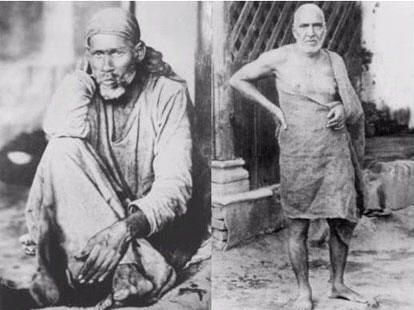
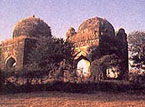
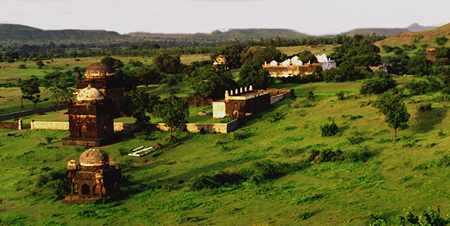
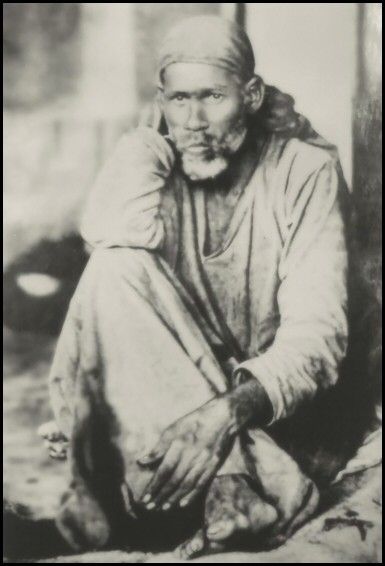
.jpg)
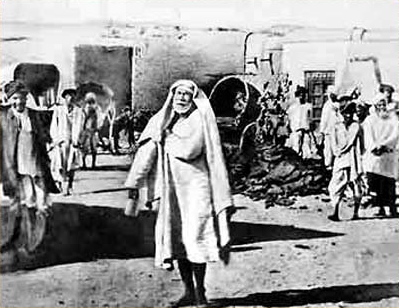
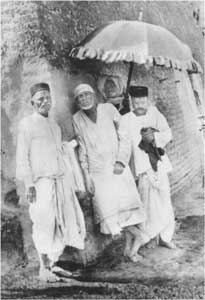
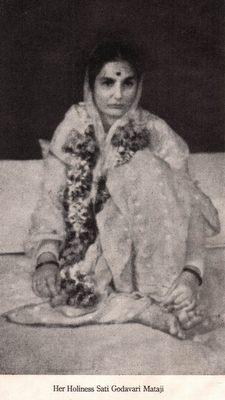
.jpg)