 Ken Wilber |
The American writer Ken Wilber became celebrated as the advocate of integral spirituality. He is also the focus of a controversy, starting within the ranks of disenchanted admirers and other critics. The varied ingredients of this dispute, encompassing metaphysical and psychological matters, are here covered in a philosophical overview, referring to the diverse writings of Wilber and his critics.
CONTENTS KEY
1. Frank Visser and the AQAL Schema
2. The Early Wilber Creative Phase
3. Up From Eden Theory
4. The Perennial Philosophy and Integral Post-Metaphysics
5. Adi Da Samraj
6. Kosmos, Ramana Maharshi, Plotinus and the Gnostics
7. Quadrant Theory, Andrew Cohen, and Stanislav Grof
8. Claim to Nondual Experience
9. The Beck-Wilber Alliance
10. Boomers, Green Meme, and Suppression
11. Integral Psychology at Issue
12. Missing History of the Great Chain
13. The “Everything” Model Disputed
14. The Postmodernism Problem
15. Integral Spirituality
16. Frank Visser in Transition
Annotations
1. Frank Visser and the AQAL Schema
The "integral" philosophy of Ken Wilber extends into metaphysics, evolutionism, and psychology. Commencing in the late 1970s, the output of this American writer became celebrated in the "alternative" sector, reaching a peak during the 1990s. Gaining a strong American readership, Wilber also achieved support in Europe. His major commentator was Dutch. However, that same commentator (Frank Visser) was one of those admirers who subsequently expressed criticism of Wilber. The critical complement is now substantial, prompting due investigation as to the reason for this revaluation. (1)
 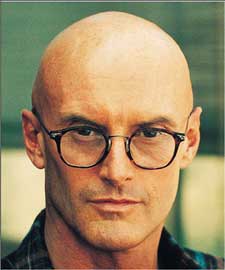 l to r: Frank Visser, Ken Wilber |
The commentarial book by Frank Visser was published by an American University Press in 2003. Ken Wilber had not formerly achieved such profile. Visser was described on the cover as “an internet specialist who studied the psychology of religion at the Catholic University of Nijmegen, The Netherlands.” Wilber himself described the Visser commentary as "an invaluable contribution to the ongoing integral dialogue." (2) That commentary was subsequently published in several other languages.
The word intregral had by then become a primary cue in the Wilber lexicon. Ken Wilber defined this word as meaning "comprehensive, inclusive, nonmarginalizing, embracing." (3) He became celebrated as an integral thinker and psychologist. An emergent criticism emphasised that Wilber theory claims too much in terms of comprehensiveness, attempting to define "Everything" with premature yardsticks.
In the same foreword (dated 2002) to the Visser commentary, Wilber affirms that "the first major statement of my own integral view" was his book entitled Sex, Ecology, Spirituality (1995), abbreviation SES. This was by far his longest work; he defined all his earlier books as "preliminary explorations in integral studies." Wilber observes that his version of integralism is sometimes called AQAL, an abbreviation for "all quadrants, all levels, all lines, all states, all types." This type of blanket formulation has met with resistance from sceptics. Wilber integralism more or less claims all reference points.
Soon after his longest book appeared, Wilber adapted the contents to provide “a popular or more accessible version.” This was published as A Brief History of Everything (1996), with some additional data. The title sounded presumptuous to some readers. However, Wilber fans were content with the ascription of a very big denominator.
In the 2002 foreword abovecited, Ken Wilber described how he had not written or published much for almost a decade prior to Sex, Ecology, Spirituality. His two main phases of author output were 1977-1984 and 1995-2000, with subsequent additions like his novel Boomeritis (2002). Frank Visser was able to comment on nineteen books by Wilber, translated into more than twenty languages. This is testimony to the influence exerted by the American writer.
2. The Early Wilber Creative Phase
The early books of Ken Wilber were located within the 1970s American counterculture, developing in the late 1960s. He expressed a commendable resistance to drugs. However, some other features of that era were strong influences in his output. The tendency to enthuse about Eastern religions had a Buddhist slant in his case, more especially in the direction of Zen and Vajrayana. A Vedantic term appeared in his third title, namely The Atman Project (1980). Any element of Hinduism was here modified extensively by the "transpersonal" context applied to human development. The sub-title of that popular book was A Transpersonal View of Human Development.
Wilber here attempted to chart various stages of development, starting with babyhood and ending with a spiritual enlightenment associated with Buddhahood. Eastern mysticism was combined with Western psychology, including Freudian psychoanalysis, Jungian theory, and the exegesis of Piaget. The basic idea of Wilber was that, by adding the "transpersonal" stages to the "lower and middle" stages, he was arriving at a balanced and comprehensive model described as the "spectrum of consciousness." Various objections have been lodged against this schema. A number of the components are regarded as incompatible by critics.
However, Ken Wilber did make a strong distinction between "prepersonal" and transpersonal states of consciousness, maintaining that psychological regressions are frequently confused with mystical achievement. Wilber became noted for his sceptical standpoint that diverse New Age trends amounted to a "pre/trans" confusion or fallacy, meaning that proclaimed mysticism in those directions was really equivalent to the "prepersonal" infantile stage. Despite his emerging popularity as a writer, this critical aspect of his output was less welcome in some quarters, especially in view of his reserve about Carl Gustav Jung.
Wilber was also keen to criticise the Freudian reduction of mysticism to the prepersonal domain. Such reflections are associated with his Eye to Eye (1983), a collection of essays and part of the phase he eventually described as "Wilber-3" (a reference to the sequence of stages in his thinking which he charted much later).
The Human Potential Movement had claimed many unsuspecting victims, especially in the sector dominated by the Esalen Institute, where Stanislav Grof gained the titular role of Scholar-in-Residence from 1973. Grof's sense of scholarship has come under strong query, being employed for suspect purposes of promoting his unconventional alternative therapies, namely LSD therapy and Holotropic Breathwork (HB). (4) The lastmentioned was a "workshop" enterprise selling for extortionate sums as a trademark therapy of Grof Transpersonal Training Inc. Grof also promoted the allied theme of transpersonalism. Together with the two founders of Esalen, Grof established the International Transpersonal Association.
Ken Wilber was heir to Grof in certain conceptual respects, adopting the word transpersonal. However, he later made a point of stressing some differences. Also, and to his credit, Wilber did step away from giving "workshops" and lectures at an early stage in his career, preferring to concentrate upon writing. (5) The new age landscape of the 1970s was littered with diverse commercial "workshops," resulting from an undiscerning enthusiasm for "personal growth." The "workshop" scene has continued to cause many confusions to this day.
Wilber's second book gives clear indication of "workshop" associations. Entitled No Boundary (1979), this popular paperback advocated a fusion of "Eastern and Western approaches to personal growth," to quote the sub-title. Included were many suggestions about the use of Eastern meditative practices and Western psychotherapies. This avowedly "hands on" approach did not always benefit subscribers to such adventures as Gestalt therapy and Chogyam Trungpa "crazy wisdom." Complete abstinence is often necessary in the interests of health.
The Esalen and related milieux featured a large number of professed spiritual teachers, esoteric adepts, and meditation masters, together with a multitude of diverse therapists. As the years passed, these ranks were frequently observed to make mistakes, sometimes fatal. The supposedly egoless teachers and "masters" could transpire to be disastrous testimonies to self-presumption and other forms of inflation.
A few years later, Wilber was expressing the leitmotif of a "transcendental sociology," a phrase appearing in the sub-title of A Sociable God (1983). That contentious phrase related to the sociology of religion. The book concerned was a compact work described by Frank Visser as a monograph. Another analyst wrote: "The general style of the book is more analytical than Wilber's earlier works, and primarily relates to the theme of the new religious movements in America which have become debated amongst official sociologists." (6)
The subject known as "perennial philosophy" became strongly associated with Ken Wilber's version of contemporary transpersonalism. Did these two really match? The impression conveyed by supporters was that Wilber understood all aspects of the perennial.
An unusual feature of the transpersonalist appetite, in A Sociable God, was Wilber's discussion of Jurgen Habermas, whom the same writer described in another book as "the greatest living philosopher." However, Wilber was in obvious regret that the output of Habermas lacked a spiritual dimension. (7) Very disconcerting is the accompanying lavish praise of Da Free John (Adi Da Samraj), the antinomian American guru soon afterwards revealed to be an abuser of devotees.
Two years after A Sociable God was published, Californian newspapers gave due coverage to the five million dollar lawsuit brought against the Bubba [Da Free John] by a female devotee who alleged serious abuse arising from the sensual strategies of ‘the master’ Da. (8)
Supporting testimonies were also in evidence. The reckless nature of Wilber's transpersonal enthusiasm was noted by careful observers. See also Wilber and Adi Da.
3. Up From Eden Theory
Perhaps the most distinctive early work of Ken Wilber is Up from Eden (1981). This bears the sub-title of A Transpersonal View of Human Evolution. A sense of affinity with Hegel is discernible. Wilber has extensively employed the word Spirit, which is one of the translations for Geist, the allusive German term favoured by Hegel.
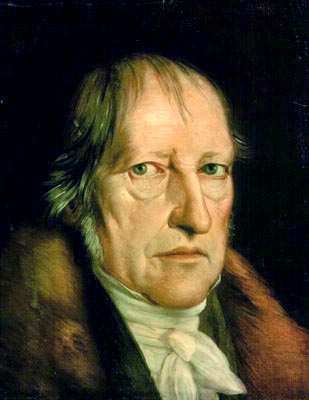 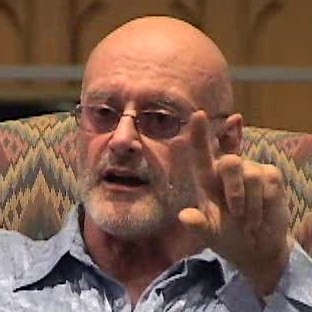 l to r: Georg W. F. Hegel, Ken Wilber |
One may ponder the scenario of Ken Wilber as the transpersonal successor to Hegel. Wilber's version of evolution is actually rather different in context to that of Georg W. F. Hegel (1770-1831), whose academic audience in Germany, nearly two centuries earlier, was markedly different to 1980s American transpersonalism. There are, however, certain resemblances in the theory of a cultural evolution. This was a theory strongly appealing to the German Enlightenment. The cultural evolution concept is more problematic for the American sector.
Wilber elaborates a theme of humanity coming up from Eden, rather than falling from Eden. The associations are rather theological in the Judaeo-Christian sense. The full implications of this theory would mean, e.g., that the American psychedelic "Me" decade (the 1960s) culturally supplanted the civilisations of both Islam and Buddhism. Wilber markedly favours Buddhism in his version of perennial philosophy, which he describes as the Great Chain of Being. This theme is pronouncedly abbreviated in the pages of Wilber, whose generalisations award priority to a "nondualist" interpretation associated with the American neo-advaita of Adi Da Samraj. Shankara is more elusive.
The present writer has contested the neo-Hegelian dimensions of Wilber evolutionism in Up From Eden. To quote some extracts:
Wilber managed to elevate his two major contemplative interests (Vajrayana and Zen) to a unique evolutionary status. American Buddhism thus gained transpersonal qualifications which tended to glorify the roles of Chogyam Trungpa and Alan Watts.... One of Ken Wilber's leading supporters... deems Wilber to have integrated the evolutionary theories of Teilhard de Chardin, Jean Gebser, and Shri Aurobindo in his thesis that an altogether new category of spiritual consciousness emerged amongst humanity from about the sixth century A. D. onwards. This new category of consciousness is associated with the Zen founder Bodhidharma and the Indian Vajrayanist Padmasambhava, who figures strongly in one Tibetan tradition of Vajrayana (or Tantric) Buddhism.
All former mystical or religious traditions (not to mention philosophical ones) are here construed to have been inferior levels of evolution, including Indian sages like Gautama Buddha.... The anthropographic view may be expressed in terms of the hope that Gautama Buddha was more enlightened than Western Bubbas like Da Free John, who is celebrated in Up From Eden on equal par with Ramana Maharshi, one of the more compelling Hindu sages of the twentieth century. (9)
Wilber's evolutionism has met with scepticism outside fan ranks. The legendary dimensions of Bodhidharma and Padmasambhava are extensive. Historians of these subjects have contributed far more sober views about the obscure nature of events.
The evolutionist theory of Wilber exhibits a strong affinity with the formulations of Jean Gebser (1905-1973). “In Gebser’s (and Wilber’s) opinion four simple words – archaic, magical, mythical, and mental - enable us to describe the whole of the complex history of the consciousness of humankind." (10) This rather insidious form of reductionism may be strongly contested. Wilber coined such exotic phrases as magical-typhonic, while relegating the "archaic" and "mythical" strata.
In Up From Eden, Wilber attempts to chart the history of humankind. However, he does this from an ideocentric standpoint relying upon contemporary transpersonalism rather than archaeology. He is preoccupied with concepts of a spiritual development, in a context signified by the phrase: "In the future we will experience collectively what in the past was only experienced by a select few." (11)
Collective transformation is a new age theme. However, the Wilber version does not totally converge with theories conceived and promoted by the holistic movement. Frank Visser concludes:
If we fail to place sufficient emphasis upon the value of rational thought, Wilber warns that we may be in for a Dark Age, in which archaic regression, magical thinking, and mythical religion are mistaken for mystical spirituality. (12)
Rational thought will eschew transpersonal jargon and ideation, which has strongly contributed to the current Dark Age of alternative thought so evident at venues like Esalen and the Findhorn Foundation. The commercial workshop game is a distraction, whatever the alluring "transpersonal" or "holistic" phraseology employed to describe that activity. In maintaining the underlying validity of alternative therapy, Wilber has provided fuel for the Dark Age.
4. The Perennial Philosophy and Integral Post-Metaphysics
A salient ingredient of Ken Wilber’s worldview has been the “perennial philosophy.” Diversely presented by various exponents, this subject requires to be more flexible than is too often the case. That is because the study materials involved are extensive; the complexities and ambiguities are far greater than is commonly believed. What generally occurs is a very simplistic form of commentary.
The theme of perenniality was an ingredient of Wilber's first book entitled The Spectrum of Consciousness (1977), composed in 1973 when the author was only twenty-four years old. This debut introduced the "spectrum model," associated with the Great Chain of Being, a phrase favoured by Wilber in relation to the perennial philosophy. The new model was encumbered by the belief that Eastern spirituality and Western psychotherapy could be fused to advantage. This belief had some affinities with Esalen. The spectrum model was to become another prop for the commercial workshop industry, despite Wilber's subsequent avoidance of the predatory circuit.
When the Ken Wilber debut volume achieved publication, the contents were welcomed rapturously by the transpersonalists. The author quickly became famous, gaining effusive reviewers. Indeed, Wilber became celebrated by his admirers as the "Einstein of consciousness research." (13) More recently, that encomium has received disapproving treatment by one of the more committed opponents. (14) For my own part, I attempted to give the early works of Wilber a fair but critical assessment, not undermining the basic premises of a perennialism, though strongly resisting the doctrines of transpersonalism. (15)
The current position of Ken Wilber is that of a "post-metaphysical" exegesis, one purportedly superseding the "perennial philosophy," which he identifies with traditional channels of religion (section 15 below). There are different methods of assessing the history of religion.
Wilber formerly described himself as a neo-perennialist, an identity setting him apart from the interpretation associated with Coomaraswamy, Schuon, and others. His worldview notably assimilated the terminology of Mahayana Buddhism. However, he has disowned a doctrinaire Buddhist standpoint. Instead, he prefers classification as an integralist.
The over-inclusive nature of the content has been considered a major drawback to integral formulations. For instance, Ken Wilber's partiality for teachings of the late Da Free John, alias Adi Da Samraj, posed acute ideological and moral problems for his neo-perennialist theory. This is partly because of the strong antinomian reputation adhering to the American "crazy wisdom" advocate.
5. Adi Da Samraj
Ken Wilber's insidious promotion of Adi Da Samraj (Da Free John) was one of the factors causing former admirers to query his line of reasoning. Frank Visser writes: "Wilber sees Sri Aurobindo, Hegel, Adi Da, Schelling, Teilhard de Chardin, and Radhakrishnan as all belonging to this neo-perennial school." (16) The other entities mentioned here might have felt morally outraged at being considered on a par to the American hedonist.
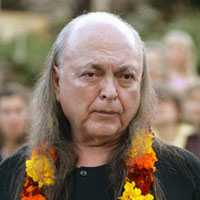 Adi Da Samraj |
Adi Da Samraj (1939-2008) was born Franklin Jones in New York. Gaining a bizarre reputation, he cultivated a habit of making sexual advances to his female devotees, to the extent of inviting a strong lawsuit and creating a faction of dissident ex-devotees. Other serious drawbacks are also on record. Adi Da Samraj became notorious in California during the 1980s, retreating to his island sanctuary at Fiji. A Californian lawyer is reported to have handled three private settlements (involving payments and confidentiality agreements) relating to the lawsuits and threatened suits of that period.
His organisation became known as Adidam. Criticism of this guru has been strong. A relatively mild version is Adi Da and his Personality Cult, which informs: "An avid drug-user over many years, in the last decade or more he was evidently often using Viagra - a known danger to cardiac health - to fuel his chronic sex addiction." Adi Da died of a heart attack.
The ex-devotee website Adi Da Archives (no longer online) reported that Adi Da Samraj:
claimed to be the First, Last, and Only perfectly enlightened Spiritual Adept that had ever appeared on Earth or will ever appear in the future. He said that his own spiritual stature was superior to that of Jesus, Buddha, or any of the great spiritual figures from human history.... Adi Da's ability to present traditional Eastern spiritual teachings in a way that made them seem likely they were the product of his own spiritual realisation, rather than mere beliefs he held, was what initially attracted many of those who became his devotees....
Adi Da was considered a controversial figure due to persistent accusations that he was having sex with large numbers of devotees, drinking obsessively, abusing drugs, engaging in incidents of violence against women, and financially exploiting his followers. He rationalised all of this as his way of teaching people, claiming his behaviour was selfless service.... The inner circle was perhaps the most critical piece of infrastructure Adi Da developed to enable his decades-long pursuit of every kind of fulfilment for himself at the expense of others....
In 1985, tensions in Adi Da's life escalated when a number of ex-devotees requested an audience with Adi Da to air grievances, and he refused to communicate with them. As a result, various lawsuits were filed by and against Adi Da, his organisation, and former members. A great deal of international media attention followed. As a by-product of the media attention, many aspects of Adi Da's life that had previously been hidden from devotees who were not inner circle members, and were unknown to the general public, became exposed. In a practice that continues to this day, Adidam [his organisation] attempted to deny allegations about Adi Da by ex-members....
As the years passed, Adi Da's inflated opinion of himself evolved into a form of delusional self-worship that reeked of outright madness.... His progressive absorption into delusions of grandeur was facilitated by a cultic group of sycophants who reinforced all of his illusions." (Extracts from the Obituary and Insider commentary)
Ken Wilber did acknowledge some of the defects in the capricious Adi Da Samraj. He nevertheless retained an evident admiration for the supposed spiritual state of that guru, also the teachings of Adi Da. See Ken Wilber and Adi Da Samraj.
Adi Da Samraj was a follower of Swami Muktananda (1908-1982), the controversial Siddha Yoga guru who gained a repute for sexual license and financial manipulations. The American yogi favoured wild parties, together with strong alcohol and drugs; he was very partial to coarse language. His published teachings were deceptive, not generally conveying any idea of his personal habits. Much of his teaching was apparently delivered while he was drunk. Adi Da is also described as using drugs to excess, including cannabis, peyote, psilocybin, nitrous oxide, and amyl nitrate. Some accounts of his behaviour are very disturbing. He is reported to have transmitted a sexual disease (herpes) to a significant number of women, while claiming that this infection was for the spiritual benefit of victims.
This antinomian entity liked to assume various exotic names. Moreover, he declared himself to have achieved the highest spiritual prerogative (that of an avatar or divine incarnation). His full self-proclaimed title was Ruchira Avatar Adi Da Samraj. He is depicted by admirers as an unsurpassed Yogi and unique spiritual authority. Critics refer to him as a neo-advaita casualty and a contemporary American Tantric of licentious tendencies.
Disillusioned devotees found that Tantric "crazy wisdom" could mean appropriating another man's wife. Integralist Ken Wilber tended to elevate the presumed spiritual attainment of Adi Da Samraj as an evolutionary objective. Journalist John Horgan relates of his interview with the integralist: "Although he now sees Da Free John [Adi Da] as a deeply flawed individual, Wilber still thinks the guru is a brilliant mystical philosopher." (17)
At a slightly earlier date, Wilber had composed two well known statements about Adi Da Samraj. In a web item of 1996, he sounded a note of caution about the hideout in Fiji, acknowledging this as an extremist recourse. Nevertheless, he again expressed praise for the books of Adi Da. In 1998, Wilber strongly confirmed his rather confusing assessment of Adi Da, in terms of being "one of the greatest spiritual Realisers of all time," while conceding that aspects of personality lagged far behind.
The books of Adi Da Samraj elevate his eccentric form of "non-dualism," presented as being greatly superior to more conventional religious approaches, and also to mystical traditions which the author evidently feared as rivals. Wilber was one of those who fell completely for this deceptive approach, which has similarities to the "crazy wisdom" of Chogyam Trungpa (d.1987), another favourite in the Wilber canon denoting reckless integralism. The drawbacks demonstrated by Trungpa included alcoholism and resort to drugs.
Misconceptions about spiritual achievement are deep-rooted in various countries. Administering due education has only a remote chance of success. The so-called "enlightenment" of late 1960s America facilitated a commercial labyrinth of presumptive organisations, gurumania, therapy cults, and "workshop" extravaganzas. These drawbacks have seduced much affluent attention. So-called spiritual teachings are too often like dime novels; they are fluently composed to attract superficial attention. Viable philosophy is something completely different.
Early influences on Ken Wilber are known to have included Zen, Gestalt therapy, Transcendental Meditation (TM), and Vedanta. (18) Gestalt therapy caused endless confusions in American neo-hippy society, gaining dubious permutations such as Neo-Reichian Gestalt, which acquired a hedonistic repute. Wilber later turned to Vajrayana Buddhism instead of TM. His elevation of Chogyam Trungpa has evoked similar criticisms to those applying in his regard for Adi Da. (19)
6. Kosmos, Ramana Maharshi, Plotinus and the Gnostics
The longest book of Ken Wilber was advertised as the first volume in the Kosmos trilogy. The word Kosmos was intended to depict the traditional spiritual understanding of the universe, which Wilber claimed to adapt for a new paradigm. The Kosmos volume was entitled Sex, Ecology, Spirituality (known as SES), being published in 1995. This book commenced the "Wilber-4" phase of the author's intellectual development, as specified by him. SES basically pursued a neo-Daist version of "nondualist" spiritual evolution, with some AQAL flourishes.
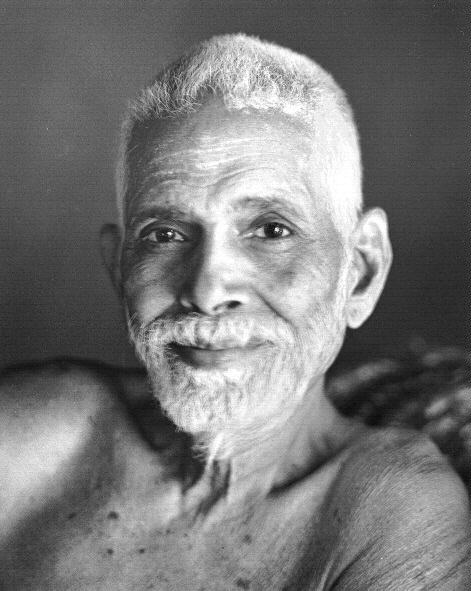 Ramana Maharshi |
The Hindu sage Ramana Maharshi (1879-1950) was elevated by Wilber as a spiritual ideal over and above two well known Christian entities (Teresa of Avila and Meister Eckhart). Ramana is one of the more impressive Hindu gurus of recent times, an austere figure who exposited vichara, a method of self-inquiry closely related to Advaita Vedanta. However, there is no purist Advaita (non-dualism) in the exposition of Wilber; instead, there is a glaring anomaly signified by the strident dismissal of ascetic "repression" occurring in the same book. The ascetic celibate Ramana Maharshi (shadowed by Paul Brunton) was discrepantly favoured by Adi Da Samraj, becoming the symbol of a nondualism grossly misunderstood in America by opportunism and transpersonalism. Neo-advaita is not the same as the putative original.
The Kosmos volume attempted to integrate Plato and Plotinus in terms of a "this-worldliness," a theme clearly intended to support the nondualism thesis. Wilber relied heavily upon the outdated version of Dean Inge for his portrayal of Plotinus, who is here presented as being well in advance of the "Ascender" Gnostics, a category furthermore depreciated as ascetic extremists.
The extending lore of ascenders versus descenders is rather emphatically profiled in a metahistory arousing scepticism. Plotinus is associated by Wilber with neo-Daist themes encompassing Eastern mysticism. There are strong disadvantages for this exegesis when the antique texts are closely analysed. For instance, Gnosticism was a rather more variegated phenomenon than contemporary integralist Kosmos theory has recognised.
The outset of Wilber's second creative phase was attended by significant frictions. Sex, Ecology, Spirituality contained polemical passages and notes which offended some of his readers. Ken Wilber now tended to be strongly critical of rivals, and not merely the "flatland" of orthodox science. However, critical annotations are not a crime. Wilber subsequently defended himself on this point, making some valid comments to the effect that polemical discourse is not necessarily unspiritual. (20) His diverse criticisms included some pertaining to the conceptualism of Stanislav Grof. These adverse reflections were marginal by comparison with certain other criticisms of Grof theory, also dating to the 1990s, being considered a relevant contrast. (21)
Resort to nonjudgmentalism can be a very cowardly option, even though this is today a common political and academic convenience. That resort is explicitly favoured by some of the worst trends in “new age” commerce. Wilber stood out in some respects from the insipid slumber of the Esalen prototype. Nevertheless, his philosophical position is considered precarious by a fair number of critics. Of course, any ventured judgment must strive to be accurate; this does not always happen by any means.
In his longest work (SES), Wilber delivered a pointed thrust at religious traditions that he assumed to be repressively ascetic. The crime list here includes the Gnostics, Theravada Buddhism, Manichaeism, Christianity, and a type of Advaita Vedanta. (22) Wilber is quite explicit in his denunciation of the rejected traditions, which are described as being "shot through with Phobos, with ascetic repression, with a denial and a fear and a hatred of everything 'this-worldly,' a denial of vital life, of sexuality, of sensuality, of nature, of body (and always of woman)" (Sex, Ecology, Spirituality, p. 340).
This particular bias confirmed suspicions that Ken Wilber neo-perennialism strongly converged with the "American new age" retreat from traditional discipline. Monastic formats were not popular in America. Mahayana Buddhism underwent strange adventures in that country when the vinaya (monastic code) was neglected. At the time of writing his attack on "asceticism," Wilber was a twice married man, his first marriage having occurred in 1972 when he was in his early twenties. The historical "perennial philosophy" had a rather strong ingredient of celibacy. The aspersions of Wilber, in that direction, imply an affinity with late twentieth century transpersonalism.
Although Wilber does not say so, even his beloved Zen was rigorously monastic in the countries of origin (China and Japan). In Wilber neo-perennialism, there is no historical (or semantic) analysis of the texts, the monastic discipline, the cultural characteristics, the biographies of monks, and so forth. There is instead a reliance upon spectrum theory, transpersonal sociology, psychotherapy, cultural evolution theory, and the elaborate integralist phraseology of the Great Chain of Being, which merely sounds poetic to historians and social scientists.
The neo-perennialist viewed Plotinus with favour, attempting to divest him of ascetic characteristics. However, Plotinus (204/5-270 CE) has been described in terms of moderate asceticism by specialist scholarship. His treatise Against the Gnostics affirms his version of Platonism as being quite superior to Gnostic doctrine, which he is said to have associated strongly with Christianity. Gnostic groups were diverse, spread over a wide geographical area, and included women. Plotinus mentions that some of his pupils had previously been adherents of Gnosticism, and were still partial to the teachings of that movement. Plotinus and his disciple Porphyry took exception to the Gnostic demotion of Plato, also to sectarian books describing Gnostic doctrines in relation to various "revelatory" figures.
Wilber moved to an extreme in his depiction of the conflict between Plotinus and the Gnostics. That conflict reflects a complex ideological situation in third century Rome. Plotinus definitely did criticise the Gnostics in his Enneads. However, his reasons for doing so were not those emphasised by Wilber, who tends very much to suppose that the Gnostics were under fire because they were too ascetic and world-renouncing. The actual charges made by Plotinus against his rivals amount to something else entirely. Contrary to the Wilber format, Plotinus realistically emerges as the austere disciplinarian; he accused the Gnostics of being lax in conduct and harbouring tendencies to magic and superstition.
Because of such misunderstandings and distortions in transpersonalism, alias integralism, it is not advisable to support the reductionism achieved by the Wilber theme "Up from Eden." Various ancient events have to be probed with more care, in the light of relevant antique European and Asiatic sources rather than the canons of contemporary integralism.
The following is an extract from a contrasting commentary on Plotinus:
Employing a transpersonal doctrine about Brahman, Wilber presents Plotinus as a sort of proto-Mahayanist who was quite at home in this-worldliness and who castigated Gnostics for their asceticism.... Wilber sees the Gnostics as rabid ascetic Ascenders and is evidently eager to promote the catchphrase of 'the way up is the way down' (the title of the relevant chapter), evidently not realising that this was one of the Gnostic themes attested in the Nag Hammadi documents. Wilber is some eighteen centuries behind the Gnostics, who were expressing his borrowed theme in a more authentic manner.
A point to grasp is that the ascetic Plotinus would not have been very amenable to Wilber’s emphases, and nor those of his [American] colleagues. The critique which Plotinus aimed at the Gnostics (or a section of them) was far more intricate than transpersonalism has cognised. A problem was that ascetic discipline and self-purification were not duly upheld by many Gnostics, a disability which that contingent had in common with Daists [the Adi Da faction].... Plotinus strongly disapproved of their resort to pleasures of the body, which he deemed incompatible with the characteristics of a spiritual nature.... he would have considered transpersonal doctrines to be anathema to the true spirit of Platonism. One of his underlying and basic accusations was that the vaunted Gnostic prerogative of his rivals led to excuses for immoral conduct. (23)
There were rigorously ascetic Gnostics and austerely celibate NeoPlatonists, plus some factors in common. Other types of Gnostic also existed. Such matters are lost to view in the “Up from Eden” milieu creating “integral” confusion. The various Gnostic sects ranged from the Carpocrateans to the Valentinians. Plotinus does not specify any sectarian identities. In a place like Rome, many Gnostic affiliates are unlikely to have been ascetics, but merely followers of doctrines and "secret teachings."
Plotinus was not attacking Gnostics for asceticism, but for what he considered to be an inferior doctrine. He disliked the claim to gnosis (spiritual knowledge), instead advocating the gradual method of Platonist enquiry. He objected to the caricature of the material world as evil, as a prison of the soul, though an aspect of Plato's teaching is not totally removed from that perspective. Plotinus insinuated that the Gnostics were elevating mere jargon, being arrogant in their refusal to acknowledge the created gods. This particular argument of his is less convincing to modern analysts than to the classical world of his day. More convincingly, he opposed the Gnostic claim to control higher powers by magic or theurgy, and to cure diseases by casting out demons.
Some scholars have urged that Plotinus was confronting the Gnostic sect now known as Sethians, which is also the Gnostic identity proposed for some texts of the Nag Hammadi library discovered in 1945. More well known categories of Gnostic are the Carpocrateans and Valentinians, named after Carpocrates and Valentinus, both dating to the second century CE. The Carpocratean sect gained an antinomian repute via the critical works of Irenaeus (of Lyons) and Clement (of Alexandria). However, Carpocrates is a very obscure figure. His son Epiphanes was identified by Clement as the founder of the movement.
Clement, writing in the early third century, attributes to Epiphanes a doctrine of communal possession of property and women, an emphasis leading to licentious assemblies. Valentinus is slightly better known; his school has a more philosophical association. Many Valentinians appear to have pursued normal vocations, marrying and raising children like other Christians. The basic difference was that they rejected ecclesiastical authority, believing in equality and direct experience via gnosis.
In his Adversus Haereses, the second century Christian ecclesiastic Irenaeus accused Gnostics of depravity. However, modern scholars have ascertained that none of the Gnostic texts from Nag Hammadi contain any incitement to immoral behaviour. An obvious factor against Bishop Irenaeus is that he disapproved of the many women attracted to Gnostic groups. The ecclesisastical rules were severe about women, who were not permitted to teach or baptise, amongst other prohibitions. The Gnostic teacher Marcus gained numerous female followers in the Rhone valley. This nonconformist was depicted by Irenaeus as a seducing magician.
Some remarks of Plotinus are thought to indicate a Neoplatonist version of the ecclesiastical logic. Textual indications of anomaly include the late Gnostic work Pistis Sophia, which denounces the inverted festive meals (of semen and menstrual blood) associated with the Phibionite extremists of Egypt. Disputes about conduct appear to have developed within Gnostic circles of the third and fourth centuries. So Plotinus could easily have been correct in his insinuation about deficiencies, bearing in mind that the actual scale of these occurrences is very obscure.
An increasing assimilation of pagan practices may have led to the conceptual and behavioural deteriorations. Two generations after Plotinus, the Christian heresiographer Epiphanius encountered a Gnostic sect in Egypt which rejected asceticism to a pronounced degree. In his Panarion, Epiphanius reports how the women in that sect attempted to seduce him. That author further describes a collective copulatory ritual and attendant practices which offended him. This encounter occurred circa 335 CE. The report has been considered relevant, but nevertheless prone to exaggerations. One of the names applied by Epiphanius to these extremists is Phibionites.
A relevant factor in these studies is the inclusion of women in Gnostic ranks. "The percentage of women was evidently very high and reveals that Gnosis held out prospects otherwise barred to them, especially in the official church" (Kurt Rudolph, Gnosis, p. 211). Women are known to have frequently gained positions as Gnostic teachers, prophetesses, priestesses, and missionaries. They were able to take a leading role in the Gnostic version of Christian ceremonies like baptism and eucharist. The extension in exorcism was a feature more likely to encourage superstition. A century before Plotinus appeared in Rome, the female Gnostic teacher Marcellina travelled to that capital, at circa 150 CE, to proselytise for the Carpocratean sect (a grouping who claimed to receive secret teaching from three celebrated women, namely Mary, Salome, and Martha).
The "integral" tactic of castigating such circles as extremist agents of ascetic repression is unconvincing. It is, moreover, obvious that Plotinus was probably more of an ascetic than many of his rivals. In his biography of Plotinus, the disciple Porphyry commenced with the observation that his teacher "seemed ashamed of being in the body; so deeply rooted was this feeling that he could never be induced to tell of his ancestry, his parentage, or his birthplace" (The Enneads, MacKenna trans., ed. John Dillon, p. cii).
There are not many modern Europeans or Americans who would obliterate their date of birth (as did Plotinus). In basic respects, the ascetic spirit of both the Neoplatonist and Gnostic traditions is a total mystery to the new age, whether declaredly integralist or no.
7. Quadrant Theory, Andrew Cohen, and Stanislav Grof
In the late 1990s, books of Ken Wilber exhibited an increasingly complex terminology. He became controversial for referring numerous matters to his formulation of Four Quadrants of consciousness, a theme innovated via his longest book (SES). This device is purported to encompass both individual and collective consciousness, with divisions into intentional, behavioural, social, and cultural.
With all this industry in conceptualism, readers could easily anticipate a dramatic surge forward in clarity. Precisely what social and cultural standards were being set? The crazy wisdom of Adi Da Samraj and Chogyam Trungpa continued to be in favour with Wilber, permitting conclusions of a massive discrepancy. Even some critics were surprised when the integralist exemplar commenced to liaise with an increasingly influential American neo-Advaita guru (and "crazy wisdom" enthusiast), namely Andrew Cohen. Wilber was installed as a permanent collaborative feature in the glossy pages of What is Enlightenment? That publication was Cohen's own magazine. The celebrated duo conversed in profile terms of the guru and pundit, Cohen being the guru and Wilber the pundit.
 The guru and the pundit |
Critics said that Wilber was now supporting the extremist camp more than ever before. Cohen had gained fame and donations as an enlightened being, despite a book by his mother Luna Tarlo denying his claim. (24) A growing number of his ex-devotees were in reaction to disparities of conduct. Some resorted to their own website (called What Enlightenment?) for the purpose of communicating anomalies. See also Rude Boy Andrew Cohen. Cohen denied the accusations, saying these lacked due context. Ken Wilber was impervious to discrepancies, evidently enjoying the limelight in his pundit role. Subsequently, the magazine What is Enlightenment? ended when Cohen lost his ascendancy, his guru role being denounced by so many former supporters.
In 2013, Andrew Cohen withdrew from the scene when his organisation EnlightenNext collapsed, an event accompanied by strong accusations of abuse. See How I Created a Cult. His own statement (dated 2016) informs: "My fall from grace has shaken me to the core." Not enough, however, to prevent him from returning to a guru role. That same year, over two hundred of his former students signed an online petition entitled Stop Andrew Cohen teaching again. See also Integral Abuse.
The purportedly enlightened Cohen was interviewed by John Horgan in 1999. Cohen told Horgan that enlightenment does not solve the mystery of existence. Cohen also informed: "I live in a strange state, where the only thing that I'm sure of is that I don't know." Confusions about enlightenment are rife in new age America, to an extent that is breathtaking. Pseudo-Advaita is only one of the warning signs for those able to decode the spurious.
An ex-devotee of Cohen is William Yenner, who spent thirteen years as a prominent member of Cohen's Foxhollow community known as EnlightenNext. "He [Yenner] was left disillusioned and disappointed after a series of debilitating, abusive experiences. Following his departure [from EnlightenNext], and in order to secure the return of a large monetary donation that he had been pressured to give to Cohen, a gag order prevented his writing or speaking publicly about his experiences in Cohen's community." See American Guru. When the gag order terminated in 2008, Yenner wrote and edited a revealing book. See William Yenner et al, American Guru: A Story of Love, Betrayal and Healing - former students of Andrew Cohen speak out (2009). This was not the first critical book on Cohen; however, the narrative does comprise a milestone in documentation. An excerpt (available on the Yenner website) is reproduced here:
Face slapping and name-calling, while they were uncalled for and may have been damaging, were mild in comparison to other questionable manifestations of 'crazy wisdom' that occurred at Foxhollow. One such incident involved a student (Mikaela) who was responsible for the marketing of Andrew's publications and who had fallen out of favour by reminding him that something he had criticised her for doing had been his idea in the first place. He decried her as evil and ordered that the walls, floor and ceiling of her office (which had been relocated to an unfinished basement room) be painted red to signify the spilled blood of her guru. She was ordered to spend hours there contemplating the implications of her transgression, with the additional aid of a large cartoon on the wall depicting her as a vampire and the word 'traitor' written in large letters next to it.
Andrew often employed red paint in this fashion to create environments designed to induce shame and guilt in students that he felt had questioned his judgment or disobeyed him. Another female student who had displeased Andrew and, after leaving the community, had returned to help out on a weekend painting project, was summoned to another basement room. There she was met by four female students who, having guided her onto a plastic sheet on the floor, each poured a bucket of paint over her head as a 'message of gratitude' from Andrew. She left the property traumatised and fell ill in subsequent days (during which she was harassed by phone calls from another student who, at Cohen's instigation, repeatedly called her a 'coward') and never again returned to Foxhollow.
Despite the innovation of Quadrant theory, Wilber's coverage continued to lack historical analysis of the perennial philosophy, a theme amounting to metaphysical abstraction in his version. Instead of that necessity, he supplied an abridgment of his longest work in A Brief History of Everything (1996). The sequel was The Eye of Spirit (1997). Again, there was no historical analysis of religions and sects. Instead, the claim was made: “Modern day integral studies can do something about which the great traditions [perennial philosophy] rather badly failed: they can trace the spectrum of consciousness not just in its intentional but also its behavioural, social, and cultural manifestations.” (25) The glorification of Quadrant theory here eclipsed the under-researched "perennial philosophy," which remained a toy of what could be called the "Up from Eden" cultural evolution complex.
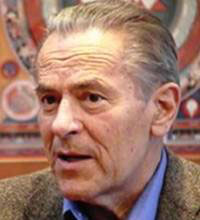 Stanislav Grof |
The same sequel volume presented "integral art and literary theory," while offering another modified criticism of Grof doctrine. Nevertheless, Wilber here described the Esalen hero in terms of "arguably the world's greatest living psychologist." There was also the disclosure: "Stan [Grof] and I are in substantial agreement about many of the central issues in human psychology, the spectrum of consciousness, and the realms of the human unconscious." (26)
Grof had made superficial references to the obscured perennial factor in his therapy books, and subsequently in The Cosmic Game (1998). That strategy of Grof served to promote a trademark enterprise, namely Holotropic Breathwork, which encouraged hallucination and trauma (and also, by association, a degree of drug experimentation). Wilber was not a holotropic enthusiast, as he made plain, and he had escaped LSD many years before. However, exegetical problems clearly persisted.
In this integral scenario, we find Wilber and Grof pioneering supposedly great psychological achievements in the transpersonal sphere. What does all this really amount to? The final chapter of The Eye of Spirit is markedly poetic, also totally remote from any research into the fabulated and diminished subject of perenniality so frequently claimed. The chapter is called Always Ready: The Brilliant Clarity of Ever-Present Awareness. Wilber there makes spectacular statements like the following:
Thus, as I right now rest in this simple, ever-present Witness, I am face to face with Spirit. I am with God today, and always, in this simple, ever-present, witnessing state. (27)
Some analysts describe these poetic assertions in terms of a reassurance factor. Quadrant theory is not convincing as a rationale for all the religious and sectarian manifestations, let alone the multiplicity of social and cultural intricacies in addition. The poetry was an accompaniment to "the guru and pundit" features in the commercial Cohen magazine, which, in the eyes of critics, failed to answer the key question posed as: What is Enlightenment?
Wilber's next book was entitled The Marriage of Sense and Soul (1998). This related to the integration or reconcilement of science and religion. Many other authors have also dilated upon that theme, which seems no nearer to any effective resolution.
8. Claim to Nondual Experience
The following year, a very different book appeared. A rather more radical offering than former works was One Taste: The Journals of Ken Wilber (1999). Wilber's diaries, here dating to 1997, include extensive reference to his mystical experiences. The phrase "one taste" refers to the non-dual experience claimed by Wilber, perhaps reminiscent of his inspirer Adi Da Samraj. Ken Wilber details his daily routine as a writer, which included meditation and weightlifting. He suggests that his meditations have enabled him to personally experience all the stages of spiritual development described in his spectrum model. The faithful Frank Visser stated: "In these passages Wilber acts as an authentic spiritual teacher." (28)
The claims made by Ken Wilber, in respect of spiritual experiences, are quite strong. "For Wilber, dreamless sleep, which is normally a period of unconsciousness, became a conscious experience." (29) The implication is that frequent spiritual experiences of the integralist had mastered the cycle of life and death. There are also contradictory statements such as "Who is not already Enlightened?" The sense of flippancy detracts from the claims.
The early Visser commentary refers very sympathetically to Wilber's books and experiences, and indeed, virtually from the perspective of a follower. There are only faint hints of any necessity for critique. Visser subsequently became a major critic of Wilber, after personally experiencing a backlash from the declared nondualist and "Wild West" blogger who caricatured his critics as outlaws. The taste had turned memorably sour.
Reactions to One Taste are varied. The options seem to be basically as follows:
1) The partisan view that the nondual experiences of Ken Wilber constitute advanced mysticism.
2) The critical view that those experiences represent rather more preliminary stages pertaining to the basically uncharted “perennial philosophy.” There are states of mental fixity and meditation which are quite different from the expansions associated with the “spiritual path.”
3) The more pronounced mood of denial that there is any value at all in such experiences, whether those of Wilber or other claimants to spirituality.
An emphasis of Wilber, receiving strong criticism, is that meditation can accelerate the level of personal development. The disputed emphasis was repeated in One Taste (p. 263), and also on a CD entitled Kosmic Consciousness. The excursion into audio is reminiscent of new age celebrity tactics. Ken Wilber has demonstrated an awareness that meditation can also exert negative effects, although he has been accused of providing "only a very few warnings of the potential hazards." Go to Meditation Research at If you meet Wilber on the road.
9. The Beck-Wilber Alliance
The year after One Taste saw the publication of Integral Psychology (2000), which gained enthusiastic reviews from supporters. More restrained comments are expressed by sceptics. This contested book starts with the theme of perennial philosophy, referring briefly to such entities as Coomaraswamy, Plotinus, and Aurobindo. However, the treatment soon develops into recent transpersonal vistas on the Great Nest of Being, with references to Piaget, Gebser, and others. There was still no in-depth analysis of any historical developments in religion over the many centuries demoted. Instead, Wilber presented the ideas of such very recent theorists as Don Beck.
Dr. Don Beck was a management consultant and co-author of Spiral Dynamics: Mastering Values, Leadership, and Change (1996), assisted by his former graduate student Christopher Cowan. Beck had been a colleague of Professor Clare Graves (1914-1986), an American psychologist who elaborated eight different value levels. The Gravesian "emergent cyclical levels of existence theory" appealed to management theorists. Beck utilised that theory, introducing the concept of "value memes." Beck also inaugurated Spiral Dynamics Integral (SDI), which has been dubbed "the Theory that Explains Everything." This tag is reminiscent of the Wilber project.
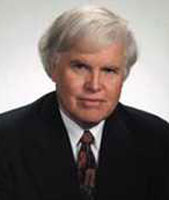  l to r: Don Beck, Ken Wilber |
In 1999, Beck engaged with Wilber, who began to promote meme theory. Subsequently, there were criticisms of high charges made for SDI workshops, part of the alternativist commercial trend. See Spiral Dynamics and the Ken Wilber Crisis. Cowan did not agree with the alliance, remaining independent of Wilber, thus gaining the repute of a critic (section 15 below).
The Beck-Cowan trend of exegesis was assimilated by Wilber with additional flourishes. This “meme” theory has aroused objections, positing eight stages of thought or value system, while allocating a colour identification to each one. The fifth is orange or scientific achievement. The sixth is the green meme, signifying “the sensitive self: communitarian, human bonding, ecological sensitivity, networking.” (30) The first six memes are denoted by the phrase “first-tier thinking.” Stages seven and eight are emphasised as being much more advanced, comprising second-tier thinking, the specified colours being yellow and turquoise, the lastmentioned meme comprising a “universal holistic system.” (31)
The word holistic can sound alarm bells. Some other recent alternative trends have extensively employed the same word. However, quite apart from the holistic conceptual jungle, meme theory is considered simplistic by critics. A major problem emerged with the yellow-turquoise zone. Many alternativists have imagined they inhabit this zone as holistic experts, and are therefore superior to all the other population sectors. More likely red for danger, say the sceptics. Depreciating references to "greens" became notorious, signifying confusions about holistic spirituality being transcendent of ecological sensitivity (however, Wilber criticises "green" in a more extensive value context). Some critics say that the best recourse is to be colourless, so one cannot be identified as inferior by those in more presumably elite holistic roles.
The Beck-Cowan theory imposes a very constricting tabulation for the first four memes. These are described in terms of archaic-instinctive, magical-animistic, egocentrism and power-gods, and conformist or absolutist-religious. All these designations are given a chronological context in the evolution of societies, overlapping with later retarded characteristics in the modern world. The unflattering assessment, of so much human life in the past, evidently derives from twentieth century American alternative conceptualism.
Wilber evidently found the constrictions of meme theory attractively convergent with his own hypothesis of "Up from Eden," which likewise marches forward (or upwards) to circa 1970 as the basic denominator for progress. Of course, that was the time when Ken Wilber and many others started to think in the influential Esalen mode of therapy, mysticism, development. The exponents are believed by supporters to have the upper hand over so much that went before. However, Wilber is noted for his critique of the narcissistic "baby boomers" associated with that supposedly progressive era (Boomeritis, 2002). Other problems have passed unrecognised.
The green meme is said to have started in nineteenth century America. The more innovative Wilber equates this concept with, e.g., ecology, postmodernism, humanistic psychology, Greenpeace, Foucault/Derrida, and human rights issues. In contrast, the "second-tier thinking" of memes 7 and 8 is ascribed to a smaller number of exemplars. Meme 7 is process-oriented or "systematic" (Beck) and "integrative" (Wilber), while meme 8 is synthesis-oriented or "holistic" (Beck). The Beck-Cowan theory (Spiral Dynamics) was claimed as successful in solving social and business problems. Critics maintain that a great deal of confusion has been generated in relation to history, religion, and psychology.
The Wilber critic Michel Bauwens referred to the alliance between Beck and Wilber as being against the explicit wishes of Cowan. Further, reference is here made to a disconcerting accusation that was one consequence of the alliance. "If you did not follow Wilber and Beck, you were immediately branded 'green' (backward if compared to 'yellow'), if worse, you were afflicted by the Mean Green Meme, but in any case, guilty of first-tier thinking" (Bauwens, The Cult of Ken Wilber, 2005, formerly online).
 Michel Bauwens |
Michel Bauwens is a Belgian commentator, sometimes described as an integralist. He was a fan of Wilber books for many years, eventually becoming a critic. He complains that "the encounter of Ken Wilber with Don Beck has been an unmitigated disaster." This verdict illustrates the informed discontent with both sides of the alliance. "Colour coding has become a Stalinist technique to silence critics, to make a debate on the merits of arguments impossible." Aversion to colour coding can be acute in view of such strictures. Bauwens also accuses Spiral Dynamics of operating as a business, being “marketed to business and political leaders as a means of social manipulation” (Bauwens, A Critique of Wilber and Beck’s SD-Integral, 2005, formerly online).
The Beck-Wilber alliance has since ended. Wilber adapted the colour coding to fit his own specific integralist format.
10. Boomers, Green Meme, and Suppression
Ken Wilber's novel Boomeritis (2002) has received criticism on grounds of both style and content. This very contemporary offering was described in terms of:
Since its main subject was the pathology of extreme postmodernism, the novel was to embody most of its characteristics, by being heavily autobiographical, self-absorbed, provocative, and even shocking. (Visser, Ken Wilber: Thought as Passion, p. 230)
Boomeritis was certainly provocative. Not everyone agreed with the sub-title declaring this to be "a novel that will set you free."
What some readers consider an invidious comparison, appeared in the Andrew Cohen magazine What Is Enlightenment ? (abbreviation WIE). This was in 2002, coinciding with Boomeritis, and relating to an interview with Don Beck, who like Wilber, was keen to feature in the supposedly advanced publication of the alternative circuit. To quote from a critical source:
In the pages of WIE, a Christian nun has been represented as being part of the ‘blue (absolutist) meme’ which arbitrarily dates back to 5,000 years ago. Whereas an ageing hippy is depicted as being in the ‘green (egalitarian) meme’ commencing 150 years ago (WIE, Fall/Winter 2002, pp. 106-7).... This argument is aggravated for critical attention because of Wilber’s defence of his ‘boomer’ generation as the first one in history ‘where a significant percentage was in fact at this fairly high pluralistic level of development’ (ibid., p. 41). This is a reference to the green egalitarian meme who were so far in advance of previous religions that Wilber’s prowess in perennial philosophy is mythical.... The critical response to these and other generalisations and errors requires to be firm and unambiguous. (32)
Unfortunately, the "boomer" generation associated with the late 1960s were not, in general, dedicated pluralists. Many of them subscribed to a rather vague and fashionable sense of the "progressive," which basically decoded to drugs, sex, and loud music. Enthusiasms for Eastern mysticism were largely superficial. Ken Wilber was prudent enough to take only one dose of LSD (John Horgan, Rational Mysticism, 2003, p. 61), preferring meditation and study. In contrast, many others were less discriminating. A fair number of these boomers were sidetracked by therapy lures, too frequently becoming candidates for psychiatry because of their immoderate consumerism in the field of sensation and addiction.
If one compares this milieu with earlier environments, then, e.g., the Mohist tradition of philosophy in ancient China could easily appear preferable, involving a contingent of self-educated men whose successors clarified terminology to an extent facilitating the conclusion: "The same basic linguistic process was occurring in the ancient Chinese language as in English during the seventeenth century when the language was reformed by the Royal Society." (33) By comparison, American diction was afflicted by the Dirty Speech Movement of the "pluralists," whose decadence assisted the decline of Hollywood and related media.
The Mohists developed their tenets in the wake of Mo Tzu (Mozi). They became a major school of Chinese philosophy during the Warring States era (403-221 BC), predating the Han dynasty. Much is still obscure about this period. The Mohists are thought to have emerged from a new class of craftsmen, merchants, and soldiers who gained ascendancy. The egalitarian complexion of some Mohist teachings had an underlying affinity with the peasantry, whose sons were recruited into the armies of aristocrats. The complex tradition of Mohism subsequently disappeared in the shadow of Confucianism, an ideology gaining the key role in official circles as the state religion.
Wilber is very critical of the green meme, despite the "Up from Eden" context. The Wilber novel Boomeritis (2002) is noted for a verdict on his generation (the baby boomers) as being narcissistic in tendency. This is accompanied by the insinuation of nihilism, which is basically how Wilber views academic postmodernism. He complained at the postmodernist argument dismissing any generally valid or objective truth, the relative "truth" being determined by the society and culture to which the individual belongs (section 14 below).
My own confrontation with "postmodernism," occurring many years ago, found that Paul K. Feyerabend, the relativist philosopher of science, was a significant problem. Although a common belief is now that Feyerabend displaced the natural sciences, permitting equality to other worldviews, he also promoted a rather flippant relativism too frequently overlooked.
The Visser commentary, extending Wilber's critique, refers to the influence of the "green front" within the ranks of transpersonalists. Frank Visser here states: "These circles now depict Western civilisation as an ethnocentric, eurocentric, racist, and rationalist culture that is hostile to nature, the body, and women, and embrace the counterparts to any of these stances as a form of spirituality." (34)
  l to r: Ken Wilber, Kate Thomas |
The victims in those circles have been miseducated by the alternative commerce, too often americentric. The assumption of countercultural non-suppression is disproven by such factors as the Findhorn Foundation suppression, excision, and libel of the major female (British) dissident Kate Thomas. Too many of the suppressors in her case were complacent new age Americans preaching empty concepts of conflict resolution, unconditional love, spirituality, holistic therapy, peace, Grof therapy, Beck Spiral Dynamics, and Ken Wilber integralism. Beware the purported memes 7 and 8, which are even more problematic than Derrida and Foucault.
The (deceased) second wife of Ken Wilber, namely Treya (Terry) Killam, was a member of the Findhorn Foundation (in Moray, Scotland) during the late 1970s. However, Wilber himself had no obvious connection with that organisation until 2009. See Ongoing Commercial Workshops. Wilber perhaps did not know about the suppression tactics of the Findhorn Foundation, whose staff are masters of evasion and excised detail.
11. Integral Psychology at Issue
Returning to the pages of Ken Wilber's Integral Psychology, the format adapts to "some important modern pioneers" of the integral approach, who transpire to be James Mark Baldwin, Jurgen Habermas, Shri Aurobindo, and Abraham Maslow. It is unusual to find the first two names in alternativist formats. However, the last two are relatively common.
By page 87, we gain "Fruition," which is part 3, and the final part. This denotes Wilber's integral model, claiming the best in premodernity, modernity, and postmodernism. Here we find, e.g., the “archaeology of Spirit” and a poetic closing chapter entitled The Integral Embrace. An "all-level, all-quadrant" approach is advocated, ranging across disciplines such as science and history to politics and business. There is reference to a threefold complexity: “integral psychology, integral therapy, and integral transformative practice” (p.193).
The last sentence of text (p.194) refers to “the ocean of OneTaste, never really lost, never really found.” One of the accompanying charts (p.200) includes terminology of Adi Da Samraj along with that of Aurobindo and Vedanta. The taste might easily turn sour for the enthusiasts of conflation. Transformative practice is in question.
In the chapter entitled Sociocultural Evolution, Wilber commences by finding fault with the Great Chain (one of his terms for perennial philosophy). The contemporary psychologist declares “a truly integral approach” to remedy the major inadequacies he mentions. Wilber stresses that the Great Chain had not elucidated the Four Quadrants on an adequate scale. American integralism is here in the ascendant. Wilber emphasises that strong criticisms had been made of the Great Chain since the German Enlightenment. He adds the postmodernist critique that consciousness is strongly conditioned by cultural background and social structure (Integral Psychology, p. 143).
The amorphous "Great Chain" covers many traditions receiving only skeletal mention in the integralist format. Some of these are far from being negated by postmodernist contextualism, and nor by Christianising accents of the German Enlightenment.
One could easily deduce that Hegel’s version of Islamic philosophy was on a par with the similar ignorance of Wilber about the vast number of manuscripts in the relevant archives. While even Plotinus has not yet been appropriately decoded by American integralism, it is perhaps unlikely that Arabic and Persian will yield up all linguistic complexities to any armchair convenience.
There is an obvious problem with regard to linguistic repertories that require bridging between different cultures. For instance, the Muslim falasifa (philosophers) mediated Greek philosophy insofar as linguistic channels permitted in their own era. The Platonist, Neoplatonist, and Aristotelian components of their heritage have all been credited with perennial relevance elsewhere. Ken Wilber's configuration of the Great Chain is strongly rooted in Mahayanist thought and neo-advaita "nondualism."
We are told that one of the inadequacies "in the traditional Great Chain is its lack of understanding of evolution, an understanding that is also a rather exclusive contribution of the modern West" (Integral Psychology, p. 144). The exclusivist Wilber was evidently unaware of basic data attaching, for example, to the Iranian Muslim polymath Abu Raihan al-Biruni (973-1048). The latter's well known India (Tahqiq ma l'il Hind) is a historiographical work of some note elsewhere, to the extent that al-Biruni has been called the father of Indology. A reference in that work has considerable significance for evolutionism. To quote one commentary:
The India had been available in an English translation for some fifty years before T. I. Rainow called attention to the fact that Darwinian theory had been expounded by Biruni more than eight hundred years before publication of the theory of natural selection. (35)
Ken Wilber also omits to mention a much more recent evolutionist work, composed by a Persian-speaking Irani Zoroastrian, that was published during the 1950s in such an obscure metropolis as New York. The language in this book was English, but decidedly "integralist," featuring many Arabic, Persian, and Sanskrit words. (36) American crazy wisdom and Esalen Aurobindo transpired to be more fashionable.
The new age (and baby boomer) cult of Aurobindo in California was employed by the commercial drive of Esalen workshops. Although the Arabo-Persian lexicon is less appealing in transpersonal and "integralist" sectors, the foreign pronunciations are arguably more authentic for "Great Chain" commentary than the very recent "Up from Eden" terminology - including pleroma/uroboros, magical/typhonic, and centaur, while not forgetting the highly coloured meme vocabulary and AQAL reference. As for Sanskrit Vedanta, Wilber has associated that factor with Adi Da Samraj nondualism, defined by some as pseudo-advaita.
Readers are told that "the contributions of Western psychology are decisive" (Integral Psychology, p. 144). This is a reference to the early development of the individual until adolescence and after. Wilber affirms that there are "at least four major stages of growth: magic (2-5 years), mythic (6-11 years), rational (11 onward), and integral-aperspectival or vision-logic (adulthood, if then)."
The absence of such (controversial) formulations is here the cue for Wilber to accuse "most of the perennial philosophy" of "substantial stretches of superstition" (ibid). The Up from Eden innovation had developed a superiority complex. Spectrum theory led to a questionable integralism in which the Western wins over the Eastern, although the claims of One Taste are clearly rooted in neo-Mahayanist meditation associated with the "boomeritis" era.
Despite the proposal of "rational (11 onward)," Western adolescents are currently one of the major drawbacks in British society. Yob syndromes and manifestations have not benefited from the supposed advances of Western psychology, which has been in such disarray for the past several decades that some affiliates actually migrated to anthropology and sociology in the hope of more clarity.
Pressing his vision-logic to a precarious extent, Ken Wilber insists that the Great Chain "failed to grasp the types of psychopathologies that often stem from complications at these early stages" (ibid.). He adds that meditation will not cure these problems, in which case we are less obliged to accept One Taste as a manual of wisdom. It has been very obvious for many years that numerous meditators do not gain enlightenment.
Wilber resorted (in some other texts) to describing the "nondual adept" Adi Da Samraj as a blend of enlightenment and psychopathology. This acute contradiction is a further symptom of severe integralist confusion.
In 2011, Ken Wilber expressed support for the contested integralist Marc Gafni as one of the "great spiritual teachers" (Statement on Marc Gafni). The controversial Gafni is described as a new age guru. The Wikipedia profile of Marc Gafni states his belief in "the sexual as the ultimate Spiritual Master" (accessed 03/04/2019). The same profile informs: "Gafni has been accused of sexual assault multiple times dating back to the 1980s" (accessed 03/04/2019). This issue has aroused a strong reaction from many Jewish critics. The complaints against Gafni include the significant report of Sara Kabakov entitled: "I was 13 when Marc Gafni's Abuse Began." The integralist scope for abuse and confusion is extensive. The concept of "great spiritual teachers" is bankrupt in too many directions. Wilber's support for Adi Da, Andrew Cohen, and Gafni is a symptom of myopia and blindness, despite lavish integralist claims to vision-logic.
In 2006, Gafni fled from Israel when accusations were made against him. He allegedly promised to marry women whom he had seduced. His ordination as a Rabbi was cancelled. Moving to California, in 2010 Gafni created The Center for Integral Wisdom. Wilber is associated with this development, and quoted by the New York Times as concluding that Gafni was, at worst, "insensitive as a boyfriend."
The books of Gafni, such as A Return to Eros, do nothing to mitigate the factor of an obsession with sexuality. His reappearance on the new age scene caused much consternation. Rabbi David Ingber, of New York, organised a petition of denouncement, gaining many signatories. Ingber, who formerly studied with Gafni, "says anyone who knows Gafni has a responsibility to warn others about him" (Backlash Gathers Steam). In 2016, Gafni was exercising a very commercial role as a course instructor in Tantric Sex. This distraction cost 5,750 dollars. The course was furthered by his Institute for Integral Evolutionary Tantra. See Teaching at Tantric Sex School.
12. Missing History of the Great Chain
The eccentric worldview of Integral Psychology includes a chapter on sociocultural evolution. This celebrates Jean Gebser and other aspects of Quadrant Theory. "For several decades the green meme successfully fought any evolutionary thinking in academia” (ibid:148). The reference is to twentieth century developments. The assimilation of Beck meme theory is here extensive. The message is that we should move from green to yellow-turquoise, a transition signifying "from pluralistic relativism to universal integralism" (ibid:145).
The implications are that the "perennial philosophy" has been superseded, in this presumed achievement, by the American neo-perennial Great Chain, which is the field of Quadrant theory, meme colours, and Great Nest poetry. The only tangible reference to antique “Great Chain” history occurs in a few lines extolling nondualism and Vajrayana Buddhism. To quote:
The great Nondual traditions began around 200 CE, especially with such figures as Nagarjuna and Plotinus; but these traditions, particularly in their advanced forms as Tantra, began to flower in India around the eighth to the fourteenth century. (37)
Neither Nagarjuna or Plotinus were nondualist in the conflatory sense assumed here. Significantly, Nagarjuna has been presented by specialist scholarship as being in affinity with the earliest phase of Buddhism.
The Emptiness doctrine of Nagarjuna is not Advaita (nondualism), furthermore showing no similarity to the teaching of Plotinus. Neither of these misunderstood figures had any connection with Tantra, despite the much later legends adhering to Nagarjuna. Advaita Vedanta was also quite a different subject to Tantra (whether Hindu or Buddhist). Integralist nondualism is a hybrid of unconvincing attributions. Moreover, the pseudo-nondualist Adi Da Samraj can be described as a left hand Tantric of the more ominous kind, discernibly indulging in a form of vampirism that is mentioned in some antique texts associated with Tantric license. (38)
13. The “Everything” Model Disputed
Transpersonal psychology became integral psychology in the Wilber model. (39) Via Qadrant theory and related innovations, the Up from Eden theorist replaced the largely unplumbed "perennial philosophy" with a contemporary "post-metaphysical" format. Ken Wilber nevertheless claims to combine the "enlightenment of the East" with the "enlightenment of the West," to borrow from a description provided by Integral Books.
The integralism of Wilber is basically concerned with spirituality. However, he has claimed an outreach in diverse disciplines. He employed the term vision-logic, equating the full development of this ability with the turquoise or holistic meme. Conceptions of "holistic" have in general varied. That fashionable word has met with objections, being regarded as a questionable significator, (40) especially in the direction of new age commerce and the so-called "holistic movement."
Despite the strong popularity of Ken Wilber paperbacks in the alternativist zone, the number of critics increased, regarding the integral model of “Everything” as being too theoretical and flawed. Various aspects of Ken Wilber’s role came under query, including his new Integral Institute, which notably encompassed the controversial guru figure Andrew Cohen. Commenced in 1998, the Institute was still at a formative stage in 2000, when the founder composed a statement of objective, including the phrase: "This integral vision attempts to honour and integrate the largest amount of research from the greatest number of disciplines" (Frank Visser, Ken Wilber: Thought as Passion, 2003, p. 237).
The disciplines specified in that summary statement were the natural sciences, art, ethics, religion, psychology, politics, business, sociology, and spirituality. Neurology and ecology were allocated to the natural sciences. The inclusion of business aroused query. The founding members included Andrew Cohen, Michael Murphy (of Esalen), Deepak Chopra, Don Beck, Frank Visser, and many others.
The strongly advertised project became the Integral Institute Inc., based in Colorado. The website (integralinstitute.org) invited visitors to "subscribe and get naked" (accessed February 2009). The phrase Integral Naked became a strongly visible component. In relation to that enticement appeared the phrase "hot philosophy, sexy ideas." In other words, the vaunted integralism was oriented to the American consumer society. The same website informed that Integral Naked is a lifestyle. There are some who resist the prospect quite strongly. The ambitious declaration was made:
Integral Naked is the world's first multimedia portal into Integral consciousness, featuring hundreds of hours of audio and video conversations with today's greatest thinkers.
The friction with resisting assessment climaxed in the “Wild West” blog episode of 2006, in which Wilber denounced his critics, who by then included Frank Visser. (41) Wilber here compared himself to Marshal Wyatt Earp, being obliged to deal with the outlaws. Unfortunately, his blog attack did not convince sceptics that he was justified in his argument. Furthermore, international critics noted the Wilber blog degeneration into vulgar American language of the type favoured in Hollywood trash videos.
The formerly partisan Frank Visser is a noted critic of the Ken Wilber corpus. For instance, the Dutch commentator describes The Integral Vision (2007) as "a rehash of material" from Integral Spirituality (2006). Visser was evidently not impressed by "a lot of flashy techno-erotic illustrations" added to the 2007 opus (Visser, Wilber Assessment Versus Advertising, 2007).
 Jeff Meyerhoff |
Supporting the critical assessments of Frank Visser (and others), a notable contribution came from the American Jeff Meyerhoff, in the online book entitled Bald Ambition: A Critique of Ken Wilber's Theory of Everything (2003). This is a systematic analysis of the subject from a "contextualist" standpoint. A number of significant factors are there addressed. For a review, see Andrew P. Smith, Contextualizing Ken (2004).
Meyerhoff is bold in his confrontation. For instance, he contests and dismisses vision-logic, a phrase frequently used by Wilber. This claimed faculty is described by Wilber as superior, on the grounds of transcending and including rationality, integrating all that has come before (Bald Ambition, chapter 3). The critique also disputes such topics as holarchy (holons and quadrants etc.), Wilber mysticism, and the integral version of social evolution and Western history.
The exotic theme of Ascenders and Descenders, as applied to Western events, gained expression in Sex, Ecology, Spirituality (known as SES). Meyerhoff is iconoclastic. "Wilber's hope for a grounded spirituality which integrates ascending and descending approaches is attractive, but he has not demonstrated that Western civilisation is driven by those forces and heading towards that resolution" (Bald Ambition, chapter 6).
The psychology theory also comes under fire. Wilber had relied upon the developmental model of Jean Piaget. However, Meyerhoff reveals that this model is challenged strongly elsewhere, and even described as having collapsed. Similarly, Wilber's elevation of Lawrence Kohlberg meets with resistance. Meyerhoff observes that, although Wilber cites legitimate sources to support his belief in Kohlberg's model, "he neglects to inform his readers of other sources that validate the opposite view" (Bald Ambition, chapter 2).
Such features of approach aroused indignation at Wilber's preferential tactic of exegesis, leading to the accusation of an ambitious theory, structurally unsound due to various components in question. The transpersonal integralist version of "perennial philosophy" is another target for the contextualist counter. For instance, Meyerhoff is keen to cite Professor Steven Katz on the neglected subject of Shankara's heated polemics with Buddhist opponents and theistic Hindu interpreters. The basic point here is that the contextualist (or constructivist) orientation asserts disagreement amongst mystical traditions (ibid., chapter 4). I have myself drawn attention to the obvious division between Advaita Vedanta and Mahayana Buddhism, not to mention the other schools of classical Hindu philosophy. To quote:
He (Shankara) was dogmatic enough in his attack on Buddhism, and ideas of a perennial philosophy should have been revised by Aldous Huxley while his brain was still relatively clear. Shankara argued for Brahman, the Buddhists for Emptiness and non-Brahman. If certain experiences were the same in both religions, then such a factor was lost upon diverse exponents, Gaudapada excepted (and his early Advaita text is problematic). Shankara emphasised discrimination between self [atman] and not-self; the Buddhists did not recognise any atman. (42)
However, my own version of textual interpretation is not conducted from within a constructivist framework, even if a degree of convergence does occur in some respects. It has always seemed obvious to me that the "perennial philosophy" is a contradictory concept at the level of doctrinal formulations and religious rivalries. The only feasible validity is at an experiential level, unfortunately elusive.
Linguistic formats are like sectarian programmes: they become anachronistic. Retrospective updating requires versatile (and detailed) philosophical analysis, which seems to be rare. That recourse must inevitably include a degree of scholarship (however independent) to grant basic confirmations.
Chapter 7 of Bald Ambition is entitled Poststructuralism and Postmodernism. Meyerhoff here says:
Wilber's integral project can be read as a reaction to what he sees as the fragmenting effects of poststructuralism and postmodernism. Wilber tries to create one great Kosmic narrative which incorporates poststructural truths, while not succumbing to the relativism and nihilism he diagnoses in extreme postmodernism.
 Jacques Derrida |
Meyerhoff then moves on to the poststructural entity Jacques Derrida, whose "deconstruction" method evolved in opposition to the structuralism of Claude Levi-Strauss. Derrida deconstruction has been very influential outside France. However, as Meyerhoff observes, this "anti-method" approach "does not provide a clear-cut positive program to replace what has been deconstructed." Another poststructuralist is also mentioned, namely Michel Foucault, though without dwelling on the controversial sadomasochistic impulse which inspired his death by AIDS. (43)
According to Meyerhoff, the poststructural critique asserts radical propositions such as: "Differing perspectives are not reconcilable into some larger scheme... the natural sciences offer no epistemological certainty... humanism which places 'man' at the center of all things is an intellectual and historical fiction; and meta-narratives, which attempt to describe the history of humanity or existence, crush differences and are exclusive while trumpeting integration" (chapter 7).
The commentator then accuses Wilber of sidestepping this critique while conveying the idea that poststructuralism essentially agrees with his "holarchic view," described as "a conception of holons within holons, of texts within texts within texts (or contexts within contexts within contexts)." Meyerhoff is here citing Wilber's magnum opus Sex, Ecology, Spirituality (SES). The commentator then argues how the Wilber system "exemplifies the intellectual excesses that poststructuralism arose to attack." The excesses are defined as:
the centrality of Man; the simplistic historical story-telling; the unproblematic use of language as transparent conveyer of truth; the purported creation of an inclusive system of integrated partial truths which denies profound differences; his unexplained role as teller of the Kosmos's story; the essentializing of the subjective realm in the face of the decentering of the subject in structuralism and deconstruction. (Bald Ambition:chapter 7))
Criticism of the Wilber system does not require poststructuralist argument, as in my own case. I have elsewhere made a point of standing against deconstruction without denying Derrida the civilised right to a hearing in critical sectors (On Jacques Derrida and deconstruction). The anti-scientific and anti-humanist tendencies of poststructuralism do not arouse admiration or endorsement in other fields. Nevertheless, the basic point of Meyerhoff's response is to emphasise that Ken Wilber integralism has evaded "any relativistic difficulty."
Part of the Wilber problem is discernibly a habit of attempting to integrate discrepant factors within his system of "Everything." Esalen, Adi Da Samraj, Andrew Cohen, and Beck meme theory are some points of convergence in dispute. One of the reasons why I expressed such a pointed disavowal of Paul Feyerabend's relativism (in my first book Psychology in Science) was my conviction that Dadaistic flippancy has no place in viable philosophy or psychology. This flippancy has since made such inroads into "postmodernism" that I feel quite justified in a non-integral approach.
Meyerhoff goes on to state that the poststructuralist "emphasis on the mediation of knowledge by language has engendered an intellectual approach called constructivism." The constructivist angle relates to "knowledge of the world as a construction rather than as a discovery of what is simply there."
Constructivism is strongly associated with Professor Steven Katz, who edited the work Mysticism and Philosophical Analysis (1978). This is well known as running counter to "perennial philosophy" cliche. Meyerhoff emphasises that constructivism posed a "great obstacle" for Wilber. The impediment arose because:
Constructivists argue that it is language that allows us to have a conscious experience of what we conceive of as reality; language arises from socio-cultural contexts, one aspect of which is religious traditions; mystical practices are embedded within the particular worldviews of these religious traditions; these contexts determine the content and form of the mystical experiences that spiritual practitioners have. (Bald Ambition, chapter 7)
The basic idea involved here is that all mystical experiences are mediated by language, cultural conditioning, and mental concepts.
Meyerhoff analyses Wilber's response to Katz theory, finding this to be confused. He observes that in SES, Wilber quotes the statement of Katz: "There are no pure (i.e. unmediated) experiences." According to Meyerhoff, Wilber misleadingly omitted a qualification from Katz that this contention represents the "single epistemological assumption" (of Katz). The axiom was not claimed as an absolute truth, but as an assumption that Katz was trying to prove in his books. According to Meyerhoff, the Wilber response is extreme and contradictory, a resort to using a misinterpeted quote from Derrida as a counter. This recourse is viewed as an attempt to transform (the relativistic) Derrida into an intellectual ally against constructivism. Wilber is construed as indulging in "silly invectives" via his conclusion:
Katz's position is a blunder of half-baked neo-Kantian aphorisms, pressed into the service of a deconstructive atmosphere of self-contradictory (and self-congratrulatory) rhetoric. It is shot through with aperspectival madness, the dominant form of intellectual insanity for the postmodern mind. As therapia, let Katz answer Habermas; we'll talk with the winner. (Wilber, SES, 1995, p. 603)
The same phrase "shot through" was also applied to the Gnostics and other ascetic "ascenders" who reaped the displeasure of the contemporary integralist (section 6 above). Even Theravada Buddhism was disowned. Gautama Buddha (not to mention Mahavira the ascetic Jain) is apparently less relevant than Derrida and Habermas.
There is a different way to counter the constructivist argument, without becoming a quasi-integralist (or a pseudo-integralist). Katz was ambivalent in his statement, relayed by Meyerhoff: "It is not being argued either that mystical experiences do not happen, or that what they claim may not be true, only that there can be no grounds for deciding this question, i.e., of showing that they are true even if they are, in fact true." If those experiences happen, and may be true, then the grounds for decision should remain open.
If a transcendent experience cannot be put into words (as many maintain), then lesser experiences can, depending upon the degree of language skill and cultural receptivity. The grounds for decision may vary in respect to the receptivity factor and the degree of mature perception. In the commercial sector associated with Esalen, almost any experience can be enthusiastically received and promoted, even if the disadvantages are legion in the case of, say, LSD therapy or Holotropic Breathwork. Even Ken Wilber cannot prove that his "One Taste" is any advanced form of non-dualism, as distinct from an introduction to more transcendent achievements.
Coming back to Meyerhoff, he poses the poststructuralist dilemma: "How do we legitimise truth-claims when there appears to be no foundation from which to legitimise truth?" One could answer: better to try in the direction of scientific (or even scholarly) verification than opt for the masochistic path to AIDS favoured by Foucault. The more sophisticated Derrida was not necessarily correct in his pessimistic verdict: "There is nothing outside the text."
The dispute now moves into the deep waters of antique texts. Meyerhoff observes that Wilber has selected Nagarjuna and Plotinus as philosophical exemplars, to whom "all Nondual roads lead." The integralist version of both these figures has been considered misleading. Nagarjuna is an even more difficult subject than the Neoplatonist. Meyerhoff gives some idea of the complexities from a poststructuralist standpoint. In SES, Wilber opted for an outdated work on Nagarjuna without covering the more extensive literature on that problematic exegete. The favoured book was T. R. V. Murti, The Central Philosophy of Buddhism: A Study of the Madhyamika System (1955). This was described by Wilber as "the finest treatment of Nagarjuna in English."
Murti's analysis relied substantially upon the commentary of Candrakirti, an interpreter who lived several centuries after Nagarjuna. The Murti version did gain high praise, later modified when, e.g., Candrakirti came into query for some of his interpetations. However, Meyerhoff does not mention this, instead following the poststructuralist revision in terms of the absolute and the relative.
The revision explains that Murti wanted to clear Nagarjuna from the charge of nihilism. Yet Murti also wished to be faithful to "the radically skeptical nature of Nagarjuna's argumentation." So he argued for an absolute component in the ostensibly nihilist philosophy of the Indian Buddhist, who lived nearly two thousand years ago. The paradoxical presentation was enthusiastically claimed by Wilber, who in this manner assumed a formative version of nondualism associated with Advaita Vedanta.
The stress on Emptiness (shunyata) found in Nagarjuna is complex. Shorn of the absolute factor, that doctrine appears relativist, and has been welcomed as such by the poststructuralists. Nagarjuna argued that all existent things are "empty," no enduring substance being present. His major work comprises aphoristic verses arranged in 27 chapters, entitled Mulamadhyamakakarika (Basic Verses on the Middle Way).
There are different versions of the "relativist" Nagarjuna, some of these not being influenced by poststructuralism in any way. The argument of the Indian Buddhist was set against a complex background of differences between Buddhist exponents, at the point of juncture between the Hinayana and Mahayana traditions. Nagarjuna cannot be seriously understood without reference to that background in time. A versatile specialist interpretation disavowed the Mahayanist associations preferred elsewhere.
Nagarjuna has been viewed by some scholars as being in strong affinity with Hinayana, meaning that he was relating to the early Buddhism prior to Mahayana. By implication here, he was neutral to both traditions, perhaps being a nascent Mahayanist, with an orientation very different to that of the later Mahayana, so much more well known. The commentary of Candrakirti is the subject of criticism for moving towards a Vedantic interpetation. That was the conclusion of Professor Kalupahana, who also stated in relation to a verse of Nagarjuna's major treatise:
His [Candrakirti's] commentary on this [negativist] verse is more than one tenth of his entire work, and it is a stupendous commentary filled with lots of metaphysical trivia and diatribes, mostly directed at Bhavaviveka and the Svatantrika tradition. (44)
Bhavaviveka may have lived in the fifth century CE, shortly before Candrakirti. His school is known as Svatantrika, meaning the "independent," in the sense of independent arguments being created. Bhavaviveka composed a commentary on Nagarjuna's major work, in which he argued that logical proofs were required to elucidate the compressed verses of his predecessor. This event was part of the developing Madhyamaka tradition, meaning the school associated with Nagarjuna that eventually transferred to Tibet.
The commentary of Bhavaviveka includes a critique of rival traditions, notably the Vijnanavada, also extending to the Hindu schools such as Vedanta and Sankhya. He frowned upon the daring Vijnanavada (Yogachara) innovation of thusness (tathata) as ultimate reality, described as empty but nevertheless real. Bhavaviveka criticised this doctrine as leading to Brahmanism (Hinduism). The reserve is significant in this Mahayanist trend of exegesis. Professor Warder expressed one aspect of the emerging complexity for Bhavaviveka and other interpreters:
"The ultimate reality or 'thusness' is not an existing eternal entity like the brahman of the Vedanta and similar 'realities' of other schools, although other philosophers have occasionally had correct intuitions and even given correct formulations of its nature. The fact of occasional agreements with Vedanta and other statements does not imply that the Madhayamika doctrine is false (as critics of the early [Mahayana] schools had suggested, holding that the Mahayanists had gone over to the Vedists with their conception of an ultimate reality and abandoned the doctrine of the Buddha)." (45)
The route to Buddhist Tantra was effectively opened, with an underlying infiltration of Shaiva teachings from Hinduism. The laconic Nagarjuna verses on Emptiness were faithfully preserved over many generations. The content of those verses has aroused criticism from some scholars. Professor Snellgrove affirmed:
Despite their claim to truly represent the Middle Way, the Madhyamikas tended to exceed in their use of the via negativa, and they were certainly regarded by their opponents, Buddhist as well as non-Buddhist, as all but nihilists. (46)
That observation tends to reflect the attitude of Shankara, the pivotal exponent of Advaita Vedanta who clashed with the Buddhist logicians, at perhaps circa 800 CE. He treated Buddhism as a heresy denying the Veda. Some have suggested that Shankara did not understand Madhyamaka philosophy. An argument can just as easily be maintained that the opponents did not understand Advaita.
Ken Wilber makes only fleeting references to Shankara, despite the overwhelming significance of Advaita (Nondualism) in his (Wilber's) own exposition. Nondualism did not exist in Buddhism, according to many scholars. The aberrant version of Advaita, associated with Adi Da Samraj, is no compensation for the general confusions.
None of the relevant scholarship is mentioned in popular works like Ken Wilber's neo-Hegelian treatise on evolution, which lends a 'Dharmakaya' sense of overwhelming priority to the Buddhist Madhyamaka philosopher Nagarjuna in relation to early Vedantic matters. Wilber states of Nagarjuna that 'his thinking/contemplation had a far-reaching influence on Shankara' (Up From Eden, p. 249). No supporting evidence is supplied for this unqualified affirmation, which tends to make of perennial philosophy a matter of doctrinal influences loaded in favour of Buddhism. Furthermore, Shankara is described by the same writer as the 'founder of Vedanta Hinduism,' which is also misleading. Such popular assumptions have the effect of obscuring the earlier Vedantic tradition, and are objectionable when made in the context of an evolutionary improvement upon the Upanishadic era so facilely relegated by transpersonalism. (Shepherd, Minds and Sociocultures Vol. One, 1995, p. 664)
What exactly is postmodernism? Is it a deceptive creation of avant garde intellectuals? Some say that the phenomenon commenced with Foucault, Derrida, Feyerabend, and related figures. The 1960s would appear to be the pivotal era. There have been various disconcerting references to Nietzsche as the ancestor of this trend. Poststructuralism tends to gain high rating as a major component of the ongoing conceptualism involved.
  l to r: Ken Wilber, Jeff Meyerhoff |
Ken Wilber has made strong references to postmodernism, contributing the integral version of this phenomenon. These references were covered by his critic Jeff Meyerhoff in chapter 7 of the online book Bald Ambition. Meyerhoff expresses a basic caution. "That the phenomenon of postmodernism even exists, let alone what its nature is, is highly debateable and it has spawned an enormous literature mainly in social and cultural studies" (Meyerhoff, Bald Ambition, chapter 7).
The Wilber references are here decoded by Meyerhoff to mean:
Wilber takes for granted that our current social world is postmodern, but, unlike those who try to describe and explain this world, he tends to think of postmodernism as naming a world-view....for him the 'ism' on the end of the word postmodernism suggests a belief-system like the words Marxism or Judaism.
The Meyerhoff probe further locates three "insights of postmodernism" appropriated by Wilber, who "tries to incorporate these insights while identifying and criticizing the extremes, and offering a remedy through his integral synthesis." These three insights are referred to by Wilber in terms of constructivism, contextualism, and integral-aperspectivalism. The lastmentioned is a phrase borrowed from Jean Gebser, signifying pluralism or the respect for multiple perspectives.
These insights are treated as "an historical advance over the modern rational consciousness." They have also developed extreme symptoms, according to Wilber. Constructivism represents the idea that reality is a construction. "The degree to which interpretation affects our description of reality is an advance over modernity's unthinking realism." Yet the extreme of this idea is the emphasis that there is nothing but interpretation, a concept militating against any objective truth, a possibility shunned by poststructuralists. An example of this extreme is the well known Derrida maxim: "There is nothing outside the text."
Contextualism refers to "the boundlessness of contexts," in relation to the idea expressed as "the meanings that we interpret to understand the world are context-dependent." Meanings are "intersubjective creations" arising from diverse personal, social, and other contexts. This idea is attended by the proviso that there is no ultimate context (because contexts are boundless). The extreme of this approach is a destructive relativism and nihilism, where no perspective is deemed superior to any other.
Pluralism similarly becomes extreme relativism when no ranking of perspectives is considered possible. Individual depths of consciousness are then seen as "a socially created illusion of modernity and nothing more than crisscrossing societal forces." Further, the Wilber model claims that modernity denied individual depths via scientific reductionism, while postmodernism accomplishes a similar denial via linguistic reductionism.
Meyerhoff urges that there are problems with the Wilber critique of postmodernism. "Wilber accuses extreme postmodern thinkers of denying reality to the objective world and for asserting that no view is better than any other, contradictorily assuming that their view is better than all others; yet he never quotes any postmodern thinker asserting these extreme views" (Bald Ambition, chapter 7).
Meyerhoff goes on to state that one extreme postmodern thinker (Stanley Fish) has explicitly denied anti-realism and moral relativism. The Wilber critic adds that there are non-postmodernists who do deny reality to the objective world, meaning university philosophers in America and Britain who argue for anti-realism. A relevant supplement here is that Professor Fish has gained much criticism in academic ranks, including the accusation of extreme relativism from Professor Martha Nussbaum, the philosopher who accused him of sophistry in her book Love's Knowledge, published in 1990.
Meyerhoff then emphasises how Wilber "also exaggerates the extent that extreme postmodernism has taken over the university and culture in general." The integralist is noted for identifying the "green meme" with extreme postmodernists; this equation underlies his assertion that "the green meme dominates virtually all of conventional academia and countercultural academia" (chapter 7).
Here Meyerhoff can interpose that Wilber is not keeping due sociological track of what is actually occurring in the American universities. A new trend has there been in operation that:
is away from degrees and classes in the humanities and social sciences and towards degrees in business, accounting, communications, computers and marketing; this is a fundamental and pervasive shift away from the traditional idea of a liberal education that teaches critical thinking, to a vision of college as vocational education. (Bald Ambition, chapter 7)
If that commercial orientation continues, then American universities could indeed be viewed as a retrogressive problem, whether or not there is any postmodernism involved. Most of the students will not even get to the stage of reading Derrida or Feyerabend.
Meyerhoff has declared his interest in the contributions of Richard Rorty (1931-2007), the American philosopher who was reputedly a deconstructionist. Meyerhoff has stated on his blog: "I like reading those who undermine philosophical attempts at certainty, absolutes, foundations, essences, finding the Truth, etc." This reflection comes from Meyerhoff, The Interplay of Personal Psychology and Philosophy (May 15, 2009).
Not myself being a fan of Rorty, I have far more interest in confirming certainty, doubt being too easy an alternative. The problem being that claims to certainty can also confuse, similar to the pedigrees of doubt deriving from Nietzsche.
Ken Wilber replied to critics like Meyerhoff. See "Ken Responds to Recent Critics: Mark Edwards, Jeff Meyerhoff, and Others" (2006) at kenwilber.com. Very briefly, Wilber proved tolerant towards his mild critic Mark Edwards, while being dismissive of the more relentless Jeff Meyerhoff.
Wilber's basic delivery on postmodernism was contained in chapter 13 of his book Integral Psychology. The relevant chapter is entitled From Modernity to Postmodernity. The language is strongly coloured by integralist terminology. For example:
To say cognitive development evolves from formal to postformal is to say that cultural evolution moves from modern to postmodern; this is, of course, a complex, four-quadrant affair....This vision-logic not only can spot massive interrelationships, it is itself an intrinsic part of the interrelated Kosmos, which is why vision-logic does not just represent the Kosmos, but is a performance of the Kosmos. (Integral Psychology, 2000, pp. 167-8)
Some find this vocabulary overpowering, or rather disconcerting. This particular statement, arising from a celebration of Jean Gebser and the German Idealists, is followed by the assertion that "vision-logic evolutionarily became conscious of itself in Hegel" (ibid:168). Further, "Saussure took vision-logic and applied it to language" (ibid). Ferdinand de Saussure is claimed as an ancestor by poststructuralism, and also by integralism.
Wilber then launches into the "bad news" about extreme postmodernism, mentioned above. He seems correct enough in stating certain of the views which gained circulation, such as "all voices should be treated equally, with no marginalising and no judging" (ibid:171). In that way, SUNY Press could publish Grof's enticement to LSD therapy entitled Beyond the Brain (1985). The full casualty rate is unknown. Post-1960s psychedelic drug consumption is believed to have substantially increased in academic circles as a consequence. However, this realistic factor is not mentioned by Wilber, who moves on to announce: "Constructive postmodernism, on the other hand, takes up the multiple contexts freed by pluralism, and then goes one step further.... pluralistic relativism gives way to integral holism" (ibid:172).
What is the nature of this new transition achieved by constructive postmodernism? A list of achievers is supplied in that respect, one of whom is Don Beck, who gains an eulogy in the penultimate paragraph of the relevant chapter. "In the terms of Spiral Dynamics, the great strength of postmodernism is that it moved from orange scientific materialism to green pluralism, in a noble attempt to be more inclusive....but the downside of green pluralism is its subjectivism and relativism" (ibid). Second-tier thinking is then declared by Wilber to be the path of constructive postmodernism (section 9 above).
Some critics say that the new integral holism has unfortunate accents of American capitalism, as demonstrated by workshop ventures of Spiral Dynamics Integral (Spiral Dynamics and the Ken Wilber Crisis). Most people associate green with ecology, one ingredient of the green meme as specified by Wilber in the same book (Integral Psychology, p. 50). However, the ecology component is here notably in low profile. The only other tangible reference to this component, in the volume under discussion, occurs in a passage that has amazed some careful analysts. To quote here:
The ecological crisis - or Gaia's main problem - is not pollution, toxic dumping, ozone depletion, or any such. Gaia's main problem is that not enough human beings have developed to the postconventional, worldcentric, global levels of consciousness, wherein they will automatically be moved to care for the global commons. (Integral Psychology, p. 137)
To make sure that readers get the message, Wilber further says that would-be ecologists must undergo "at least a half-dozen major interior transformations, ranging from egocentric to ethnocentric to worldcentric, at which point, and not before, they can awaken to a deep and authentic concern for Gaia" (ibid:137-8).
Instead of "vision-logic," we can here use some less elite form of assessment to gauge this leisured approach to global problems. The integral ideal is evidently that of declaring "One Taste" nondual realization, and then soon afterwards (the very next year), invoking (in a further book) an automatic caring at some unspecified date. While we are waiting for the other transformed initiates to change the "worldcentric" indifference to pressing international problems, we may conclude that constructive postmodernism of the integralist variety has pronounced drawbacks of delay. All the ice will probably have melted by the time of awakening. The heat could be impossible in some locations.
While integralism was reposing in the postconventional meditation, certain other commentators were discovering a very upsetting fact. The global commons needed urgent care, as the Club of Rome had stipulated three decades before. The American capitalist sector of oil interests were still debunking Club of Rome warnings. Energy economists were very disapproving of restraints. Whether they wore orange suits is not on record. One suspects that they were hyper-allergic to the colour green in all known shades.
A shock to the general complacency was administered, the very same year that Wilber's Integral Psychology was published. In 2000, Simmons and Company International posted an internet report substantially vindicating the Club of Rome manifesto dated 1972. Not only had the Club been misrepresented by detractors, they had proved stunningly accurate in their prediction for population growth by the year 2000. Furthermore, Simmons divulged: "The Club of Rome got the whole picture right; it was the rest of us who missed the mark" (cited in Shepherd, Pointed Observations, 2005, p. 315).
The belated honesty in assessment was slow to percolate all relevant sectors. The present writer duly commented: "How many years will it take for the rest of them to catch up with the research of Simmons conducted three decades after basic Club [of Rome] conclusions?" (Shepherd 2005:315) Even the person who passed me the internet report of Simmons had difficulty in adjusting to the new information, which contradicted what he had formerly been led to believe by distorting sources.
Those who are waiting for the meditators to gain an automatic sense of care for the global environment may have to wait a long time. It is already too late, according to some of the most alert ecologists. A subject known as Integral Ecology is associated with some of Wilber's supporters; however, Wilber himself frequently appeared to rate alternative therapy quite as much as ecology.
The Wikipedia entry on Ken Wilber lists him as a writer on "psychology, philosophy, mysticism, ecology, and spiritual evolution" (accessed 06/06/2009). His angle criticising "deep ecology" is associated with SES; this is largely an internal new age conflict. Hard core climate science is not obliged to delay for integral transformations.
Experts on ecology (including Americans) say that the affluent and indulgent lifestyle of America has been disastrous for the planet. As a major contributor to the ecological deficit, America does not have the answer to global problems, despite a certain amount of retrospective analysis that may be commended. The Trump administration, of 2016-2020, was the last nail in the coffin for a wake up call to crucial action.
In 2006 appeared Wilber's Integral Spirituality. This work quickly gained a review the same year by Frank Visser, appearing on the internet. That was only three years after the publication of Visser's own partisan commentary on Wilber. The style of reporting was now very different, far more critical, and lacking the earlier commendation that is pervasive in Ken Wilber: Thought As Passion (2003). The title of the Visser review was evocative: Lord, Give Us Integral But Without the Hype.
What had happened to change the perspective of Frank Visser during the interim? Some idea of this will be attempted in section 16 below. In the present section, I will give a synopsis of his significant review, followed by some of my own reflections. Visser is intimately familiar with the Wilber corpus, including unpublished material, and has personally interviewed the subject.
Visser commences his review by reflecting on his disappointment with the earlier work Integral Psychology. This book is highly rated by Wilber fans. In contrast, Visser states the drawbacks quite clearly, affirming that the treatment exhibited very little in relation to the current academic field of psychology:
While broad in scope, it failed to address questions of research, areas of controversy within psychology, and recent advances made during the last decades in that large field. It reflected a sweeping style of writing, a rushed state of mind, that has become typical of Wilber over the last years. As a consequence, it failed to serve as a text that would be taken up by professionals and researchers in the field of psychology.
Of course, the fans could say that Wilber had provided a new format of psychology, and that conventional experts would be biased against such a radical presentation. The point is made by the reviewer that he wanted far more context than was on offer. Further, Visser's main point is that the failing was repeated in the new book Integral Spirituality, which does not discuss what scholars in the field of comparative religion, or the sociology of religion, had contributed. The word integral did not connote comprehensiveness in that respect. Visser complains that the new instalment comprised "another quick 'application' of Wilber's main concepts, written in a feverish style, full of repetitions and references to Wilber's other writings."
The accusation is made that "the reader has to wade through shamelesss self-promotion," meaning in terms of the integral image. Visser quotes the Wilber phrase: "If you like this, join Integral Institute!" That organisation was Ken Wilber's new front since 2000. Visser is clearly sceptical, adding that "marketing has taken over." The Wilber message amounts to: Get Integral, no need to go anywhere else for fragments.
However, the reviewer also informs that "the [2006] book has substance to it as well." The main argument of Wilber here is that spirituality is doomed in the absence of becoming reconciled to the demands of modernity, and especially postmodernity. So Wilber is adopting a "post-metaphysical" approach, meaning that traditional religion and mysticism is demoted. Integralist metaphysic is exalted, however, and so the post- tag can be misleading. Visser dares to ask if Wilber is reducing the perennialist tradition to a postmodernist outlook. (47)
Frank Visser complains at the repetitiveness of such Wilber themes as "spiritual traditions still believe in the 'myth of the given.' " The myth decodes to accepting beliefs as being the simple truth. Postmodernity is accused by Wilber of having killed both modernity and premodernity. Visser complains again at the aggressive metaphors. Wilber seems to be reconciling himself to the killer, who may resemble Katz or Foucault. The conclusion of Visser is: "The book has a lot of integral theory, but little spirituality in it."
Visser concedes "a major new theoretical advance in integral theory." The disputed Four Quadrants, innovated by the lengthy SES in 1995, are now subdivided into eight "primordial perspectives." Visser remarks that this new development is "an implicit confession" of problems in Quadrant theory. "As the lengthy debates in the Integral World [website] reading room testify, the concept of the quadrants (and of holons) is riddled with ambiguities." We are informed that "Wilber did not want to hear any of it."
The new "post-metaphysical" approach is called Wilber-5. Some analysts have traced the beginning of this approach to 2001. Wilber has been ingenious over the years in demarcating former phases of his thinking in terms of Wilber-1, Wilber-2, and so on. This is by no means a common feature of authors; indeed, it is very unusual. However, via this recourse, the mounting integralist tendency was to disown criticism of former phases.
Frank Visser adds an enlivening anecdote to the Wilber-5 drama. Originally, the suggestion of a necessary phase 5 was made by Visser. Wilber responded negatively. Yet with the passing of time, more people started to notice the emerging criticisms of integralism. Ken Wilber then became reconciled to the idea of phase-5. Visser observes: "Presently, Wilber-5 is all the craze, and criticising ideas from the Wilber-4 period or earlier is seen as backward." The partisan stance is here represented.
The book Integral Spirituality has more references to Wilber's favoured theme of gross-subtle-causal-nondual. Visser takes exception to the integralist assertion that one can access the subtle stage from virtually any stage "simply because one sleeps and dreams." Visser complains that even cats and cows could become enlightened in the face of such qualifications. He also says in his review that Wilber uses the word "simply" no less than 268 times in Integral Spirituality.
Visser also complains at the scarce references to research in Wilber-5 spirituality. "When, on rare occasions, research does get mentioned (but not quoted, not referenced), it is the same old research (the boomers' protest against Vietnam, meditation speeds up development, etc.) that has been mentioned in Wilber's previous books."
 Ken Wilber |
The meme theory of Spiral Dynamics had been assimilated by Wilber in Integral Psychology (section 9 above). However, the sequel volume of 2006 indicated that the alliance had weakened. The integralist now declared that meme theory was not comprehensive, though still suitable as an introductory tool. This meant that "we (Beck and Wilber) firmly part ways here" (Integral Spirituality, p. 86). More pointedly, Wilber stated:
SD (Spiral Dynamics) has not incorporated a single criticism, from me or anybody else that I can tell, largely, in my opinion, because it is not possible to have an academic discussion with individuals whose economic livelihood depends upon one model being the only correct model. (Integral Spirituality, pp. 86-7)
The colour coding was now altered by Wilber. Blue became amber, and yellow became teal. Some further colours were also innovated, namely indigo, violet, ultraviolet, and Clear Light. These additions are described in terms of "third tier," depicted by Wilber as being more advanced than "second tier" thinking associated with holistic turquoise. Visser commented that Wilber was here returning to the spectrum of light metaphor discernible as an inspiration for his first book. Moreover, the third tier comprises the mystical stages acquired from some "perennial philosophy" traditions that are deemed outdated in Wilber-5. Many modern writers have referred to these mystical stages, but which is the correct version? The sources are complex and generally ignored.
In a prominent Wilber chart, Clear Light is aligned with Supermind, reminiscent of Aurobindo, who became popular in the American new age associated with Esalen. Wilber refers in passing (ibid:95ff.) to the well known book of Evelyn Underhill (Mysticism, 1911), which is basically about Christian mysticism. He is clearly preoccupied with the Buddhist model. Underhill made a few brief references to Sufism, a subject missing from Integral Spirituality. Many Sufis were married men; some worked in occupations such as crafts and trades. They were not contemplative monks, although many were ascetics to some degree. Their teachings varied quite markedly, but the differences are a blank in American integralism.
There are a number of footnotes in Integral Spirituality. However, these are not systematic annotations relating to the history of religion or other departments of scholarship. The impression conveyed is one of an avant garde new age schema with a more intellectual complexion than is frequently found.
The explicit disclosure and formulation of 8 fundamental perspectives and methodologies, in 2000, which led to the notion of training or exercising each of those zones, not just in an academic setting, but in a personal life practice – what is now called AQAL Praxis or Integral Life Practice. (Integral Spirituality, p. 201)
This emerging doctrine was amplified by the Integral Institute, which in 2004 inaugurated the first public Integral Training “seminars and workshops” (ibid). Thus, the integralist platform basically follows the new age “workshop” trend. The Mahayanist complexion decreased in the "post-metaphysical" exegesis, with subsequent developments placing Ken Wilber (KW) more firmly in the new age category of conceptual innovation.
Since the 1960s, a substantial number of Americans were fodder for entrepreneurial workshops in new age thought. The diverse “workshops” have supplied excitement, sensation, doctrines, techniques, and economic revenues. The clients often believe that they are being trained in “spiritual development.”
Wilber devotes the final chapter of Integral Spirituality to Integral Life Practice (ILP). This activity is evidently regarded as the apex of the integralist pyramid. Wilber stresses the unique features of ILP, and rhapsodises:
As soon as Integral Institute began offering ILP workshops, it was apparent by the response that the Integral Approach resonated deeply with the passionate desires and inherent dimensions of the participants. (Integral Spirituality, p. 202)
The desires of participants do not necessarily comprise a sufficient gauge for assessing what is in occurrence. Many new age workshops have provided what affluent clients most desired, which is frequently a sense of achievement and importance. A substantial number of clients have afterwards felt disillusioned. It is not sufficient to believe the promotionalism. Integralism is no exception to that caution.
The ubiquitous and commercial new age term of “modules” is applied to the components of ILP. Four core modules and five auxiliary modules are specified. The four core modules are Body, Mind, Spirit, and Shadow (Therapia). Therapy is very much a component of ILP, which claims to integrate and transform the personal “shadow," a common theme in new age therapy, and yet to prove convincing. Many shadows grow larger. Big Mind Meditation (BMM, associated with contemporary Zen) and TM (Transcendental Meditation) are both listed in the Spirit module (ibid:203). Wilber himself clearly favours BMM, incorporated into ILP as a Gold Star practice.
Wilber says that the auxiliary modules are also “particularly helpful.” These are recommended by the Integral Institute. The auxiliary ballast comprises ethics, sexual yoga, work in the world, transmuting emotions, and relationships (ibid:204-5). There are known problems in contemporary America with sexual yoga, which can easily confuse relationships.
All the new age talk about transformation (in which Wilber also indulges) remains unconvincing to close analysts, especially in view of the KW jibe at traditional versions of spiritual discipline. “Dead from the neck down” (ibid: 206) is the "integralist" response to celibate contemplatives, who are caricatured in terms of: “No humour, no sex, no aesthetic sensibility whatsoever, wasting away, spending one’s days and nights ignoring the world and lost in prayer” (ibid).
Plotinus and Shankara were moving in the opposite direction to the Integral Institute, despite the awkward and contradictory elevation they have received in the integralist lore (e.g., ibid:219). ILP decodes to a fashionable version of the new age American lifestyle of affluence. The declared “new spirituality” of Ken Wilber affirms that “a sexual surrogate” is a “deeply spiritual” category (ibid:206). That equation is capable of producing extreme confusions.
The AQAL matrix requires due evaluation outside the commercial zone. The postmodernist claims of integralism have little to do with Derrida. Foucault is elevated as “a more sophisticated thinker.” Perhaps his sadomasochistic version of the sexual surrogate (leading to death by AIDS) would be welcome in ILP. However, all we are really told by Wilber is: “With Habermas, I agree that Foucault is the postmodern poststructuralist that one simply must come to terms with” (ibid:156). This apparently means acknowledging gay rights and the problem of language (ibid:279-80).
The postmodernist lore of integralism is in question. The Wilber-5 post-metaphysical paradigm transpires to be neo-Daist via ILP sexual yoga and nondualist superiority complex. Adi Da Samraj and Ken Wilber are now both strongly associated with the depression of traditional Asiatic spirituality, in preference for American innovations of “nondualism.”
Wilber uses the term "intersubjectivists" for the promoters of postructuralism and postmodernism. His last and third appendix to the book under discussion closes with a critical review of rival theorists whom he describes as playing into the hands of the intersubjectivists (ibid:282ff.). The integralist critique here extends attention to several well known new age writers such as Fritjof Capra, Ervin Laszlo, Deepak Chopra, Rupert Sheldrake, and Michael Murphy. All these rivals are found wanting, even though sympathy is expressed in certain directions.
The illusions operating in so many beliefs (e.g., meditation prowess) are a stark reminder of the need for caution. The imposition of a proposed scientific credibility or endorsement, in that fashionable scene, is a hazard. Wilber argues that integral spirituality has achieved the due objectivity and knowledge required for prowess in metaphysics and interdisciplinary extension. Are the integralist truth claims backed up by adequate evidence?
Wilber relies heavily in his “developmental” groundplan upon writers like Jean Gebser, Jane Loevinger, Clare Graves (Spiral Dynamics), and Robert Kegan. His preference for “turquoise altitude” and third tier experiences does not prove that his version of “development” is correct or remedial. He has controversially claimed meditation prowess in One Taste (1999). See section 8 above. There is still no proof that meditation leads to enlightenment.
KW is proposing a "post-metaphysical" theme based upon presumed stages of "development," a theme portrayed as valid because it is "integral." Some critics conclude that we are on safer ground with the expanding history of religion than with subjective meditation experiences and doctrinaire colour coding.
A chapter is devoted by Wilber to the subject of “boomeritis Buddhism,” an AQAL version of pathologies in the contemporary American scenario. The treatment is loaded with integralist terminology. However, Wilber does credibly convey that Buddhism, the religion of non-ego, so often became in America “the religion of express your ego” (ibid:105). The complaint is made that Buddhism was being “used to support and encourage green” (ibid), that indigo texts were being translated into green texts. A pronounced relativism is also expressed:
I can come out of a nondual state of awareness, and if I am green, I will interpret Nonduality in green terms; if I am ultraviolet, then in ultraviolet terms. (Integral Spirituality, p. 106)
Boomeritis has infected the integral discourse also. The prevalent assumptions about experiencing “nondualism” are rampant in contemporary neo-Buddhism, neo-Advaita, Daism, and yet other new age channels. The relativism in evidence, via colour significations, serves to pinpoint the drawbacks in assumption. For nondual state, read “temporarily suspended normal awareness in meditative state.”
To correct the fluent assumptions about experiences, one will not be able consult the original exemplars (of nondualism) such as Ramana Maharshi and Shankara. These deceased entities are effectively (if unwittingly) caricatured by integralist lore as celibate non-participants in the freedoms of sexual yoga, a pathology preferred by Franklin Jones (Adi Da Samraj) and related hedonists (e.g., Chogyam Trungpa, for long favoured by Wilber). The postmodernist situation, in the new age sector, is more than a little misleading. The most rigorous empirical criteria are urgently needed in this deceptive field.
Wilber complains that instructions to intensify meditation can cause the meditator to become a candidate for therapy. However, we are not obliged to accept the accompanying integralist rationale for this type of occurrence. Indigo teachings which "crash down into a pluralistic-green self" is not the most clarifying description of the problem mentioned (cf. ibid:107).
KW became strongly associated with the American Buddhism to which he subsequently reacted. The general enthusiasm for Mahayana was not matched by sufficient discipline in too many cases. Some persons were unsuited to a celibate lifestyle. Zen and Vajrayana were popular, becoming elevated to a unique status assisted by Wilber exegesis. The history of these traditions was neglected by enthusiasts, a situation that continues. Wilber subscribes to a constricting view of Hinayana that is commonplace in neo-Buddhism. He refers to the "realization of Nonduality" as "the cornerstone of both Mahayana and Vajrayana" (ibid:108). In contrast, analysts of Vedanta say that the atman-Brahman nondualism has a different slant to the Mahayanist theme of "nirvana is samsara." Ahistorical and metahistorical integralism is a jungle in which deceptions like Adi Da and Marc Gafni can so easily emerge.
Wilber favours the commentary of Traleg Rinpoche, while emphasising that “Buddhism, like all spiritual and contemplative traditions, has no real understanding of zone#2 stages” (ibid:115). In the superior language of vaunted integralism, the favoured zone#2 denotes contemporary structuralism and related trends as understood by KW, a configuration including Baldwin, Gebser, and Foucault (ibid:50ff.).
In slight contradiction, KW says: "The claim of Integral Post-Metaphysics is that the invaluable and profound truths of the premodern traditions can be salvaged" (ibid:46). Meaning in the face of recent scientific discoveries like DNA and the neocortex. Via the new integralist stress on context, KW refers to a medieval Tibetan meditator imagining that "he is contemplating timeless truths, truths that hold for everybody, whereas a good number of them are Tibetan fashions" (ibid:45). Yet KW also says that "nothing needs to be changed" in relation to Buddhist psychology and philosophy, which he describes as sophisticated (ibid:115).
The American fashion of ILP mandate is notably severe with Asiatic Buddhist monks. “Many Tibetan and Japanese meditation masters” are conceded to possess meditative ability, while being relegated in Wilber-5 to an amber-to-orange colour coding, which is below the despised green (ibid:97). The implication is that they are too conventional and ethnocentric. The Dalai Lama is criticised by Wilber for beliefs averse to homosexuality and oral sex, this scruple gaining the KW low rating of amber (ibid:98). One might not wish to know what the ultraviolet version of ILP will be doing in sexual yoga. There were necessary constraints in the Buddhist vinaya or monastic discipline, homosexual relations being regarded as a similar distraction to other forms of sexual activity. However, the history of monasticism is currently of no interest in the hedonistic sector of new age America, being eclipsed by Integral Sexual Yoga and related emphases.
The pedigree of “nondual” integralism is no older than 1960s boomeritis. Plotinus, Shankara, Nagarjuna, Ramana Maharshi, and many other famous names of the past, were celibates and ascetics who do not fit into the new age lifestyles. The ethnocentric KW postmodernism, converging with both Foucault and Gebser, has an orientation far closer to Esalen than to traditional spirituality.
The burden of Wilber’s depreciating refrains is that Integral Life Practice (ILP) is the saviour. Readers are told: “You need to vertically transform to around the indigo stage” (ibid:116). That means if you can survive sexual yoga, unlike two Wilber heroes: the rabidly heterosexual Adi Da Samraj, and the bisexual Chogyam Trungpa inseparably associated with the problem of AIDS. These are just unpopular cautionary footnotes in the workshop milieu, where the theorised passage from green to indigo and Clear Light may constitute a primary hazard.
The ILP resource urges: “If you keep your spiritual path just as it is, and simply plug into an AQAL framework, the result is an ‘integral Christianity,’ ‘integral Buddhism,’ ‘integral Kabbalah,’ and so on” (ibid:117). Is that simple connection any proof of transformation? Or is this theme just optimistic publicity for the Integral Institute?
ILP has replaced neo-perennialism and the even more remote “perennial philosophy,” now such a disturbing reminder of the pre-workshop era to the post-boomeritis entrepreneurs. AQAL means Get Integral, or the prospective client might get accused of being a fundamentalist. This is one suggestion that can be read between the lines of some integralist statements, e.g., those who practise only one path can become “both deep mystics and narrow fundamentalists at the same time” (ibid:118).
The integralist theory has formulated eight "hori-zones" of conceptualism. These "horizontal" zones are a complement to the vertical stages of development associated with SD (Spiral Dynamics) colour coding. Zone #2 basically means "structuralism," which has not achieved perfection, though invidiously employed by Wilber against traditional rivals. The hori-zones are a support for KW Quadrant theory, strongly contested by critics. Zone #5 is described in terms of cognitive science (ibid:169ff.); the KW version of this science shows a preoccupation with theories of Francisco Varela, a Buddhist and a founding member of the Integral Institute. Varela is here described as attempting to bridge zones #5 and #1, the latter being defined as "interior phenomenology," to which Wilber allocates meditation and traditional mysticism.
Zone #6 is designated as behaviourism and empiricism (ibid:163ff.). KW says he takes that zone seriously, specifying two mistakes made in relation to this sector of the quadrant. He means that modernity has absolutized zones 5 and 6, while postmodernism has denied them. In general, KW Quadrant theory claims that Wilber integralism is at the convergence of premodern traditions, modernity (or "scientific materialism"), and postmodernity. "Shorn of their metaphysical baggage, the premodern wisdom traditions fit into an integral framework that allows modern and postmodern truths as well" (ibid:46). The talk about wisdom traditions is a commercial workshop farce.
Quadrant theory is extended in the diagram known as the Wilber-Combs Lattice (ibid:90). This claims to interpret "meditative states"in conjunction with evolutionary stages of growth. Allan Combs is the colleague of Ken Wilber. The meditative states are described as gross-subtle-causal-nondual. The accompanying evolutionary schema is borrowed from Jean Gebser, proposing a sequence from archaic to integral. This combined format is no proof whatever that the experiential transition from "gross" to "nondual" is being charted successfully.
There is a question as to whether various KW integralist allocations are accurate. For instance, readers are told that “around 70% of the world’s population is (sic) Nazis” (Integral Spirituality, p. 179). The stigma is basically aimed at fundamentalist religion. The description is acknowledged by KW as being an extreme expression. He nevertheless seems content with the insult extended. Integralist fundamentalism might be much worse in the degree of confusion exerted.
About two thirds of the global population are economically disadvantaged by comparison to America. The global presence of poverty is scarcely cognised by new age America, whose affluence has created the misleading “workshops” purporting to represent spirituality (for a high price).
Wyatt Earp Video Guru
The "turquoise altitude" claimed by Ken Wilber fundamentalism aroused criticism. This situation became accentuated the same year that Integral Spirituality appeared. A revealing disagreement then occurred between Wilber and major critics. Frank Visser says that both he and Don Beck were on the receiving end of Wilber's displeasure in the celebrated "Wyatt Earp" blog episode of 2006. Ken Wilber here resorted to a characterisation of his position as being that of Wyatt Earp against the bad guys. Marshal Earp, alias Ken Wilber, was out to gun down the outlaws with his integralist blog revolver. Critics complained that the AQAL law enforcer was not disposed to reasoned debate, instead being committed to a dismissal employing offensive language.
Another outlaw was Christopher Cowan, the "green" colleague of Don Beck who resisted the assimilation by integralism. Commentator Frank Visser informs that Wilber took aim at Cowan with the words:
I will say that personally I have never seen any professional writing as toxic as Cowan's; his anger laces every word, acidly, unrelentingly, eating away at the reader, as it surely must its author.
That quote comes from the now notorious "Wyatt Earp" (and Zen swordsman) blog of June 8, 2006. Cowan was galvanised into response, or rather two responses, one using a Wild West idiom and the other a more professional delivery. Both of these are commemorated at integralworld.net. Amongst other matters, Cowan objected to an elevating statement of Ken Wilber: "I am at the centre of the vanguard of the greatest social transformation in the history of mankind."
Cowan expressed the observation:
Despite all the self-aggrandizing 'I'm a turquoise' or 'we second-tier folk' talk that abounds in the Integral community, the definitions many rely on are based in descriptions from the old 1996 Spiral Dynamics book, descriptions we know too much about to take very seriously anymore. (Observations on Ken Wilber's June 8th Rant) See note 41 below
Cowan made due reference to the Cowan/Beck split, meaning that meme theory had achieved a division. One reason for the split was the antipathy of Beck for the green meme, "a system which he doesn't seem to understand." The loyal green Christopher Cowan indicates that the alliance of Beck and Wilber was a distraction of which he firmly disapproved.
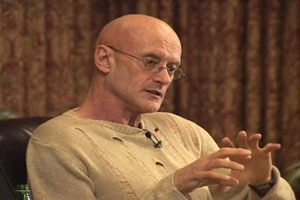 Ken Wilber |
Reactions to Wilber-5 have included very critical assessments. One may reflect upon some of the more obvious anomalies. Many early readers were impressed by Ken Wilber's support for the "perennial philosophy." Most of them were probably only very marginally familiar with that popularised subject. However, Ken Wilber's confrontation with postmodernism has resulted in an assimilation of the latter factor to a noticeable degree, pushing aside earlier preferences of description associated with perennialist conceptualism. The KW "post-metaphysical" orientation is still very metaphysical, while treating the traditional religions as decisive rivals.
Some critics have dwelt upon the commercial aspect of the Integral Institute. The Wilber-5 Kosmic Consciousness is celebrated for audio and video innovations of integralism. These have offended more restrained tastes which formerly lionised the "Einstein of consciousness research." In 2004, a set of ten Ken Wilber cassettes sold for seventy dollars in the ad pages of WIE, the disputed Andrew Cohen magazine. These were considered so great a bargain that satisfaction was guaranteed (Shepherd, Pointed Observations, 2005, p. 409).
The integralist pundit became known in some circles as a video guru. The KW video phenomenon gained both admirers and critics. The charismatic guru of integralism exhibited a confident vocal delivery. In one of these performances, Wilber dilates upon the theme of I Am-ness, stated in terms of: "It is absolutely infallible - it's that simple." This theme is closely related to present-centredness and the accompanying assertion "I Am Big Mind." Critics have described the Wilber exposition in terms of neo-Mahayana, more especially American Zen. The "Big Mind process" was created by a contemporary American Zen roshi, being praised by Wilber as an important innovation. Others regard this novelty as extremely misleading, encouraging inflation of the small mind and personality.
A related video performance features the American pundit discoursing on Integral Sex. This celebration refers to erogenous zones and kundalini chakras. There are also references to Theravada Buddhism and Mahayana Buddhism. However, the latter is dominant in terms of Tantric imagery. The audience of new age Americans appear to be very attentive, to the point of unquestioning acceptance. Affirmations do not necessarily denote achievements. To what extent can an affluent and pleasure-loving audience become susceptible to fashionable new age topics? Are the subscribers really Big Mind achievers? Or are they confused by sex talk and contemporary chakra lore?
Despite his references to Brahman, Ken Wilber does not emerge as an advocate of purist Advaita, a subject displaced by American innovations. Vintage Advaita Vedanta texts are far removed from the contemporary idioms of "neo-Advaita." There is no Tantra in the authentic documents, no chakra references or sex talk. The ascetic milieu was pronounced, representing the stage in which the householder became divorced from caste life. The pursuit of atman-Brahman complexities followed a celibate code of jnana (knowledge) that is basically foreign to the affluent lifestyles of America and Europe.
For instance, verses in a key Shankara text urge discrimination of the Self (atman) from the body, senses, and the intellect. These familiar obstacles comprise ignorance (ajnana), which is superimposed upon the atman (Upadeshasahasri, chapter 15). That text may be over a thousand years old, exhibiting semantic complexities set against a further context of obscure historical developments. This text "has gained credence as an authentic work, even though possibly redacted in its present form at a slightly later date than the author" (Shepherd, Minds and Sociocultures Vol. One, 1995, p. 878 note 318).
American countercultural present-centredness commenced circa 1970 with Richard Alpert, who was so confused by the psychedelic new age that he changed his name to Baba Ram Dass. This event accompanied other exotic identity switches, including those demonstrated by Franklin Jones, alias Adi Da Samraj, alias Da Free John, alias Da Avabhasa, alias Da Avadhoota. Again, affirmations do not necessarily denote achievements.
Another example of the Ken Wilber video output is Descartes: Reviving the West's Greatest Vedantist. The acknowledgment of Western philosophy is here couched in a rather unusual idiom. There are strong objections to the contention of Descartes as a Vedantist, on the basis of his affirmation "I think, therefore I am." Descartes can more logically be considered an early vivisectionist, in clear contrast to the ahimsa (non-violence) sensitivities of Indian celibate ascetics.
The KW literary project became a new age workshop enterprise appealing to the affluent consumer. The claim to a comprehensive metaphysics of Spirit can arouse resistance. The God expert Ken Wilber declares: "At Integral Institute, we have developed a series of guided meditations - called The 1-2-3 of God - designed to help people move through all 3 dimensions of their own deepest Spirit. If you are interested, please check out www.integraltraining.com, ILP Starter Kit. You can also see The One Two Three of God CD set from Sounds True" (Wilber 2006:161).
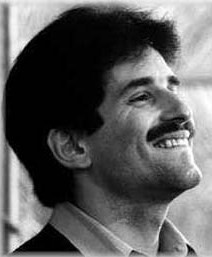  l to r: Andrew Cohen, Ken Wilber |
The Integral Institute proved keen to emphasise an accredited programme in partnership with John F. Kennedy University. Critics noted discrepancies in the educational outreach. For instance, Ken Wilber maintained his strong affiliation with the neo-advaita guru Andrew Cohen. KW was promoted as an accompanying celebrity to Cohen in a commercial package hosted by the Findhorn Foundation in May 2009. That three day event advertised Wilber as a participant via phone bridge. Cohen was an on site attraction.
The inclusion of Wilber, in a workshop programme of the "second Esalen," did not commend the Integral Institute to the more rigorous academic universities. The fee for the three day event at the Findhorn Foundation was £475. The elevated title of that event, in the new age idiom, was "Co-Creating an Awakened Culture." See Ongoing Commercial Workshops.
Recent books of Wilber include Integral Meditation (2016), The Religion of Tomorrow (2017), and Integral Buddhism (2018). The reactions of Wilber fans appear to be admixed. Critics are not disposed to change their assessment of claims made by integralism. Reviewing The Religion of Tomorrow, Frank Visser observed that Wilber does not refer to "the many controversial gurus he has supported and promoted in the past decades who have fallen from grace" (Climbing the Stairway to Heaven). The drawback of deficient gurus is not a good prospect for the integralist religion of tomorrow.
16. Frank Visser in Transition
The pro-Wilber website of Frank Visser became a focus of critical response to Ken Wilber integralism. A Wilber enthusiast turned reassessor, Visser became a salient critic (My Critical Essays on Ken Wilber). An interview illustrates the changing attitude of Visser to his former hero (Maxim Korman, Ideology and Inflation).
 Wouter J. Hanegraaff |
Professor Wouter J. Hanegraaff, of the University of Amsterdam, authored New Age Religion and Western Culture (1996). This authority on New Age developments contributed a review of the original Dutch edition (2001) of Visser's book Ken Wilber: Thought As Passion. That review appeared in 2002 in a Dutch magazine, before the English translation of the book was published the following year. Hanegraaff gave Wilber some credit for his self-taught career, while remaining cautious. The web version of his review includes the observation:
In university circles, interest in Wilber is practically nil.... The reason for this is not hard to find: Wilber approaches the psychology of religion and the analysis of religion and culture from a decidedly 'spiritual' perspective, based on specific mystical beliefs; and his books are not published by prestigious University Presses but by theosophical or otherwise esoterically-oriented publishing houses.... Wilber is seen by psychologists and religious studies scholars as a New Age author, from whom of course one cannot expect any serious contribution to scholarly debate.
However, Professor Hanegraaff was not himself offput by such routine considerations. He conceded the claim of Visser that Wilber wrote "academic" books showing a familiarity with professional literature. Yet he was evidently concerned at the danger of scientific credibility being lost by an "integral" psychology of religion and culture based upon metaphysical axioms. Accordingly, he felt that the Visser book was lacking in critical evaluation of the Wilber phenomenon. "Visser completely identifies with the perspective of his hero."
The academic commentator urged that the fundamental problem with Wilber's approach is the "totalitarian" character, "in the sense that all existing psychological and religious perspectives are assigned their proper place within an all-encompassing metaphysical model." There is no real possiblility for a dialogue, rooted in equality, with those of a different religious perspective. "Wilber does not speak with 'the other,' but only to him." This was serious critique. Hanegraaff added: "In my opinion, Frank Visser therefore errs in stating that Wilber cannot be accused of Western ethnocentrism." Neo-perennial philosophy was here in question. Many Wilber partisans had ignored this aspect of the integralist corpus. Hanegraaff drove home his point further by stating:
What is it that gives Wilber the right to dismiss the idiosyncratic perspectives of those other cultures as mere 'peculiarities,' which can be generously tolerated on the condition that they will be so kind as to conform themselves to Wilber's 'universal' and therefore evidently superior point of view? The answer is clear: Wilber believes he has that right because his own perspective just happens to be the most correct and complete one of all. (48)
For some time thereafter, the Hanegraaff review remained one of the largely subterranean components of the critical reaction. Ken Wilber had achieved phenomenal salience as a popular author. Hanegraaff was careful to acknowledge "eight voluminous tomes" comprising The Collected Works of Ken Wilber, a project commenced at the time of Wilber's fiftieth birthday.
What was happening behind the scenes during the next few years? Everyone knew that Wilber had started the Integral Institute in Colorado. Disillusioned reports emerged. These were interpreted in terms of a dictatorial attitude prevailing. Visser himself divulged that things were not as they should be. In May 2006, he posted an item entitled Talking Back To Wilber: A Call for Validation.
 Frank Visser |
Visser here relates that, two years earlier, Wilber had assigned him the task of detecting whenever the Integral Institute was being "less than integral." In relation to a projected book, he was also asked to collect all online criticism of Wilber's output. Visser reports that he collected over 150 essays on integral philosophy in the Reading Room of his website. These articles came from all over the world, though mostly from America, Britain, and Australia. "Many of these, but not all of them, have been critical of Wilber's version of integralism, or aspects thereof."
Visser goes on to explain that the Reading Room "provides space for reflection on all things integral in a non-promotional and non-commercial setting - a conditio sine qua non for objectivity." Wilber had not given much attention to the essays under discussion, except for some minor cases a few years earlier, when he posted replies to the authors, mainly brief. Wilber instead asked Visser to post a warning to readers of the essays, "stating that whenever they [the essays] criticised his views across the board, they were unreliable."
The critical essays were insistent that things were "not as simple, sturdy, straightforward, or sweeping as Wilber suggests." Those essays were generally a call for validation, i.e., "what is the proof for this statement?" Visser adds the words clarification and qualification, defining these in terms of "what is meant by this terminology?" and "does this statement hold true in all cases?" He also comments that this procedure should be "standard practice for a school of thought that claims to be scientifically and/or philosophically sound."
The commentator goes on to emphasise that, if the validation process is considered irrelevant, then this refusal will strengthen the "conditioning and cultic tendencies latent in all spiritual communities, including the integral ones." A true university curriculum will validate theories and beliefs regardless of personal convictions.
Frank Visser adds that the Integral Institute had become suspect with regard to discouraging critical assessment. Critics were viewed as "attackers," requiring a defence mechanism on the part of integralism. Critics were accused of "misrepresentation," also of being "green" (including "mean green"). The latter stigma was imparted by the Wilber version of meme theory. Visser singles out Jeff Meyerhoff's Bald Ambition as being "a sustained effort to reflect on core integral concepts from a particular perspective, postmodernist in this case." Visser serialised that contribution on his website, observing that he had witnessed the full gamut of defence mechanisms in operation from the Wilber sector, i.e., ignoring, ridiculing, dismissing, discrediting.
The major conflict now commenced. Ken Wilber's response to the call for validation was expressed in his now famed blog attack upon the critics as outlaws. His dramatically reactive stance as "Wyatt Earp against the outlaws" was unyielding. This stance was regarded as unmerited polemic by the recipients, who notably included Frank Visser. The condemnatory blog was dated June 2006. Go to kenwilber.com/blog/show/46. That gesture evoked a wave of resistance from the dissidents, causing Visser to post The Wild West Wilber Report (2006).
A subsequent posting of Visser was entitled 'If You Meet Wilber on the Road, Kill Him': On the Importance of Independent Integral Research (2007). The rather dramatic wording was expressed in the contemporary spirit of emulating an antique Buddhist slogan of iconoclasm. Perhaps more to the point, Wilber's Dutch biographer was lamenting that he had undergone five basic stages in his approach to the subject, meaning those of fan, student, biographer, critic, and outcast from the Integral Institute. Such a disadvantage is very strongly reminiscent of the situation of ex-devotees and their gurus, although Wilber had never claimed to be a guru. His repute as an assertive pundit has nevertheless been problematic for some former admirers.
In another web item, Visser divulged information about his past connection with the disputed integralist. That entry of 2008 is entitled The Trouble with Ken Wilber. Visser started to read Wilber books in 1982, shortly after starting his university studies in the psychology of religion. Wilber became his "author hero." In the 1990s, he translated The Atman Project into Dutch. He had to stop at SES, because that book was too long for the Dutch market. Instead he translated A Brief History of Everything, said to have represented Wilber's canny move to make his SES thesis more popular.
This committed partisan also took over the role of webmaster for the site known as The World of Ken Wilber. That website then comprised only a dozen pages. Years later, in 2008, that site was renamed integralworld.net, which "totals over 1,000 pages in 12 languages, all realised with no funding and as an integral grassroots phenomenon."
In 1995, Visser gained fax contact with his hero. In 1997, he attended a Wilber conference at the California Institute of Integral Studies. He was afterwards able to visit Wilber at the latter's home in Boulder, Colorado. Subsequently he returned to stay with Wilber for five days, producing a 90-page transcript of the interview which resulted. His host was at that time composing the material for One Taste (1999). Then around 2000, several authors started to submit articles to Visser's website. The webmaster was surprised at Wilber's "defensive" attitude to the accumulating articles, written in an analytical spirit. Wilber complained that the critics misrepresented his work. Visser comments: "My Wilber website was virtually the only place in the world where people took the time and the effort to apply the tools of reason to Wilber proposals."
Wilber was averse to the application. "Around 2004, Wilber urged me to change the name of this website 'The World of Ken Wilber' to something else, unrelated to his name, since he no longer felt his work was accurately reflected by this website." Visser complied, choosing the name Integral World, while maintaining focus on the same entity. In 2004, Wilber submitted a statement, for the Visser website, to the effect that "only critics who are in personal contact with him have a chance of understanding his work correctly, and therefore have the opportunity to criticise it, if at all." This response was seen as a violation of public dialogue or debate. The point is made that Ken Wilber had probably not been in personal contact with any of "the hundreds of authors he has so freely criticised."
More writers became represented at integralworld.net. In 2006, Wilber's annoyance with this phenomenon "exploded during the Wyatt Earp episode, in which Wilber insulted his critics, degrading and dismissing them by basically stating that he was smarter than everybody else." This fraught event was accompanied by "another attempt at starting a debate with Wilber, this time on his views of biological evolution." The attempt is said to have been aborted by aggressive dismissal. Visser states that the episode "ended my faith in Wilber as someone who could really make a difference in the world of science and spirituality."
Frank Visser further depicts this problem in communication as leading to an ideology of integralism, accompanied by an increasing sales language at the Integral Institute. Visser now believed that Wilber should listen to critics like Jeff Meyerhoff, and even sceptics like Geoffrey Falk. However, Ken Wilber decided to remain aloof, furthering Integral Life Practice and the web profile of his Institute. (49)
Despite being a dissident from the Wilber model, Frank Visser evidently does not wish to see integralism destroyed, but rather validated in a due critical and scientific manner. He sees benefit in a generalising approach, as distinct from the purely specialist approach operative in the academic field. (50)
In conclusion here, to avoid any misunderstandings, I should express my own orientation in what I have called citizen philosophy (and philosophical anthropography). The philosophical quest is a demanding pursuit, though not requiring to "integrate" diverse and conflicting doctrines and opinions. Where some synthesis is attempted, I believe that it is better to avoid claiming any integral qualification, in case the presumed expansion transpires to be a contraction in terms of scientific validation. For instance, validation might disqualify some components as a hindrance, while disclosing that omitted elements are actually far more pressing. Such prospects should inspire due caution, also diligence with regard to complexities of any kind.
I have never been a Ken Wilber partisan, and in that respect must be regarded a total outsider. My preliminary work Meaning in Anthropos (1991) was published in between the two creative periods of Wilber output. Only after this event did I read closely several books of Wilber (phases 1-3). Prior to that, I had encountered Up From Eden (1981), without being in any way convinced by the contents.
Kevin R. D. Shepherd
August 2009 (with additions January 2011; modified December 2020)
Copyright © 2020 Kevin R. D. Shepherd. All Rights Reserved. Page uploaded August 2009, last modified December 2020.
ANNOTATIONS
(1) See, e.g., the Wilber discussion site at integralworld.net. Frank Visser is the webmaster of that site, showing numerous contributions in the “Reading Room.” The entries vary greatly in emphasis and interpretation. The articles include a significant number by Visser, although many other writers are represented. See also The Collected Works of Ken Wilber (8 vols, Boston: Shambhala, 1999-2000). See also kenwilber.com.
(2) Ken Wilber, 2002 Foreword to Frank Visser, Ken Wilber: Thought As Passion (2003), p. xii. Wilber also states: “I myself have some friendly disagreements with Frank about many of these topics, but I always learn something important from him in our exchanges” (ibid). The relationship was evidently very amicable at that time. Frank Visser's book is noticeably partisan in tone, commending his subject in many ways, giving a detailed analysis of the Wilber corpus and affording insight into biographical details.
(3) Ibid. Earlier, Wilber had aligned himself with transpersonal psychology, a format strongly associated with Stanislav Grof and Esalen. The claims made for transpersonalism have frequently been dramatic, arousing criticism from other sectors. For instance, there was the announcement from Jack Crittenden that the twenty-first century had only three choices: Aristotle, Nietzsche, or Wilber. Cf. Shepherd 2004:90ff.
(4) The controversial book that launched Holotropic Breathwork was Grof, The Adventure of Self-Discovery (Albany: State University of New York Press, 1988). See also Grof, Psychology of the Future (SUNY Press, 2000). For a critique of Grof and his therapies, see Shepherd 2005:6-24, also index page 417.
(5) Visser 2003:26-7. Wilber became noted for a "relatively reclusive lifestyle." He had earlier dropped out of Duke University, being keen to practise Zen meditation, and to study mystical and philosophical matters outside his scientific curriculum. He married in the early 1970s, taking menial jobs during that decade. For a year or so, he gave many lectures on his first book, subsequently realising that this resort was blocking his creativity.
(6) Shepherd 1995:113. Wilber's book A Sociable God had gained two sub-titles, namely Toward a New Understanding of Religion, substituting for the original A Brief Introduction to a Transcendental Sociology.
(7) Visser 2003:136-7. Wilber's assessment of Jurgen Habermas as an important philosopher is associated with the former's Eye to Eye: The Quest for the New Paradigm (1983).
(8) Shepherd 1995:115. Four years after A Sociable God, the co-edited work entitled Spiritual Choices included Da Free John (Adi Da) in a critical treatment of controversial cult figures. See Dick Anthony, Bruce Ecker, and Ken Wilber, eds., Spiritual Choices (1987). The bohemian American guru here figured in a critique extending to Chogyam Trungpa, the Maharishi Mahesh Yogi, Swami Muktananda, and the Zen celebrity Richard Baker. Commentators later said that Dick Anthony was responsible for the critical comments on Da Free John and Chogyam Trungpa, who were both known favourites of Wilber. Cf. Visser 2003:139ff, informing that the co-edited volume was originally prompted by a seminar of 1980-81 on the New Religious Movements. On Adi Da, see also Georg Feuerstein, Holy Madness (second edn, 2006). Cf. Shepherd 2004:74-85.
(9) Shepherd 1995:110-112. The Wilber supporter mentioned in this passage was Professor Roger Walsh, of the University of California, who also became noted for his partiality to shamanism. On this, see Shepherd 1995:4-6, citing Walsh, The Spirit of Shamanism (1990).
(10) Visser 2003:98-9, urging that "the similarities are remarkable" between Gebser and Wilber. Nevertheless, Gebser does not refer to transpersonal stages of development. Wilber used the terminology of Gebser as a prefix to his own specifications derived from mythology. Jean (Hans) Gebser (1905-73), a German, is favoured by the current integralist sector. His major work is The Ever-Present Origin (1985), the title here being a translation from the German original. Though praised by integralists, the theory of Gebser is regarded by critics as being very speculative.
(11) Visser 2003:104. The form of presentation, devised by Wilber, can arouse resistance. For instance, the Wilber vocabulary in Up From Eden states: “This analysis is supported, not just by the hierarchic ordering of past transcendent heroes, but also by the hierarchic disclosures of present-day meditators" (cited by Visser 2003:104). There are strong disagreements possible. For instance, there is no compelling reason to believe in any collective repetition of minority achievements. Wilber was clearly influenced in this respect by his belief that contemporary meditators could gain “final and complete enlightenment,” a belief that can be deemed deceptive, as he himself later suggested.
(12) Visser 2003:106. Nevertheless, Wilber does express some ideas that strongly resemble certain "new age" concepts, as in the Up from Eden statement “because we are now collectively at the precise point in history where the exoteric curve is starting to run into the esoteric curve” (cited in Visser 2003:104).
(13) Ibid:25, citing the verdict of John White. A slightly less emphatic support came from Jean Houston, associated with humanistic psychology, who opined: "Wilber might likely do for consciousness what Freud did for psychology."
(14) See Geoffrey D. Falk, “Norman Einstein”: The Dis-Integration of Ken Wilber (2009). Falk has the reputation of being the most relentless of all Wilber's critics, who are rather varied in temperament. He is also very critical of the Integral Institute, founded by Wilber in Colorado. In Chapter 12, Falk lists founding members of that Institute, with some rather sceptical comments. In Chapter 9, he refers very pointedly to Wilber's "Wyatt Earp" blog of June 2006. The chapter is entitled Bald Narcissism. Falk urges: "All that one would have to do is read that blog by Wilber to see why he is losing respect even from those academics who used to think he deserved his high standing in the transpersonal/integral community." Falk accuses Wilber of "intellectual abuse" in fitting details from varied sources into his theorisings, a feat which does not amount to integration in this sceptical perspective.
(15) Shepherd 1995:101-127, addressing the Wilber format in terms of transpersonal sociology.
(16) Visser 2003:308 note 65. Visser here drew upon Wilber’s The Eye of Spirit (1997), p. 63, specifying “neoperennial philosophy,” also praising Hegel’s idea of history as evolution in terms of "propounded the doctrine with a genius rarely equalled." Some other commentators have been far less sympathetic to Hegel's glorification of the Prussian monarchical state. However, Wilber does acknowledge the "almost manic enthusiasms" of the German philosopher in that direction.
(17) John Horgan, Rational Mysticism (2003), p. 70. Horgan refers to Wilber's dogmatism, relaying: "Wilber speaks with an authoritarianism, pedantry, and didacticism that imply omniscience" (ibid:65). Horgan also affirms: “There is much to admire in Ken Wilber.... Wilber was more modest and amiable than I had expected. But he did make it quite clear that vanishingly few people have reached his level of enlightenment. Not even the Dalai Lama can sustain nondual awareness through deep sleep, Wilber informed me, as he can" (ibid:64-5). The interview occurred at Wilber’s home in Colorado, apparently in 2000, after publication of the provocative One Taste (1999). In that book, Wilber claimed to have achieved nondual awareness, meaning spiritual enlightenment.
(18) Visser 2003:22-3. The Zen influence is considered to have been the strongest on the early Wilber, who tracked down Philip Kapleau, author of The Three Pillars of Zen. Frank Visser’s research into the life and career of Ken Wilber was assisted by his six-hour interview with the latter in Colorado, dating to 1997 (ibid:289 note 2).
(19) See Shepherd 2005:58, 62ff, with reference to Wilber, “A Spirituality That Transforms,” What Is Enlightenment? (Fall/Winter 1997) Issue 12, pp. 22-32. In that disputed article, Wilber attempted to vindicate the careers of Trungpa and Adi Da with the theme of “radical transformation.” The article was so popular that WIE reprinted it. Wilber appeared on the front cover of this glossy magazine in 1997, along with his statement: “Authentic spirituality is revolutionary; it does not console the world; it shatters it.” The anomalies in this emphasis have been noted (Shepherd 2005:57). WIE described the Wilber article with the following caption: "America's foremost transpersonal theorist points beyond conventional religious pursuit to the revolutionary possibility of authentic spiritual transformation." Some muted criticism of the New Age guru Deepak Chopra appeared in the same issue. However, Wilber was considered beyond reproach in WIE circles.
(20) Wilber, The Eye of Spirit (1997), pp. 277ff. Wilber here discrepantly includes Nietzsche in a list of polemical "spiritual philosophers" extending to Plato and Plotinus. Other analysts describe Nietzsche as a nihilist.
(21) See Shepherd 1991:xxxiv-xliv; id., Minds and Sociocultures (1995), pp. 61-84. Cf. D. Rothberg and S. Kelly, eds., Ken Wilber in Dialogue (1998), including Grof-Wilber exchange. Wilber's more well known discussion of Grof theory, in Sex, Ecology, Spirituality (1995), declared only "relatively minor" differences with his own model. In this respect, he referred to "the Grof/Wilber overlap." Wilber even stated here that Grof's basic perinatal matrices were "completely consonant" with his own model. Cf. Shepherd 2004:94-5, in a section commenting on Wilber's longest book (most of my Philos. Critiques was written in 1996-97). See also note 26 below.
(22) Wilber, Sex, Ecology, Spirituality (1995), pp. 340, 520. The disapproving reference to "a type of Advaita Vedanta" has been decoded to mean the Shankara Order and the Ramakrishna Order, as distinct from the neo-advaita associated with Wilber and Adi Da Samraj. See Shepherd 2004:278 note 276. The neo-advaita trend in the West has taken different forms, including the rather amorphous variant associated with Andrew Cohen.
(23) Shepherd 2004:99-100. See also the chapter on Plotinus, pp. 160 ff., including the observation: “Plotinus gives the impression that he was aware of suspect undercurrents which Gnostic doctrines harboured, though the references are of a generalised nature. He appears to have made an effort to be polite for the benefit of his Gnostic acquaintances” (ibid:180). Professor Rist stressed, concerning Plotinus, "his moderate asceticism, his strict sense of morality" (J. M. Rist, Plotinus: The Road to Reality, Cambridge University Press, 1967, p. 15). See also John Dillon, "Plotinus: An Introduction," in Dillon, ed., The Enneads, trans. Stephen MacKenna (London: Penguin, 1991), describing the subject as "a mystic who is also a rationalist, for whom the intelligible world is more real than the physical, but who is confident that its contours and functions can be established by reasoned argument" (ibid:xc). Still a useful work is Kurt Rudolph, Gnosis: The Nature and History of Gnosticism (Edinburgh: T. & T. Clark, 1984), stressing that Gnosticism was essentially a city religion found in Antioch, Ephesus, Alexandria, Rome, and Seleucia-Ctesiphon, with the centre of gravity in the Near East from Egypt to Asia Minor (p. 291). The Valentinians were the most frequently reported Gnostic school, but many details remain obscure. Like Plotinus, Valentinus moved from Alexandria to Rome, though a century earlier. See also Giovanni Filoramo, A History of Gnosticism (Oxford: Blackwell, 1990), p. 186, comparing the heresiographical tactic of Irenaeus to the procedure of Plotinus. "Having established correct ethical positions, he [Plotinus] then draws the logical conclusions, accusing the Gnostics of immorality." Professor Filoramo also supplies a translation of the relevant passage in the Panarion, about the orgiastic sect encountered by Epiphanius, commenting that "however coloured it might be, the very prudishness of the account guarantees the substantial truthfulness of the picture" (p. 183). There are ongoing probes of textual complexities in Gnostic and heresiographic works, e.g., Alastair H. B. Logan, Gnostic Truth and Christian Heresy: A Study in the History of Gnosticism (Edinburgh: T. & T. Clark, 1996), deducing that the Gnostic worldview presented by Irenaeus is Platonist, "being not far removed from the ideas of Syrian Middle Platonists of the second century like Numenius of Apamea," though "essentially a Christian scheme" and reflecting "the experience of salvation through a Christian Gnostic initiation ritual based on baptism" (p. 22). In relation to Plotinus, a strong suggestion is that the Nag Hammadi treatises Zostrianos and Allogenes are the very same apocalypses mentioned by Porphyry as being "produced or used by Gnostic attenders at Plotinus' lectures and refuted by him and his pupils in the period between 244 and 269 CE" (ibid:51). Those apocalypses have been attributed to the Sethian Gnostic group; Porphyry indicates that this obscure sector were Christians, despite their assimilation to Neoplatonism (ibid). See also Plotinus and the Enneads.
(24) See Luna Tarlo, The Mother of God (New York: Plover Press, 1997). See also Andre van der Braak, Enlightenment Blues: My Years with an American Guru (New York: Monkfish, 2003). Van der Braak lived in Andrew Cohen’s community for over ten years; he was one of the original editors of the What Is Enlightenment? magazine created by Cohen. In contrast, Ken Wilber’s glowing descriptions of Cohen have met with scepticism from varied analysts.
(25) Wilber, The Eye of Spirit (1997), p. 35. The following chapter is sub-titled “Integral Psychology and the Perennial Philosophy” (pp. 37-57). This tells us very little about the second subject, though much more about the first. Wilber’s basic theme is one of how his schema has updated and modernised perennialism. He specifically mentions his third book The Atman Project (1980). To quote: “The Atman Project was, as far as we can tell, the first psychology that suggested a way of uniting East and West.... In so doing, it incorporated a good number of approaches, from Freud to Buddha, Gestalt to Shankara, Piaget to Yogachara, Kohlberg to Krishnamurti" (ibid: 51). The disadvantages of conflation are sometimes evident. Freud is no gauge for the Buddha, who is still very imperfectly known. Gestalt has no relation to Shankara, who is better served by the advanced textual and semantic studies missing from The Atman Project. Krishnamurti is not regarded as part of the "perennial philosophy" by close analysts, but rather as a distraction exhibiting serious doctrinal and moral flaws. See further Shepherd 1995:101-105. "Very suspiciously, he (Krishnamurti) denied the relevance of a developmental 'path,' a convenience which was an increasing fashion in the New Age that came under his influence to no small degree" (ibid:104).
(26) Wilber, The Eye of Spirit, p. 165. Despite Ken Wilber's declared measure of agreement with Grof, he does articulate a pointed criticism of the perinatal theory devised by the latter. That theory relates to the apparent reliving of biological birth in psychedelic experiences. Wilber stresses that the Grof theory arises primarily from intense LSD sessions, whereas “the necessity for first experiencing oneself as a fetus is found in none of the traditional texts” (ibid:172). Wilber appropriately observes that there is no necessity to relive clinical birth in a process of transpersonal development. The LSD (and Holotropic Breathwork) phenomena are not paradigmatic for such development. Wilber also refers (ibid:175) to the critique of Grof theory by Huston Smith in Forgotten Truth (1976). However, the relevant Appendix to the Smith book tends in some ways to erroneously validate the Grof theory as being in convergence with traditional concepts. A more recent work by Huston Smith has drawn criticism for a misleading approach to entheogens. See Smith, Cleansing the Doors of Perception (New York: Tarcher/Putnam, 2000). The Appendix on Grof is there reprinted as chapter six, along with a retrospective preamble including the statement: "I found his [Grof's] findings so in keeping with the traditional concept of the self that I had outlined in my book that I added an Appendix to my book to summarize his work" (ibid:79). Cf. Shepherd 2005:78. Cf. Horgan 2003:20-21. The policy of SUNY Press in publishing misleading books by Stanislav Grof is not recognised by Wilber. "The mass of citizens are potential guinea pigs for Grofian experiments endorsed by SUNY" (Shepherd 2005:343).
(27) Wilber, The Eye of Spirit, p. 291. Although a quotation from Eckhart follows, the mood is reminiscent of the 1970s vogue for present-centredness, which has persisted until today. Certainly, in Wilber’s two earliest books (published in the late 1970s), there is a strong emphasis on the now, associated chiefly with Krishnamurti, whom Wilber substantially endorsed.
(28) Visser 2003:220. A factor in Wilber's doctrine arousing query is the theme that one of the "two crucial errors.... is to imagine that the step from the Self to the One requires an effort (ibid:219). This cultivation of sloth is not impressive. The meditation injunctions of Wilber refer to, e.g., resting as the Witness and in Freedom. "Relax in the space of Freedom that you are" (ibid). Realistically, this approach affords a prodigious scope for deception. Meditation exercises are not the same as enlightenment, which is merely mystified by such themes as “Who is not already enlightened?” The relaxation option is certainly more amenable to the current consumer demand. There is reason to believe that meditation is unsuitable for some people, various drawbacks being on record.
(29) Ibid:221. Visser enthusiastically remarks: “For Wilber these spiritual states are a daily experience, even if they are not yet constantly sustained” (ibid:222). Journalist John Horgan was rather more critical during this same period. He comments: “For all his (Wilber’s) warnings about the perils of narcissism, or ‘psychic inflation,’ he does not seem to have entirely avoided that pitfall himself. Soon after I started reading his books, a sentence popped into my head, one that came back to me again and again during my research for this book: I’m enlightened, and you’re not.” (Horgan 2003:65.) An analysis of Wilber's Kosmic Consciousness CD reveals that he did not explicitly claim a full enlightenment, though his general angle receives strong criticism in Jim Andrews, Ken Wilber on Meditation (2006), comprising an appendix to the book by Geoffrey Falk. See note 14 above.
(30) Wilber, Integral Psychology (2000), p. 50. The green meme is here described as applying to ten percent of the population. The classification is in terms of: “deep ecology, postmodernism... humanistic psychology, liberation theology, World Council of Churches, Greenpeace, animal rights, ecofeminism, postcolonialism, Foucault/Derrida, politically correct, diversity movements, human rights issues, ecopsychology" (ibid:50-51). Exception has also been taken to the analysis of scientific achievement, here denoted by the fifth or orange meme, said to comprise thirty percent of the population. The Wilber coverage of this disputed meme includes: “Wall Street, the Riviera, emerging middle classes around the world, cosmetics industry, trophy hunting, colonialism, the Cold War, fashion industry, materialism, liberal self-interest" (ibid:50). Critics say that the analysis is confused, reflecting a certain type of contemporary reductionism in value terms. Realistically, scientific achievement is nowhere near thirty percent.
(31) Ibid:52. Memes seven and eight are viewed with reserve elsewhere. The yellow meme is described by Wilber as integrative. The turquoise or "holistic" meme "sometimes involves the emergence of a new spirituality" (ibid). These two memes comprise "second-tier thinking," encompassing only one per cent of the population. Wilber also states that only 0.1 per cent are at turquoise level, which is evidently elite territory. "Beck and Cowan mention items ranging from Teilhard de Chardin's noosphere to the growth of transpersonal psychology" (ibid). One could guess that Wilber, Adi Da, and Andrew Cohen are in the turquoise zone. Wilber does mention that green is not to be abandoned, but instead enriched (ibid:53). Freedom from colour hypnosis can fortunately occur, as in the instances of disillusioned ex-devotees and admirers like Frank Visser.
(32) Shepherd 2005:64-5, here utilising the WIE article “An interview with Dr. Don Beck.” My critical comments were in reaction to the glamorisation of circa 1970 as a “transpersonal” dateline in meme theory for advanced minority achievements. In reality, the achievements were very largely potential, it may be countered, and substantially offset by the distractions created via management consultants, new age therapists, and other presumed holistic experts. "The elitist dimensions of this theme are lent stigma by the implication that the transpersonalist jet set are in the vanguard" (ibid: 63).
(33) Shepherd 1991:97. The Mohist philosophical tradition appears to have flourished in the fourth century BC, "being rooted in the trades and crafts of the towns, amongst people who were normally inarticulate" (ibid:98). The movement was at first religious in complexion, subsequently developing into a highly rationalised approach. “In the Mohist worldview, the extravagances of the nobles wasted the resources of the land and the people” (ibid). Mohists were skilled in optics and mechanics. See further A. C. Graham, Later Mohist Logic, Ethics, and Science (London: School of Oriental and African Studies, 1978); idem, Disputers of the Tao (La Salle, Illinois: Open Court, 1989).
(34) Visser 2003:231, also relaying the aversion of Wilber to the extreme expression of postmodernism “that has taken root in the American universities” (ibid). Wilber instead maintained “the search for generally valid truths” denied by the postmodern argument (ibid). The search for truths stumbled in confusions created by meme theory. A drawback being that the truths can be simplified or over-generalised. Further, the Wilber version of postmodernism is contested (section 14 above).
(35) Shepherd 1991:160, citing J. Z. Wilczynski, "On the Presumed Darwinism of Alberuni Eight Hundred Years before Darwin," Isis (1959) 50:459-66. The comments of Rainow were published in 1943. Critical coverage of this issue by Wilczynski conceded that Biruni's India really does contain "views resembling the basic principles of Darwin's future doctrine," though affirming that these views are "vague and accidental." There have since been other learned discussions of this and related matters in the corpus of Al-Biruni. The familiarity of Al-Biruni with Indian religion extended to quoting the Bhagavad-Gita; he was also conversant with Hindu scientific works. His distinctive treatise Kitab al-Jamahir “briefly expressed the view that mankind evolved through the species until the form of cats was arrived at, subsequently passing on to bears, and then to primates before reaching the anthropoid stage" (Shepherd 1991:161). Not only this, but Al-Biruni somehow discovered that animal life exists at a very low level of cellular organisation. "He maintained that sponges are animals, and credited corals with the posession of organs of perception, a sense of touch, and contractions which he regarded as animal properties. This has recently been considered to mark the greatest advancement in the field of zoology until Cuvier or Lamarck (which brings us forward in time very close to Darwin). Even in seventeenth century scientific Europe, corals were still regarded as plants" (ibid). Furthermore, one should include here the concept of slow geological transition, widely recognised amongst Muslim scientists even before Al-Biruni. “Aside from such specifically modern concepts as the Darwinian theory of evolution, there are many modern geological ideas, such as the change of land and sea, sedimentation, rise of mountains, and so on, which are to be found in various medieval Muslim treatises, particularly those of Al-Biruni." This quote comes from Seyyed Hossein Nasr, An Introduction to Islamic Cosmological Doctrines (revised edn, London: Thames and Hudson, 1978), p. 141.
(36) See Meher Baba, God Speaks: The Theme of Creation and Its Purpose (New York: Dodd, Mead & Co., 1955). This dictated work of the Irani mystic exhibits some linguistic complexity; the basic format is English. The contents depict a form of spiritual evolution, with a distinctive version of progress through species-forms that escapes totally from the diffuse ideas about retrograde incarnation found elsewhere. See also Meher Baba and Yazd.
(37) Wilber, Integral Psychology (2000), p. 155. The appropriation of Plotinus by the American "nondual" tradition has met with scepticism. The juxtaposition of that Neoplatonist with both Nagarjuna and Tantra is not convincing, because the varied teachings do not tally. In the same passage, Wilber describes Tibetan Tantra in terms of an "unparalleled flowering," specifying the eighth to the eighteenth centuries in this context. The high estimation of Vajrayana lost moorings in other directions. Florence and the rise of humanism are described by Wilber in terms of "the first collective or average-mode glimmers of vision-logic" (ibid).
(38) See further Shepherd 1995:18-19, on Taoist yoga, vamachara, and discrepancies in the exegesis of Mircea Eliade. “Ignorance of psychic depletion is currently pronounced, and doubtless facilitated by the talk of altered states of consciousness” (ibid).
(39) In 1997, Wilber's definition of transpersonal psychology referred to five major approaches, namely systems theory, altered states of consciousness, the Grof holotropic model, "various forms of Jungian psychology," and his own spectrum or integral theory (Wilber 1997:139). Versions of the integralist outlook are associated with Aurobindo, Gebser, Michael Murphy (of Esalen), and the philosopher Richard Tarnas. The lastmentioned, a supporter of Grof, is noted for his book The Passion of the Western Mind (1991). Wilber was very critical of the Grof connection here, commenting that Tarnas "seems to miss so much that is actually crucial to the historical emergence of modernity" (Eye of Spirit, p. 169). The relation of Wilber to Michael Murphy was rather more positive, signified by Wilber's statement in the same book: "Michael Murphy very well might be the single most significant spiritual pioneer of our generation" (ibid:259). Murphy had recently praised Wilber's Sex, Ecology, Spirituality (1995) as one of the four great books of the twentieth century. This exchange of compliments tends to underline the basic affinity discernible between Ken Wilber and the Esalen milieu.
(40) The term holistic achieved popularity during the 1970s, becoming associated with intuitive faculties. The so-called "holistic movement" furthered entrepreneurial workshops exploiting a widespread blindspot. Moving in the direction of popularisation was Robert E. Ornstein, The Psychology of Consciousness (1972; second edn, 1977), who drew upon varied sources in his presentation of brain theory and the holistic mode of consciousness. There followed an overwhelming popular trend opposing the mechanistic worldview of Cartesian-Newtonian science. That trend is associated with Fritjof Capra, The Turning Point (London: Wildwood House, 1982). Cf. Peter Medawar, Pluto's Republic (Oxford University Press, 1983). Cf. Shepherd, The Resurrection of Philosophy (Cambridge: Anthropographia, 1989), pp. 82ff., for a criticism of the Capra format without denying the holistic conception of reality. However, at commercial level, so-called "holistic" concepts are effectively meaningless and even predatory.
(41) Wilber, What We Are, That We See Part 1: Response to Some Recent Criticism in a Wild West Fashion (June 8, 2006) at kenwilber.com. Wilber here asserted: "I have done my homework, and done it much better than my critics." Wilber also described himself as "using his Zen sword of prajna to cut off the heads of critics so staggeringly little that he has to slow down about 10-fold just to see them.... and then rip their eyes out and piss in their eye-sockets." The lurid scenario of the giant sword-wielder against the little critics evoked some strong reflections elsewhere, including the accusation of sordid verbal indulgence. Counts were made of the indecent wordings used; even some Wilber fans were shocked by the Wild West Zen idiom. On this evocative dispute, see Frank Visser, The Wild West Wilber Report (2006). This feature gives access to the various Wilber blogs and the critical responses involved from diverse sources. See especially Visser, Games Pandits Play: A Reply to Ken Wilber's Raging Rant (June 14, 2006). This item refers to "the immature and abusive language" used on the Wilber blog of June 8. Visser affirms: "All ingredients of cultic logic are in full swing now at Integral Institute." Visser also emphasises: "Wilber's posting was phrased rudely on purpose: to separate the green from the yellow." The Wilber contingent being the elevated yellow meme, and the critics representing the inferior green meme. Michel Bauwens also accused the Ken Wilber movement of "becoming a closed cultic environment," a symptom of this being "a total inability to deal with criticism" (Bauwens, Ken Wilber is losing it, June 2006). The Belgian analyst also complained that the Boomeritis novel of Wilber had already revealed a strong stylistic streak "full of sexual innuendo that we should not expect, and I think, accept, in a man of such purported stature." From another angle, the Spiral Dynamics exponent Christopher Cowan commented: "The number of people we encounter who have been programmed to dislike the sixth level (green [meme]) because of Wilber's writings is astounding." See Cowan, Observations on Ken Wilber's June 8th Rant (June 2006). Another critic, Jeff Meyerhoff, expresses his belief that Wilber has been exposed and cannot confront the truth. Meyerhoff accuses Wilber of avoiding critical engagement via such diversions as mockery, plus "the supercilious and unexplained notion of altitude," meaning the sense of spiritual elevation insidiously conveyed by the integralist. See Meyerhoff, An "Intellectual Tragedy" (2006).
(42) Shepherd 2004:140, adding that there is no reference to any personal religious experience in the works of Shankara. Firm attribution of those works has proved difficult in a number of instances. Shankara was basically concerned to elevate knowledge (jnana) above ritual, opposing his ritualist opponents known as Mimamsakas. "Though Advaita is attractive to many Westerners, it is very closely bound up with the exegesis of brahmanical scripture according to medieval standards" (ibid:141).
(43) Ibid:245ff, for a critical version of Foucault. See also J. Miller, The Passion of Michel Foucault (London: Collins, 1993). Foucault "made no secret of his special interest in the consensual form of sado-masochistic eroticism that flourished in a number of San Francisco bathhouses" (Miller 1993:27). During his visit to California in 1975, Foucault ingested LSD and became active in the flourishing gay community of San Francisco. He returned several times in his pursuit of "forbidden pleasures," recklessly referring to "the sensuality of death" and other dubious themes (ibid:280). Foucault demonstrated an obsessive interest in the writings of the Marquis de Sade.
(44) David J. Kalupahana, Nagarjuna: The Philosophy of the Middle Way (Albany: State University of New York Press, 1986), p. 105. The negative verse here reads: "No existents whatsoever are evident anywhere that are arisen from themselves, from another, from both, or from a non-cause" (ibid). Candrakirti emphasised the Prasangika method of reductio ad absurdum. Kalupahana is more sympathetic to "Nagarjuna's disciples like Bhavaviveka and the more positive thinkers of the Madhyamika school" (ibid:26).
(45) A. K. Warder, Indian Buddhism (second edn, Delhi: Banarsidass, 1980), p. 478. Bhavaviveka argued against Buddhapalita, an earlier Madhyamaka philosopher who represented the Prasangika school, maintaining a strict form of argument based upon inferring consequences from the positions of opponents. Later, Candrakirti supported the Prasangika attitude against Bhavaviveka. There have been more recent arguments about the complexities.
(46) David L. Snellgrove, Indo-Tibetan Buddhism: Indian Buddhists and Their Tibetan Successors (London: Serindia, 1987), p. 89. Opponents of the Madhyamikas identified them as nihilists (nastika). Snellgrove adopts the more severe form of assessment. "There may be a lack of logic in the Madhyamaka position, but as it is claimed throughout that any stance is essentially a nonstance, they can scarcely be judged by logical considerations" (ibid:91). Earlier, the French scholar Louis de la Vallee Poussin had stated a similarity of ascetic emphasis between Hinayana and Nagarjuna. "Nagarjuna's method is quite similar; the ascetic persuades himself that in real truth, misery and pleasure, the I and the you, etc. are all void of misery and pleasure, of I and of you" (ibid:92, citing la Vallee Poussin "Reflections sur le Madhyamaka," in Melanges Chinois et Bouddhiques, Brussels 1933, 2:1-59). The close connection with ascetic psychology is too rarely emphasised. Insofar as is known, all the varied Buddhist commentators of those early periods were monks.
(47) Frank Visser dated the "post-metaphysical" development to an interview in 2001. Subsequently, "Wilber has most vocally and fiercely criticised what he sees as the shortcomings of perennialism." See Visser, Perennialism Lite: Comments on Integral Post-Metaphysics (2008).
(48) Wouter J. Hanegraaff, "Everybody is Right": Frank Visser's Analysis of Ken Wilber. The title phrase comes from a statement of Wilber reproduced by Visser, the context being that "every perspective contains a certain, although limited, amount of truth." The purpose of Wilber here being to demonstrate how the limited truths complement one another within the all-encompassing integralist scheme. Hanegraaff also comments with reserve on a chapter featuring in the Wilber novel Boomeritis, where the author attacks the "cultural relativism of postmodernists and deconstructivists." That Wilber tactic here accuses the opponents of being "morally responsible for the catastrophe" afflicting the World Trade Center in 2001. Professor Hanegraaff closed his review by allocating Ken Wilber to the same bracket as Jung, Rudolf Otto, and Mircea Eliade, who were here considered to be similar upholders of a religious (or metaphysical) perspective.
(49) "Wilber's intent has not been to open up his work for a true academic debate, or even an online debate among those thoroughly familiar with his works, but to teach his ideas to an increasingly wider circle of his own students.... to even create an Integral University of his own." This verdict comes from Visser, Telling the Story As If it Were True, being a review of Wilber's book The Integral Vision (2007). Visser deems that work to be a rehash of Integral Spirituality, giving the verdict: "This is a blatant Wilber-commercial." Visser characterises the approach as "telling the story as if it were true, with all the rhetorical devices at his [Wilber's] disposal - wild claims of support from scientific research, from spiritual traditions, from his own experience." Visser evidently does not take seriously the fact that, in this book, "Wilber gives 1-minute exercises to strengthen your subtle and causal bodies."
(50) Randi Cecchine, Frank Visser on Ken Wilber. In this video interview, Visser says that he has distanced himself from the "integral circus" for the past six or seven years. However, he admits to an ambivalence, in that he is still a fan of Wilber, though also an antagonist. "In the academic world, Wilber is mostly seen as a bookshelf tumbling over....an overkill of sources and name calling, with five famous names in one single sentence....what he's catering to is impressing the laymen." The purport of this criticism is that Wilber presents the famous names as being in agreement with his theory. The interview informs that Visser now represents about seventy authors on his website, all of them (or mostly) amateurs. That site (integralworld.net) is here said to involve five thousand print-out pages (some authors have contributed many articles). Some contents are significant in terms of a reappraisal of Ken Wilber. The site has expanded to include many articles not relating to Wilber. Visser retained a disposition to elevate concepts of "integralism," which some view as an error. Wilber did not actually integrate anything. He appropriated diverse concepts which he adjusted to fit his ambitious metaphysical theory and emergent new age workshop enterprise.
Anthony, Dick, Bruce Ecker, and Ken Wilber, eds., Spiritual Choices: The Problem of Recognising Authentic Paths to Inner Transformation (New York: Paragon House, 1987).
Falk, Geoffrey D., “Norman Einstein”: The Dis-Integration of Ken Wilber (Toronto: Million Monkeys Press, 2009; Kindle edn, 2016).
Horgan, John, Rational Mysticism (Boston: Houghton Mifflin, 2003).
Meyerhoff, Jeff, Bald Ambition: A Critique of Ken Wilber’s Theory of Everything (Inside the Curtain Press, 2010).
Rothberg, D., and S. Kelly, eds., Ken Wilber in Dialogue: Conversations with Leading Transpersonal Thinkers (Wheaton, Illinois: Quest Books, 1998).
Shepherd, Kevin R. D., Meaning in Anthropos: Anthropography as an Interdisciplinary Science of Culture (Cambridge: Anthropographia, 1991).
-----Minds and Sociocultures Vol. One: Zoroastrianism and the Indian Religions (Cambridge: Philosophical Press, 1995).
-----Some Philosophical Critiques and Appraisals (Dorchester, Dorset: Citizen Initiative, 2004).
-----Pointed Observations (Dorchester, Dorset: Citizen Initiative, 2005).
Visser, Frank, Ken Wilber: Thought As Passion (Albany: State University of New York Press, 2003).
Wilber, Ken, The Atman Project: A Transpersonal View of Human Development (Wheaton, Illinois: Theosophical Publishing House, 1980).
------Up from Eden: A Transpersonal View of Human Evolution (New York: Doubleday, 1981).
------A Sociable God: A Brief Introduction to a Transcendental Sociology (New York: McGraw-Hill, 1983).
------Eye to Eye: The Quest for the New Paradigm (New York: Doubleday, 1983).
------Sex, Ecology, Spirituality: The Spirit of Evolution (Boston: Shambhala, 1995).
------The Eye of Spirit: An Integral Vision for a World Gone Slightly Mad (Boston: Shambhala, 1997).
------One Taste: The Journals of Ken Wilber (Boston: Shambhala, 1999).
------The Collected Works of Ken Wilber (8 vols, Boston: Shambhala, 1999-2000).
------Integral Psychology: Consciousness, Spirit, Psychology, Therapy (Boston: Shambhala, 2000).
------Boomeritis: A Novel That Will Set You Free (Boston: Shambhala, 2002).
------Integral Spirituality: A Startling New Role for Religion in the Modern and Postmodern World (Boston: Integral Books, 2006).
Copyright © 2020 Kevin R. D. Shepherd. All Rights Reserved. Page uploaded August 2009, last modified December 2020.